Tag Archives: oca painting 1

Colour Relationships 5: Still Life with Colour used to Evoke Mood

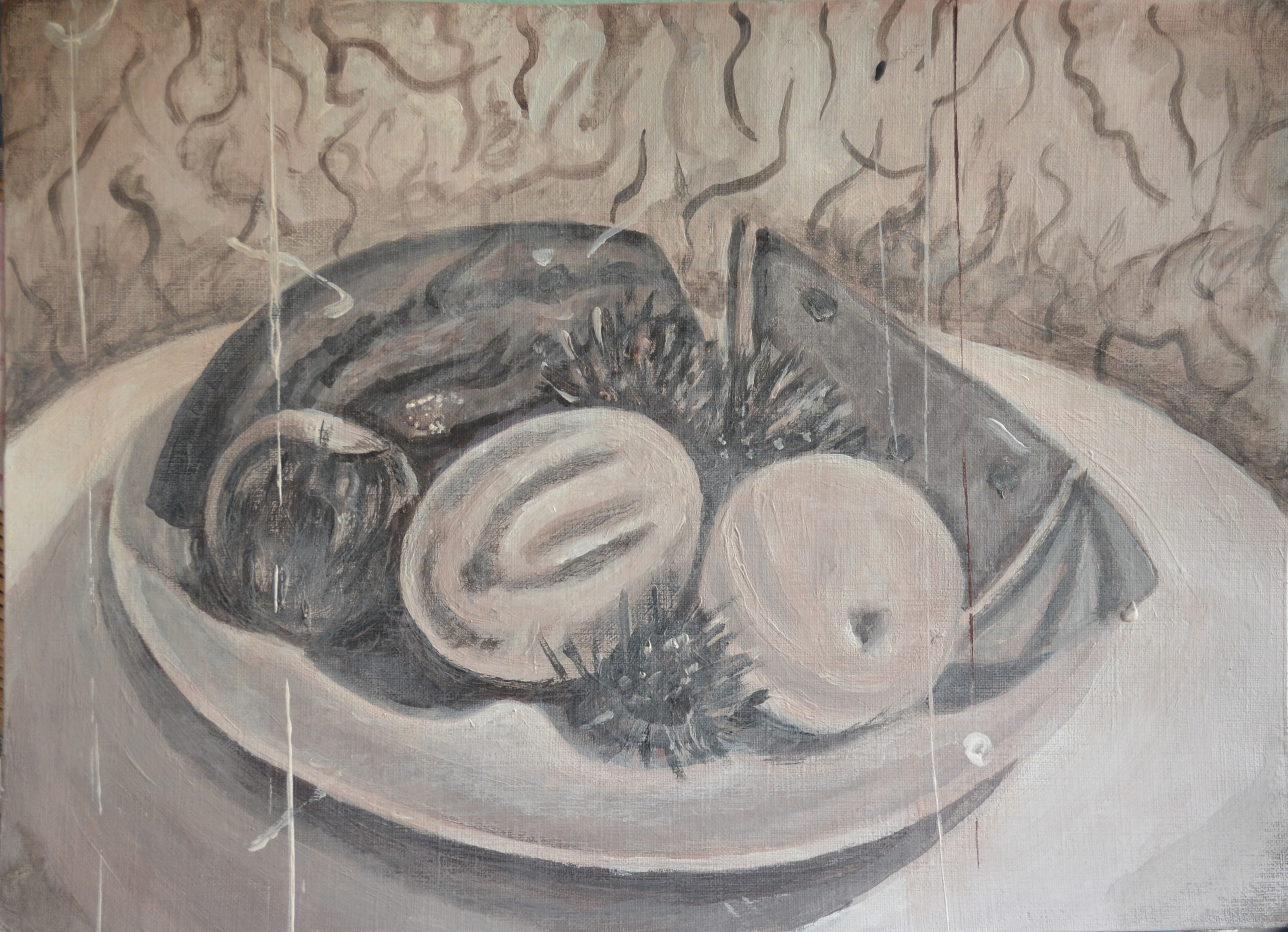
Finished Piece in Sepia

Finished Piece in Sepia

For this exercise paint your still life in any way that you choose. Make decisions an advance about the range of colours that you will use. You are aiming to create a mood or atmosphere in your use of colour and handling paint.

The idea for this exercise started with the last study in complimentary colours. Experimenting with the background made the painting look quite creepy and looking at it I couldn’t help thinking of a Tim Burton movies so with that in mind I tried to build on that for this exercise hoping to evoke a sinister mood to the painting.

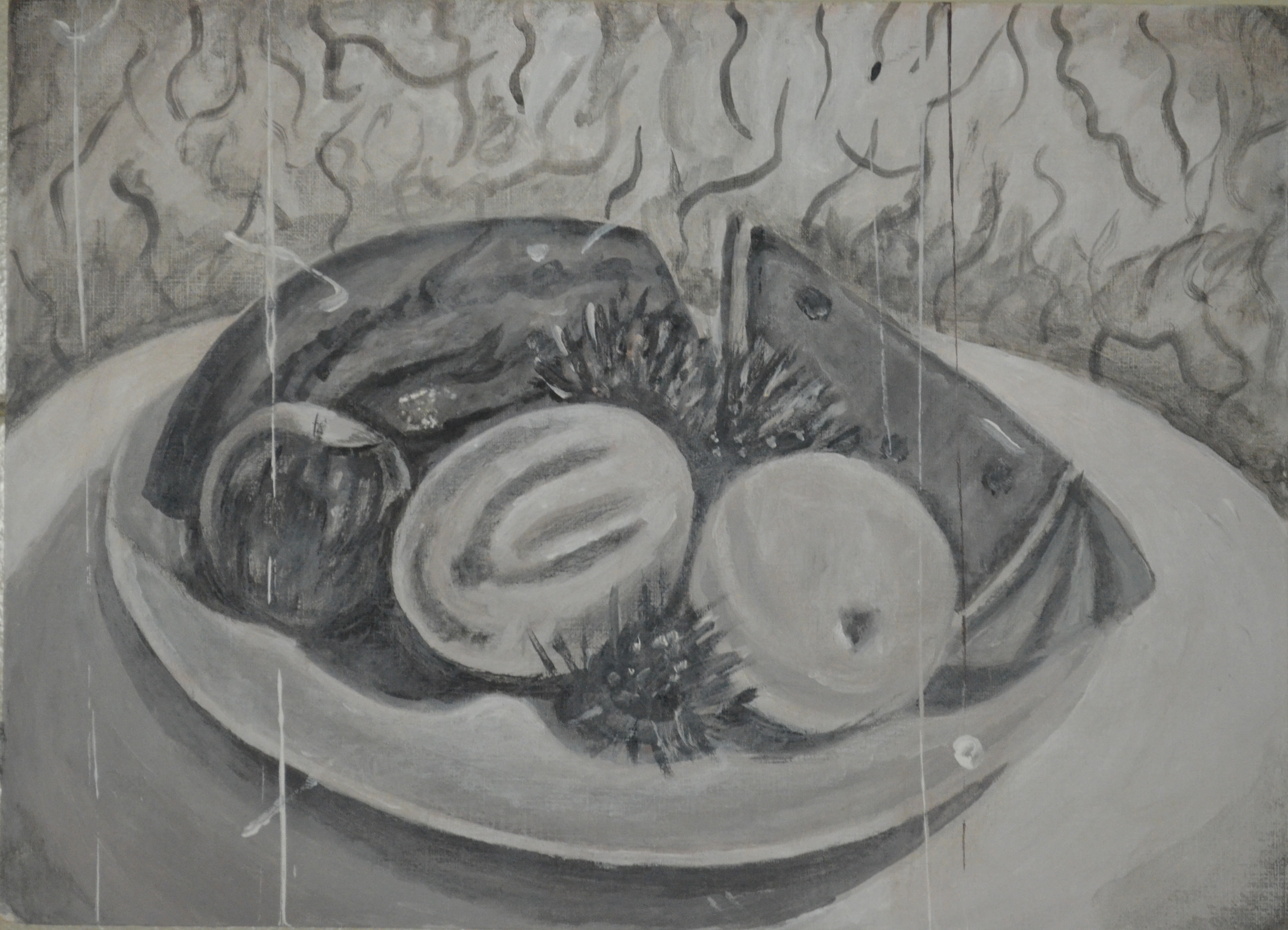
For some reason I couldn’t imagine this still life in any other colour but Sepia and so I edited a photo of the previous still life in Photoshop so that I could try and work out for myself, without looking on Google which colours would make Sepia.

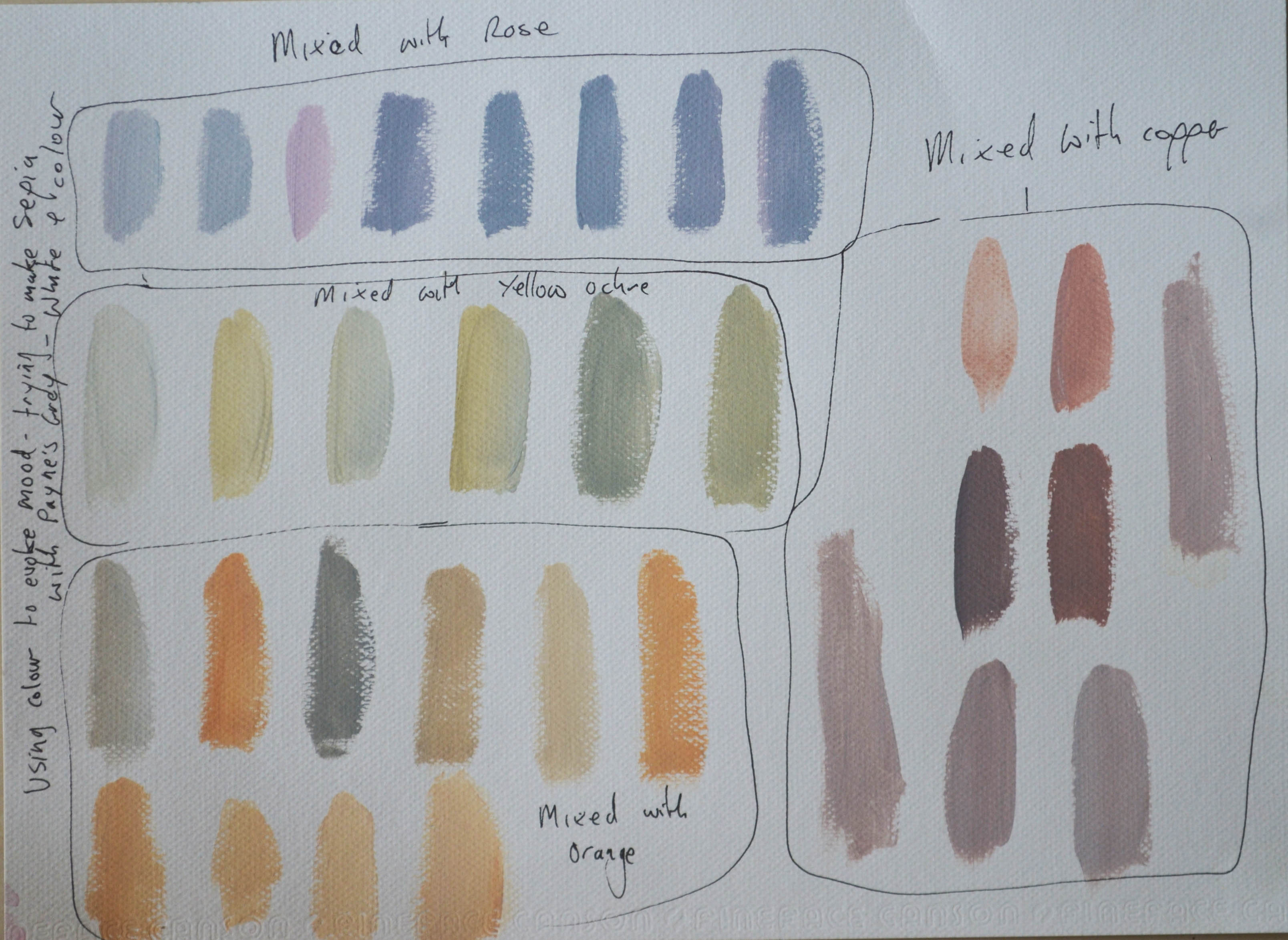
It wasn’t as easy as I thought, I could see a lot of different hues in the Sepia photo and so I decided to experiment with some colours, these were:

  1. White + Payne’s Grey + Rose
  2. White + Payne’s Grey + Yellow Ochre
  3. White + Payne’s Grey + Orange
  4. White + Payne’s Grey + Copper
1 Finding Sepia

1 Finding Sepia

Of all the colours the copper mix looked best and so I decided to start the still life composition to see how well the colours looked together. I used the same big brush technique as in the previous exercise barring the spines of the rambutan. Eve though the three colours looked great together in my experiment they didn’t look that great on paper the Payne’s gray looked too blueish and it was obvious it needed swapping for black. I was also going through the copper at an alarming rate as it was only a small tube  then I realised that the copper was very similar to Burnt Umber and so I swapped again.

2 Still ife in Sepia

2 Still Life in Sepia

The finished piece looked great, you could see it was a Sepia painting but it didn’t look how I expected it to, I asked my girlfriend how she felt when she looked at it and her reply was ‘sad and cold’ these weren’t the moods I were going for but at least the painting was getting some kind of emotional reaction.

At this stage I thought it wouldn’t hurt to experiment further and so I kept experimenting hoping to find the result I had been hoping for. I began by making a very thin mix of Burnt Sienna and white and applied it over the top of the painting with a scrumbling technique to try and give the painting an aged look.

I then applied made a light mix and a dark mix of the same colours then run the edges of a another sheet of paper through them and and then applied the paint to the painting in very thin vertical lines to give it an old movie flicker effect then added a few more white specs and flicks with a thin detail brush.


3 Still ife in Sepia - Trying to be Sinister

3 Still ife in Sepia – Trying to be Sinister

I’m not sure what mood this painting evokes but if nothing else it does look like the scene from an old movie or a cine-cam clip from an horror movie or at least I hope it does.

I am satisfied with the way this painting turned out , the photo above doesn’t do it justice there is actually a lot more colour to it,. I Think that this style would really suit a portrait and so I hope to put it to use a bit later on in this course.

Still Life with Complimentary Colours

Still Life with Complimentary Colours

3 Still ife in Sepia - Trying to be Sinister

Colour used to evoke mood


Looking at the paintings side by side the composition is almost identical but the effects that I have created in both are completely different. In the first study, Still Life with Complimentary colours the subjects are very three dimensional but yet due to the limited palette of two complimentary colours the subjects look to have an over-exaggerated sense of form as if they are made from Plasticine, the background seems to emphasize this.

In this last exercise my intention was to build on the qualities that already existed in the previous painting and to try and evoke mood by realizing what I imagined the finished painting to be like. The effects used in this new painting were very different, unlike the first study in this last study I managed to create a sense of distance, like the composition is in the background and the movie clip lines/flicker effects are in the foreground. I think going over the painting with the mix of white and burnt Sienna with the scrumbling technique I mentioned earlier to tone down the composition and then painting definite horizontal lines over the top created this distance effect. It probably doesn’t look as sinister as what I expected with the still life but I can imagine this effect would work really well with a Sepia self portrait or scary doll on a trike.

Colour Relationships 4 – Still Life with Complimentary Colours

Make a colour study of your still life using only a narrow range of colours. This will require great concentration and discipline in observation and interpretation. Make the most of using colour in an inventive way.

Still Life with Complimentary Colours

Still Life with Complimentary Colours

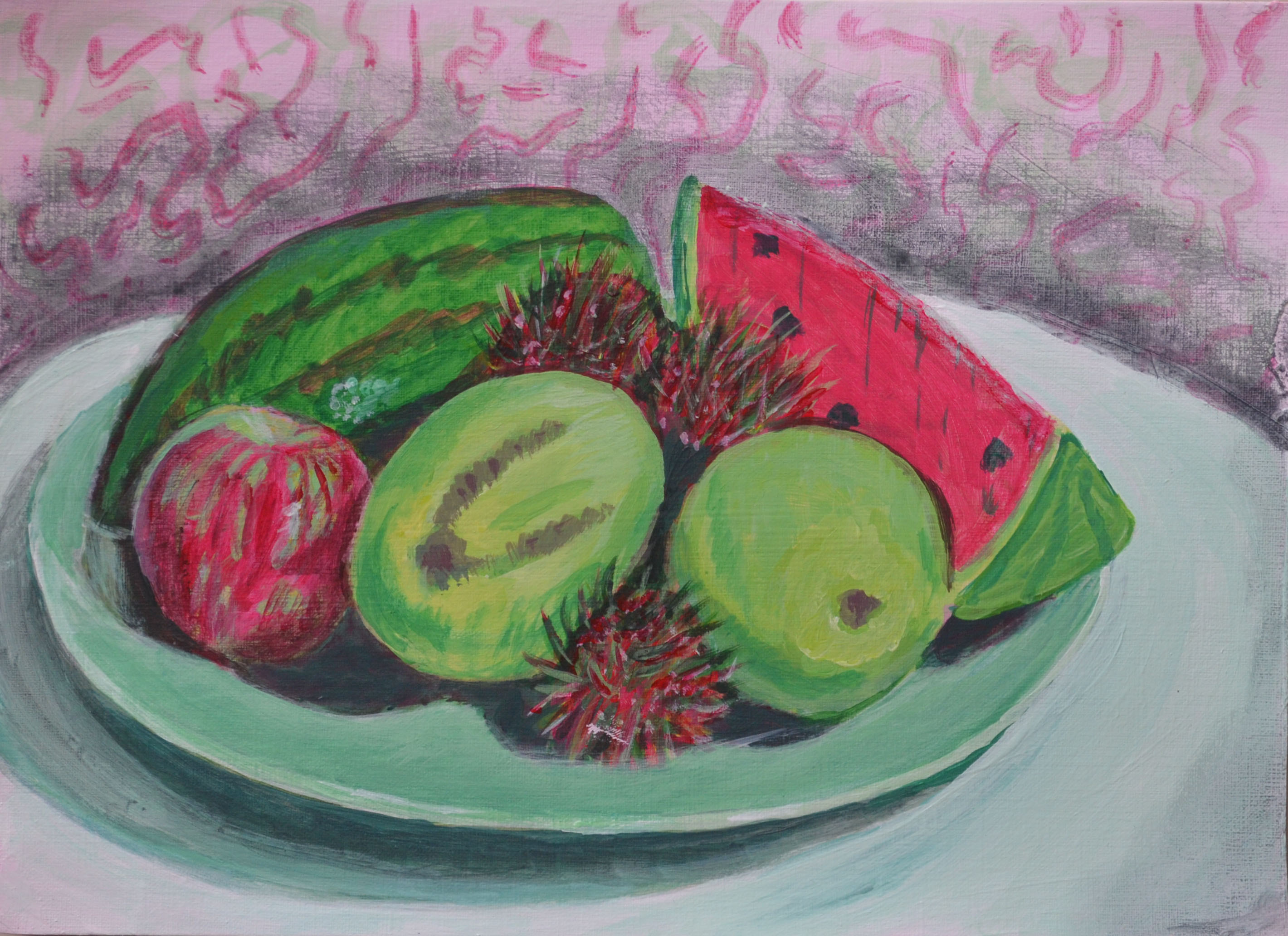
I should have probably used my Chromium green with primary red for this exercise but I decided to mix my own green from primary yellow and primary blue. Some would call that cheating as even though I did make a nice dark green out of the two colours some of the lighter tones looked blueish with others a yellowy green.

I could have been a bit more inventive with the subjects I used for the still life maybe choosing subjects of all different colours and I regret not doing that instead of choosing subjects of similar colour properties like I did but I still feel satisfied with the end result.

Materials used:

  • Oil/Acrylic Paper 24 x 33 cm
  • Acrylic Paint: Primary Yellow, Primary Blue and Primary Red
  • Brushes: Small Filbert, Large Round and Large Flat

This was the first time using  small sheets of paper although it was only a study I still intended to use it not only to develop my understanding of colour relationships but to further develop my brush skills and painting on a small scale I decided, would help me to do that.

I begun with a very light wash of green mixed with white followed by a very light wash of red. As the green was mixed with a lot of white and went on unevenly the red wash settled around it creating a prime coat of light red and green, which reminded me of rhubarb.

Chosen Subjects

  • Mango x 2
  • Rambutan (gno) x 3
  • 2 slices of watermelon
  • Red Apple
  • Plate

Although the subjects I chose were mainly red and green there were other colours as well which were omitted by using only the complimentary colours these were, yellow, orange and light brown. For the grey details such as the bruising on the mangoes, the watermelon seeds and the dark stripes on the skin of the watermelon on the left of the plate I mixed the colours together and and allowed them to cancel each other out. This was also a technique I used for the darker parts of the rambutan, painting wet red over wet green to get the darker strands.

I also allowed the pigments to cancel each other out for the shadows although I made the result of this biased towards red in most places so that the green of the mango would really stand out.

Being Inventive

I find it hard to use my imagination when painting still lifes and to me there wasn’t really much I could do here to make this stand out all I know is that I was bored of using the same old round table with the plain backgrounds and so if I were try and get inventive wouldn’t this be the best place to start. I applied a light coat of white/red to the background with a scrumbling technique followed by fine drip like streaks then painted the shadows with a muddy green applied with the same scrumbling technique. It may not be genius but it makes the still life composition stand out,however it wouldn’t be until the next exercise Still Life with Colour used to Evoke Mood that the background would really come alive.


Colour Relationships 1 – Exploring Contrasts

1 Exploring Contrasts

1 Exploring Contrasts

Choose any colour you like (colour A), then mix a series of several colours that are close to colour A on the spectrum. From there paint a series of small squares of colour A, surrounding it each time with one of the colours you’ve mixed.

Following the brief’s instructions I chose red as colour A and then made various mixes similar to colour A then used colour A to paint a series of small squares then surrounded the small squares with the other colours that I mixed. I noticed how the surrounding colours altered how the centre square of red looked, in some squares looking more orange-red and others looking darker and even brownish.

From there I made a series of several small squares in yellow and several mixes of different tones of violet which I surrounded the centre squares. Each of the mixes had different amounts of white in so that I could try and equal the tonal value of the yellow centre square. Which I think I managed to match with the mix in the bottom left of the above image.

Matching the tonal value by adding white seems to tone down the yellow centre square but with the darker mixes of violet surrounding the yellow it seems to look the brightest.

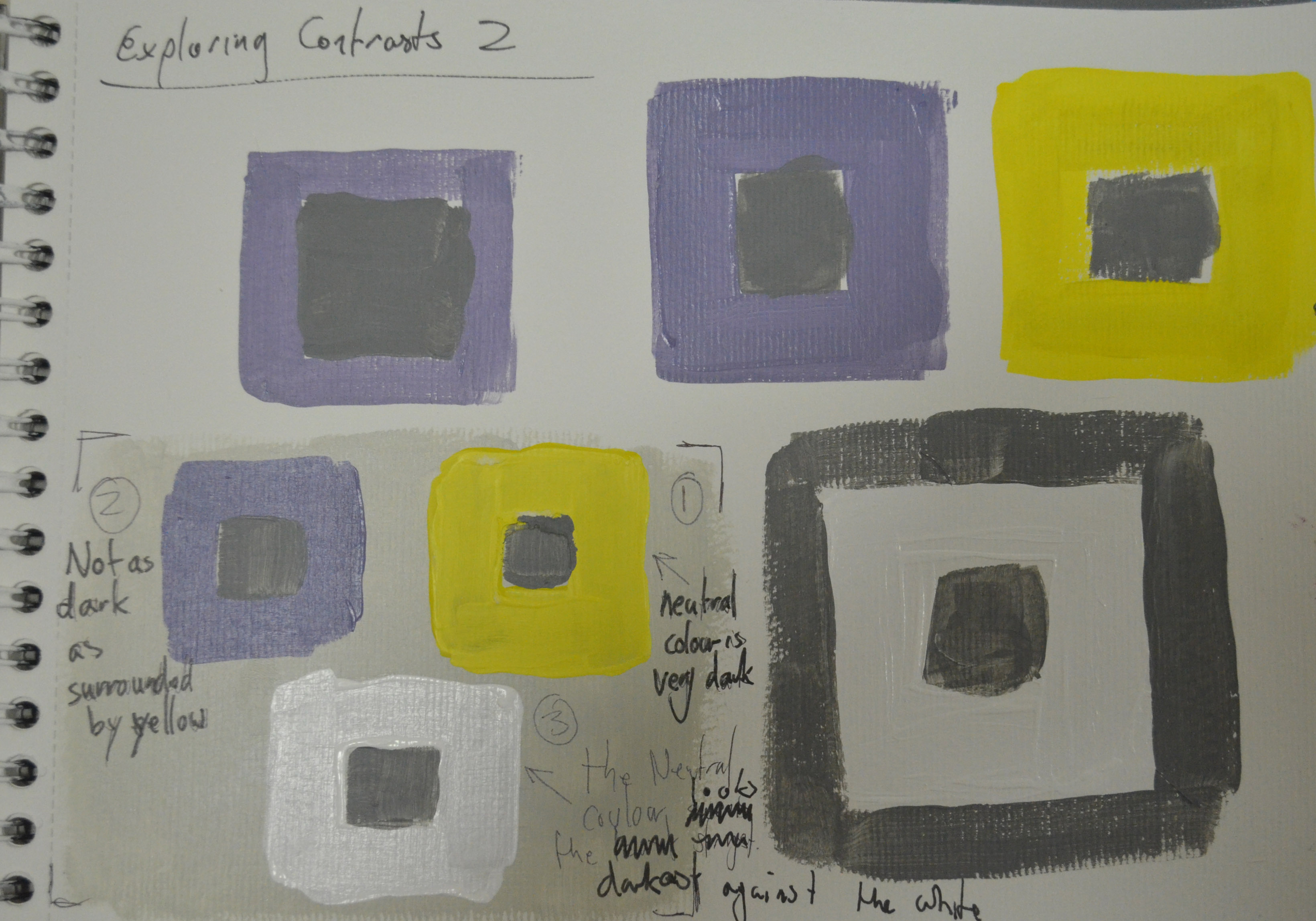
2 Exploring Contrasts with medium Grey Centre

2 Exploring Contrasts with medium Grey Centre

Next I painted a square of violet leaving a space in the centre, next to it I did the same with yellow and underneath both of them I painted a white square, again leaving a space in the centre. From there I mixed a neutral grey and painted a small square of this colour in the centre of each.

Doing this I noticed that the neutral grey looked different with each of the surrounding colours. With the violet surround the grey looked the lightest then darker in the centre of the yellow surrounding square with the medium grey looking the darkest in the centre of the white square.

I was pushed for time with this project so I didn’t have much time to experiment further but I made a quick painting using some complimentary colours and a medium grey noticing how the tone of the grey altered against the different colours.

3 A Simple painting with Complimentary Colours

3 A Simple painting with Complimentary Colours


Still Life 4 – Still Life with Natural Objects

5 Finished Painting with Natural Forms

Finished Painting with Natural Forms

The brief for this exercise: Assemble a group of natural objects such as fruit or vegetables, more subtle coloured vegetables or highly structured objects that are almost monochrome such as shells, skulls, rock crystals or seed heads. If you chose to work with tertiary colours and subtle lines and tonal variations you could include an element that is highly coloured such as a red fabric background or a brightly coloured piece of fruit such as an apple, orange or  lemon. It’s best to chose simple forms rather than complex ones for this exercise, just two or three objects will give you enough subject matter.

Subjects for this exercise

I already had some objects for this exercise, leaves which I picked up at the beginning of the year from the park just outside the school where I work. While visiting England last month I picked up some more objects that I thought would go with them, baby pine cones attached to twigs from a walk around Newmillerdam near my hometown Wakefield, plus a large pine cone that my mother gave me which she brought from Italy.

Subjects:

  • 2 leaves
  • 1 large pine cone
  • 4 baby pine cones attached to a twig
  • A piece of Thai Buddhist monk robe material

Inspiration for painting leaves

Looking for new artists while studying the Drawing 1 – Drawing Skills course I came across Eliot Hodgkin who painted leaves, vegetables and other natural objects with Tempera, one of my favourite paintings by Eliot Hodgkin is this one Large Dead Leaf 2:

Large Dead Leaf 2 - Eliot Hodgkin

Large Dead Leaf 2 – Eliot Hodgkin

In this painting he manages to breathe life into the dead leaf and it’s twisted form becomes a ballet of light and shadow allowing you to see every detail, stalk, veins and surface texture. It’s a painting that inspired my leaf drawing with stipples and dots in the drawing course and will probably keep influencing my work with natural forms.

Process

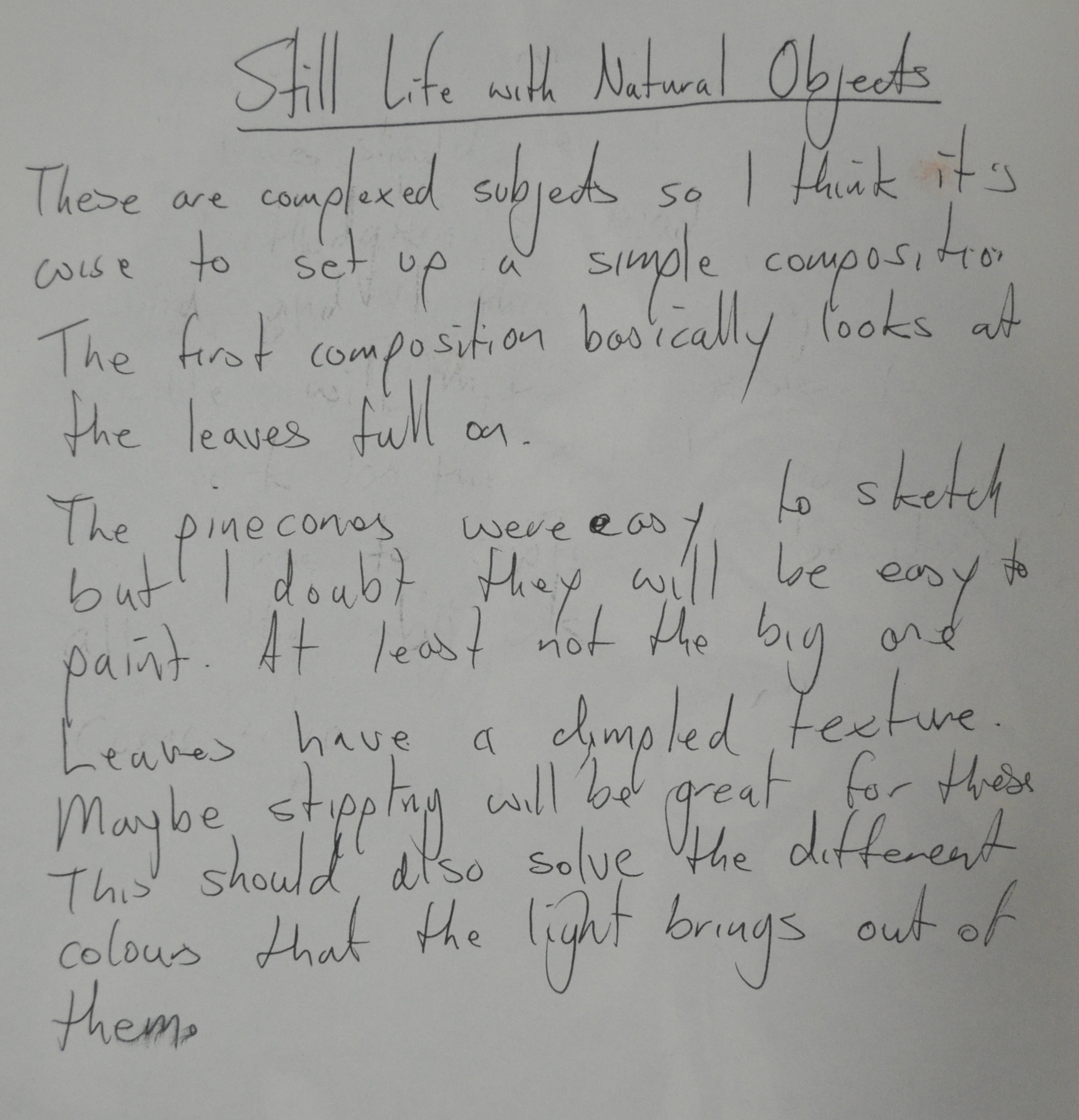
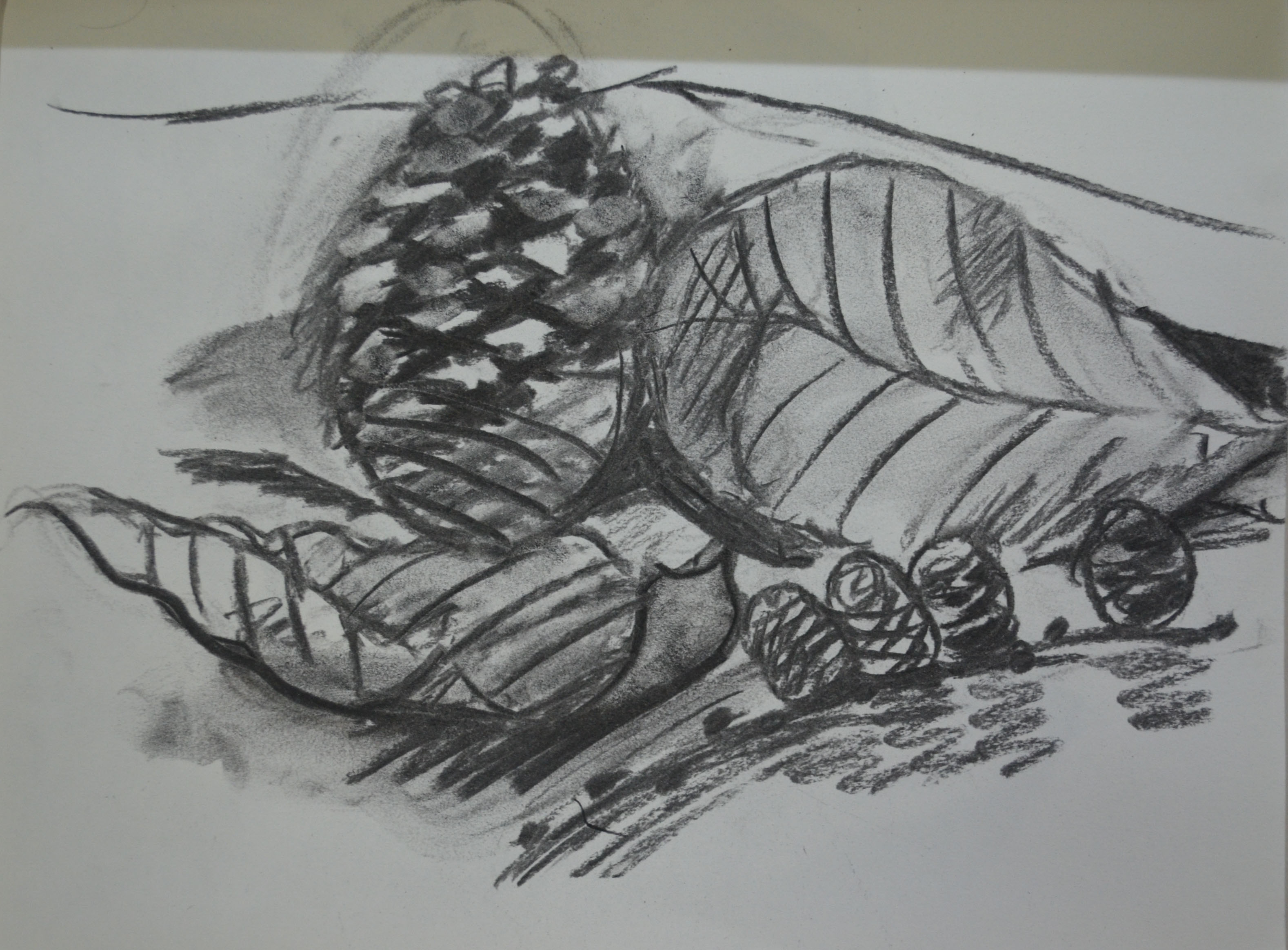
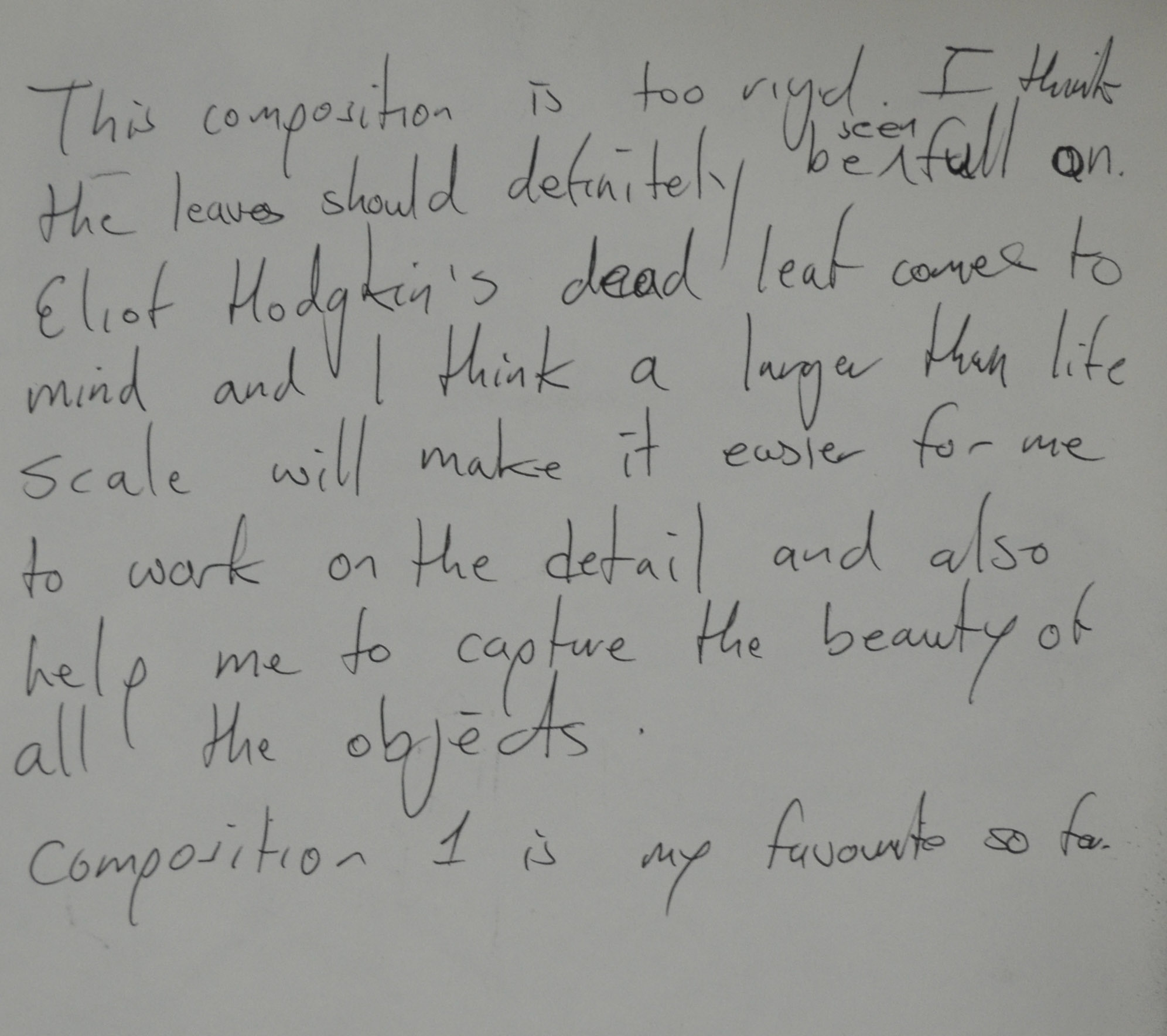
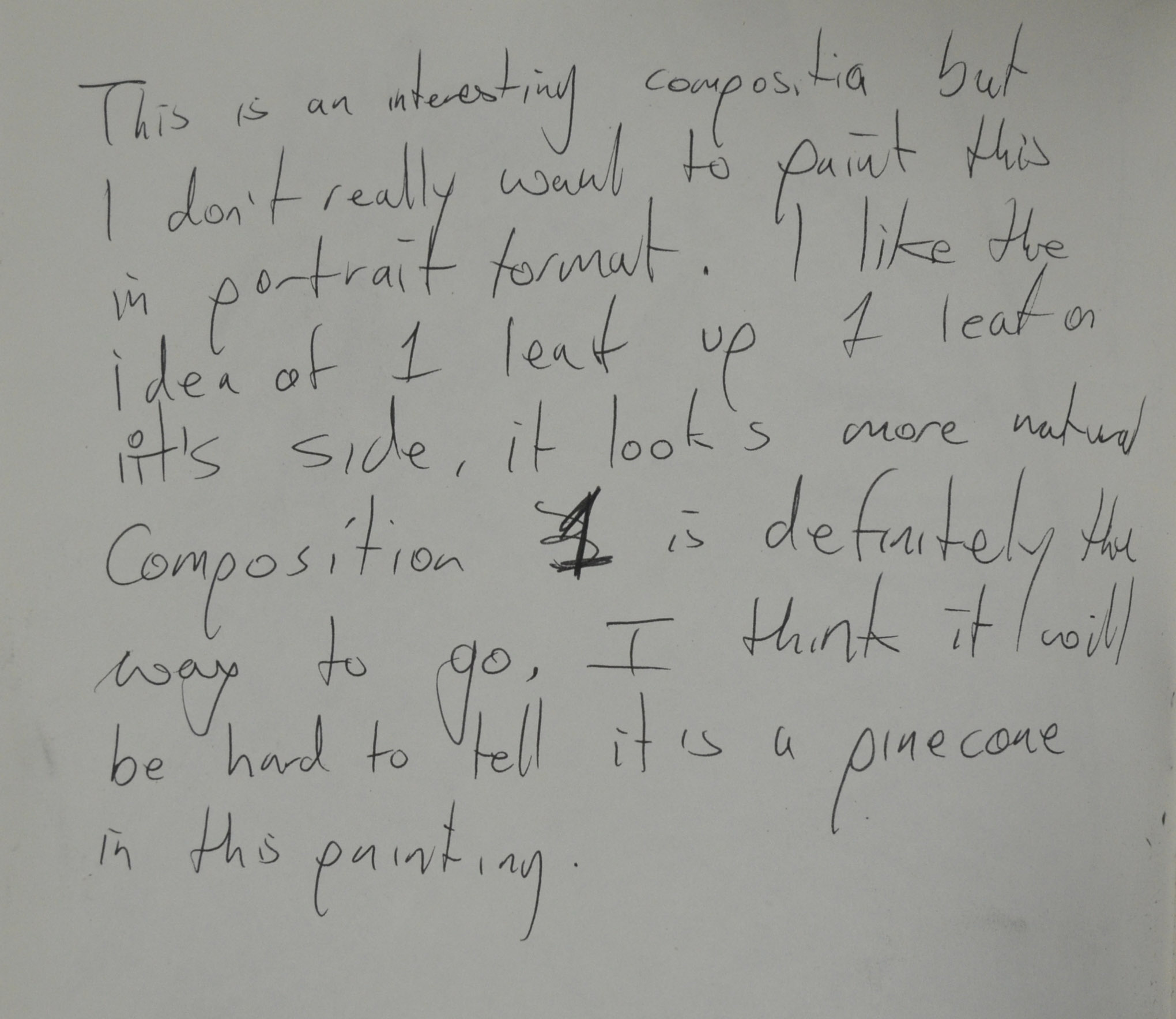
I started by making sketches of the subjects in my sketchbook and notes on the best composition and the best technique to use for the exercise. Decided that it would be better to tackle the leafs full on to see all their detail and colours and to do this a stippling technique would probably be the best technique to use for the chosen subjects.

1st Sketch in Charcoal

1st Sketch in Charcoal

1st Sketch in Charcoal - Notes

1st Sketch in Charcoal – Notes

2nd Sketch in Charcoal

2nd Sketch in Charcoal

2nd Sketch in Charcoal - Notes

2nd Sketch in Charcoal – Notes

3rd Sketch in Charcoal

3rd Sketch in Charcoal

3rd Sketch in Charcoal - Notes

3rd Sketch in Charcoal – Notes

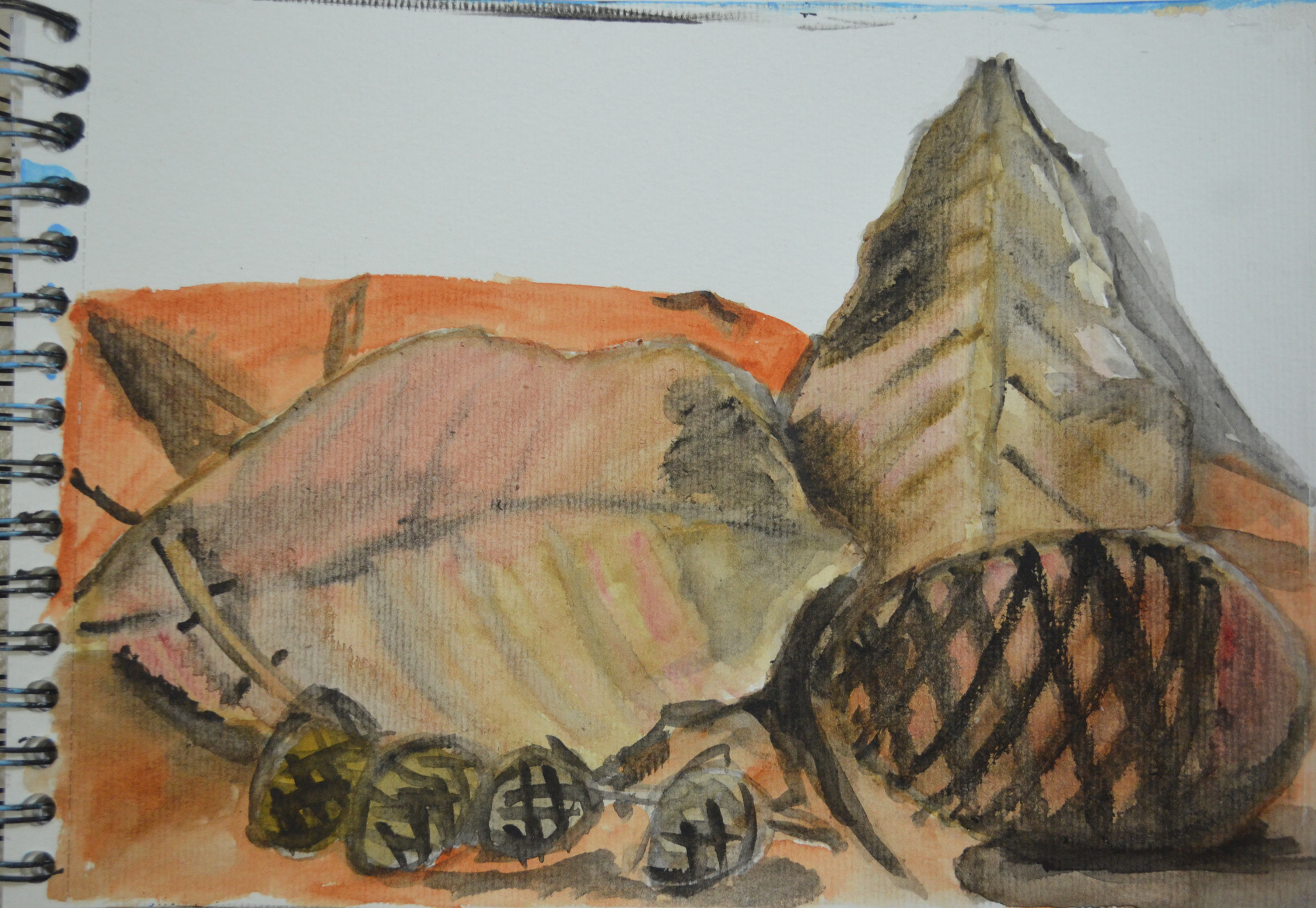
After making three charcoal sketches to find the best composition I made a watercolour sketch to see which colours I would be using for the final piece. With the lamp shining on the composition I could see just how complex the objects that I chose were. I was half tempted to make a sketchy painting rather than detailed as I did well to depict the objects in both the charcoal sketches and the watercolour sketch below but the detail and the so many different colours that I could see in all the objects with the light shining on them the way it was it would have been a shame not to try and capture as much detail and colour that I could in the finished piece. Stippling was perfect for this painting, not just for the leaves and cones but for the white background as I could see several different colours through the light reflecting off the wall.

4th Sketch in Watercolour

4th Sketch in Watercolour

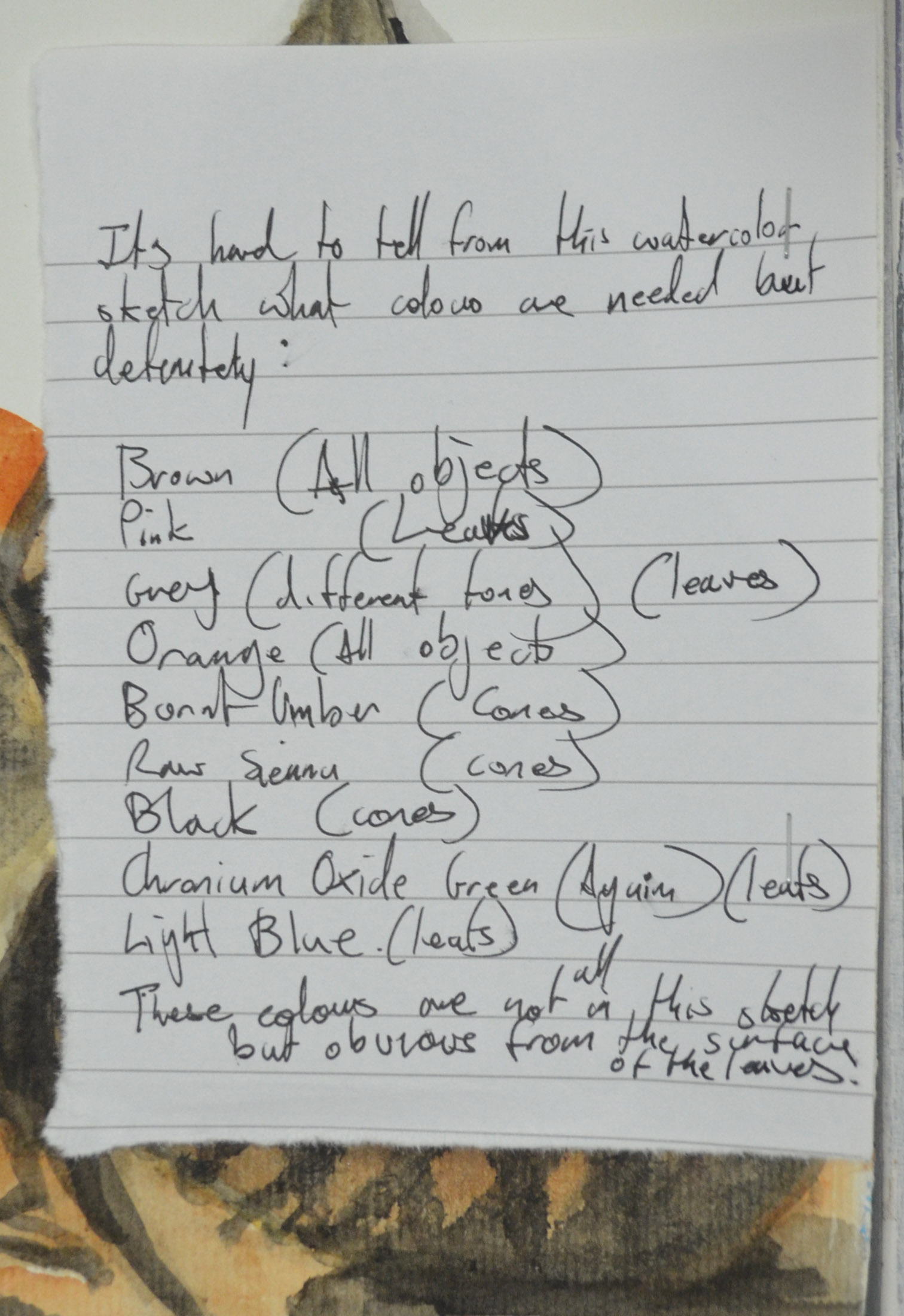
I made a note of the colours that I was confident I would be using, even though it was difficult to depict half of the colours in the watercolour sketch. These were:

Brown

Pink

  • Grey
  • Orange
  • Burnt Umber
  • Raw Sienna
  • Black
  • Light Blue
  • Chronium Oxide Green
4th Sketch in Watercolour - Notes

4th Sketch in Watercolour – Notes

The painting took four evenings to complete, 1 evening for each leaf, 1 for the background orange cloth and 1 for the pine cones which were the most difficult to paint. i started with grey on the leafs over an orange wash and then started to build up the colour from dark to light and and then back to dark for the shadows and darker tones such as for those in the veins of the leaves.

The process was pretty much the same for the large cone which shared similar hues and tones to the upright leaf but when it came to painting in the shadows for the centre of the cone the whole thing pretty much had to be painted again rethinking the process on how I was to get things just right. The cone was a pretty complex shape and the needles fit together life a jig saw and so finally I treat them as such painting in the darker tones ti give each of the needles a similar shape which I highlighted in white.

From there I painted white background, again with a stippling technique so I could depict the different colours I noticed with the light reflecting off the white surface then the  orange cloth which I didn’t want to spend too much time on as this was not the main focus. Finally I painted the twig of the smaller cones with various shades of green and white stippled over a dark reddish- brown undercoat and then for the small cones various tones of light grey and orange for applied the needles applied with a medium size filbert over dark reddish-brown undercoats.

5 Finished Painting with Natural Forms

5 Finished Painting with Natural Forms

Noticeable Progression

I am pretty pleased with the finished piece, I am not sure if the quality of this painting is better than my first still life, still life with flowers but I do seem to have loosened up, which is what I am hoping to do, as well as gained a lot more brush control.

Problems with painting natural objects

The biggest problems I encountered painting these subjects were, firstly, depicting the texture and secondly trying not to tighten up so they did indeed look like natural objects and not made objects. The stippling technique I used helped me to depict texture in the subjects but I am far from where I need to be with loosening up when I paint.

What I learnt from this exercise

Probably to have more props at hand and not to bight off more than I can chew working on complex forms and textures at this stage, however leaves were something I have wanted to paint for a while and so I am glad I got this chance to do so.

Part 1 – Introduction to Painting, Assignment 1

Finished Piece with brown tinted Background

Finished Piece with brown tinted Background

The Subject

It wasn’t difficult to think of a subject to paint for this assignment, I really enjoyed painting on the dark ground for the last tonal study and I managed to pull the chiaroscuro effects off quite well, I really needed to see if I could do it again with different subjects. Maybe in the style of Caravaggio.

Finished Tonal Study

Tonal Study on a dark ground

While working through the drawing 1 course, one or more students had drawn still life’s that included a chopping board and a knife, this gave me a great idea, I had used an orange in the last two tonal studies, Tonal study on a white ground and Tonal study on a dark ground  so why not finish this part of the course with a still life of that orange been sliced in half on a cutting board. It would not just be the last in a series of paintings but it would be symbolic of the end of part 1.


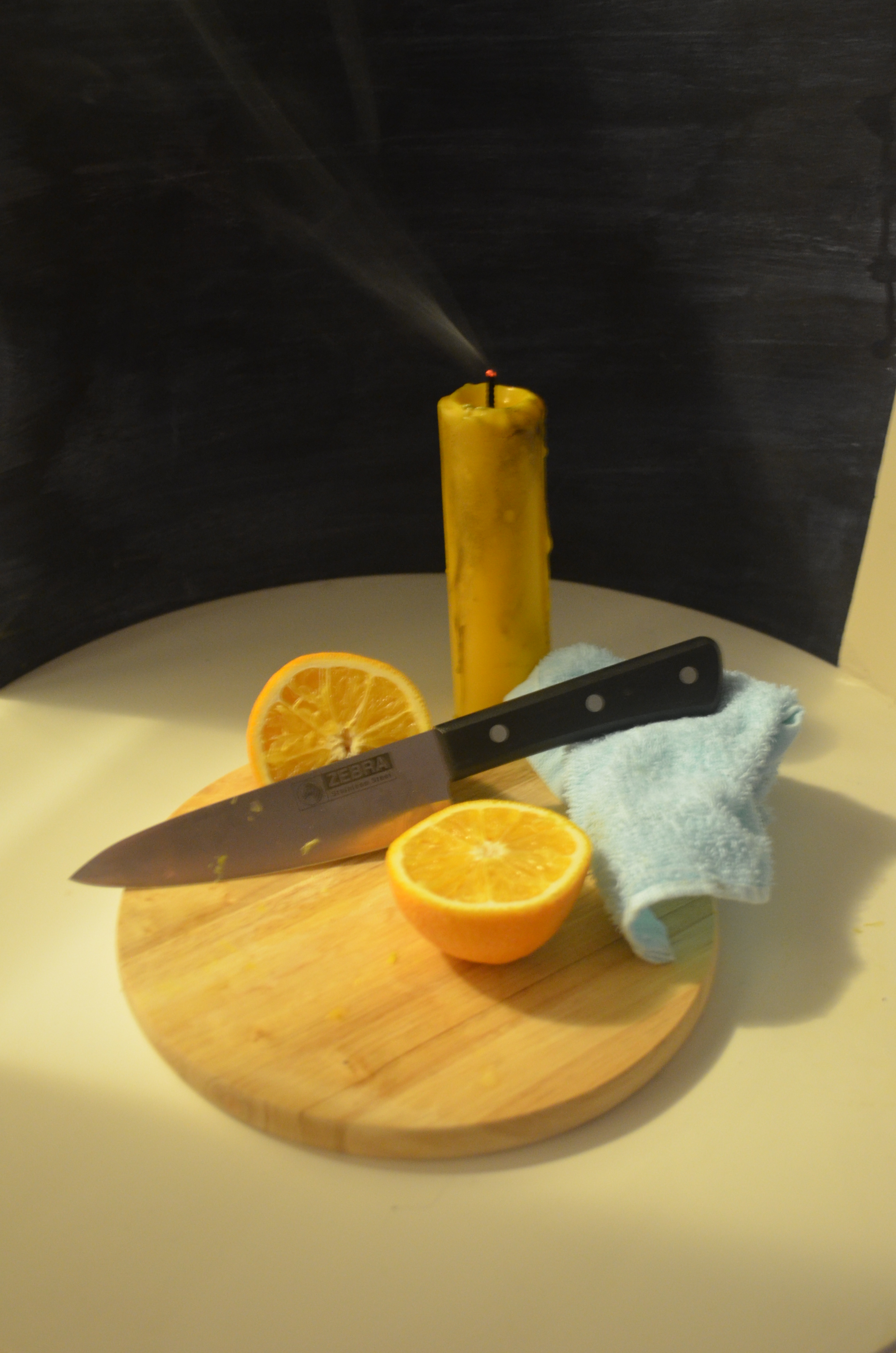
chosen subjects

chosen subjects

I also wanted to include the candle that I had used to light the second tonal study in my assignment piece so I was only lacking two subjects a large knife and a chopping board, I tried getting a natural chopping board, I usually see people selling them on the streets but when it came to buying 1 they were no where insight so a machined board and carving knife from Tesco had to do. Because i wanted to use as much as the dark ground as i possibly could I chose a black handled knife with three rivets.

After cutting the candle in half to bring it lower to the other objects, it was apparent that I needed an extra object, a small towel, to prop up the knife.

Preliminary Studies

Materials used:

  • Canson A4 sketchbook
  • Derwent Charcoal Pencil
  • Compressed Charcoal
  • Graphite stick
  • Putty rubber
First study - charcoal pencil sketch with notes

First study in Charcoal pencil


The first study I did was of all the objects together but with the orange in 1 piece, I did the first studies with the light on and candle unlit but took notes of how the composition looked in electric light and daylight. It was pretty hard to choose as both lighting looked good and the compositions looked great from all angles.

The tonal studies helped me to group the objects and specific parts of the objects into groups that shared the same colour properties and tonal properties e.g. the orange, the cutting board and the candle shared similar tones and colour, the handle and the background and the towel, blade and rivets; in candlelight the groups changed.

2nd charcoal pencil sketch notes
2nd charcoal pencil sketch notes

2nd charcoal pencil sketch

2nd charcoal pencil sketch


After the first study I decided to go ahead, be brave and cut the orange, the composition then went from a simple composition with 4 objects to a more technical composition with five. It also created more groups with the light off the candle and orange on its side sharing similar colour and tonal properties and the board and other half of the orange having similar properties.

In the third study I decided to omit the towel but there wasn’t enough contrast in the composition for my liking plus i didn’t know if the knife would stay up for long. The blue towel was a nice contrast between the yellows, orange and beige and other natural tones of the cutting board.
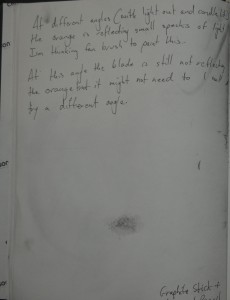
3rd Study - Notes

3rd Study – Notes

3rd Study in graphite stick and charcoal pencil

3rd Study in graphite stick and charcoal pencil


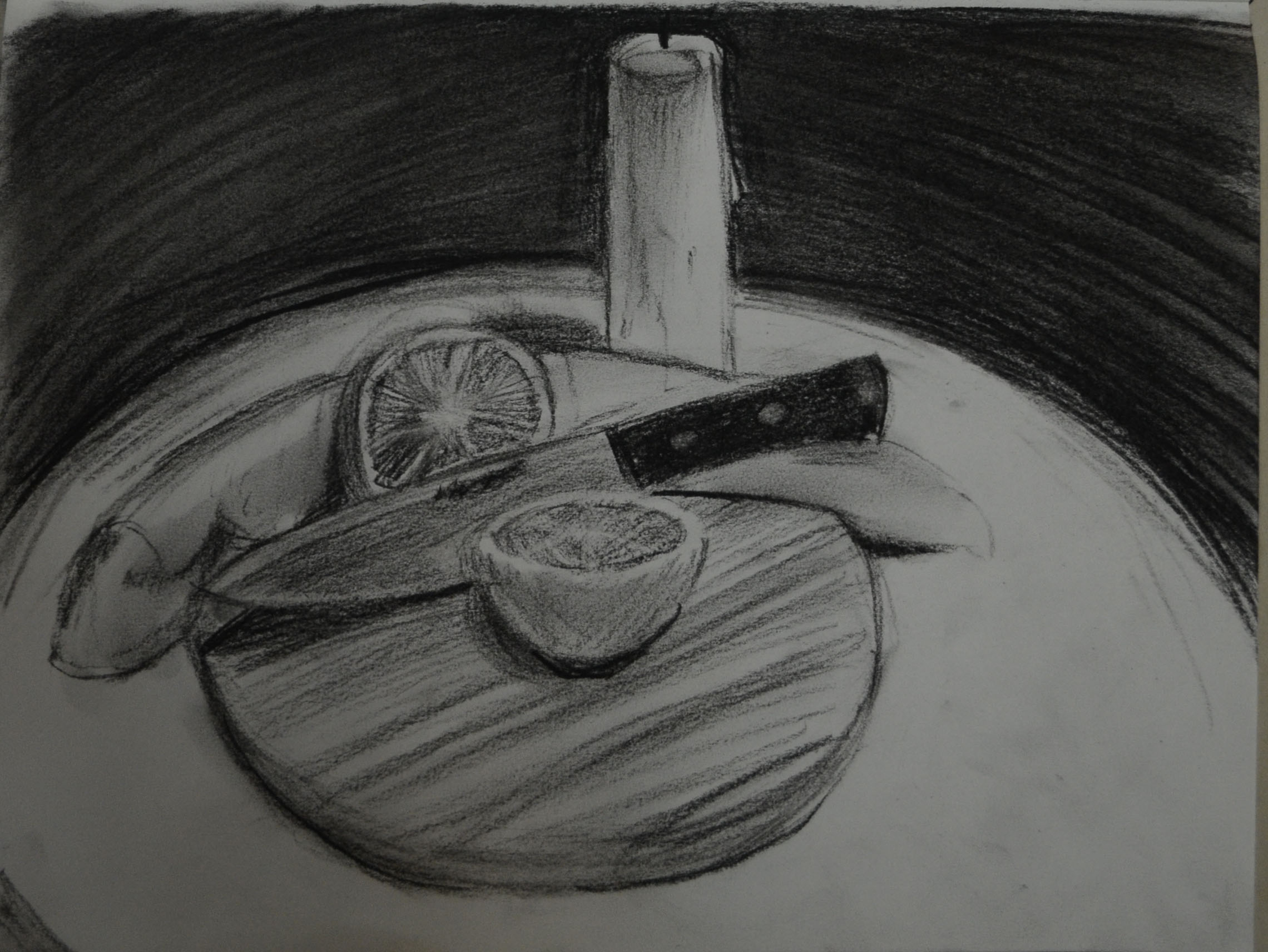
After making three studies with the light on I decided to try something different, as I would be painting this most likely with the light on to try and to further experimentation with chiaroscuro which was what I had initially intended to do I would make the next sketch in candlelight. This gave me an idea to make the next drawing using an entirely different technique. Lifting off the charcoal rather than drawing with it.


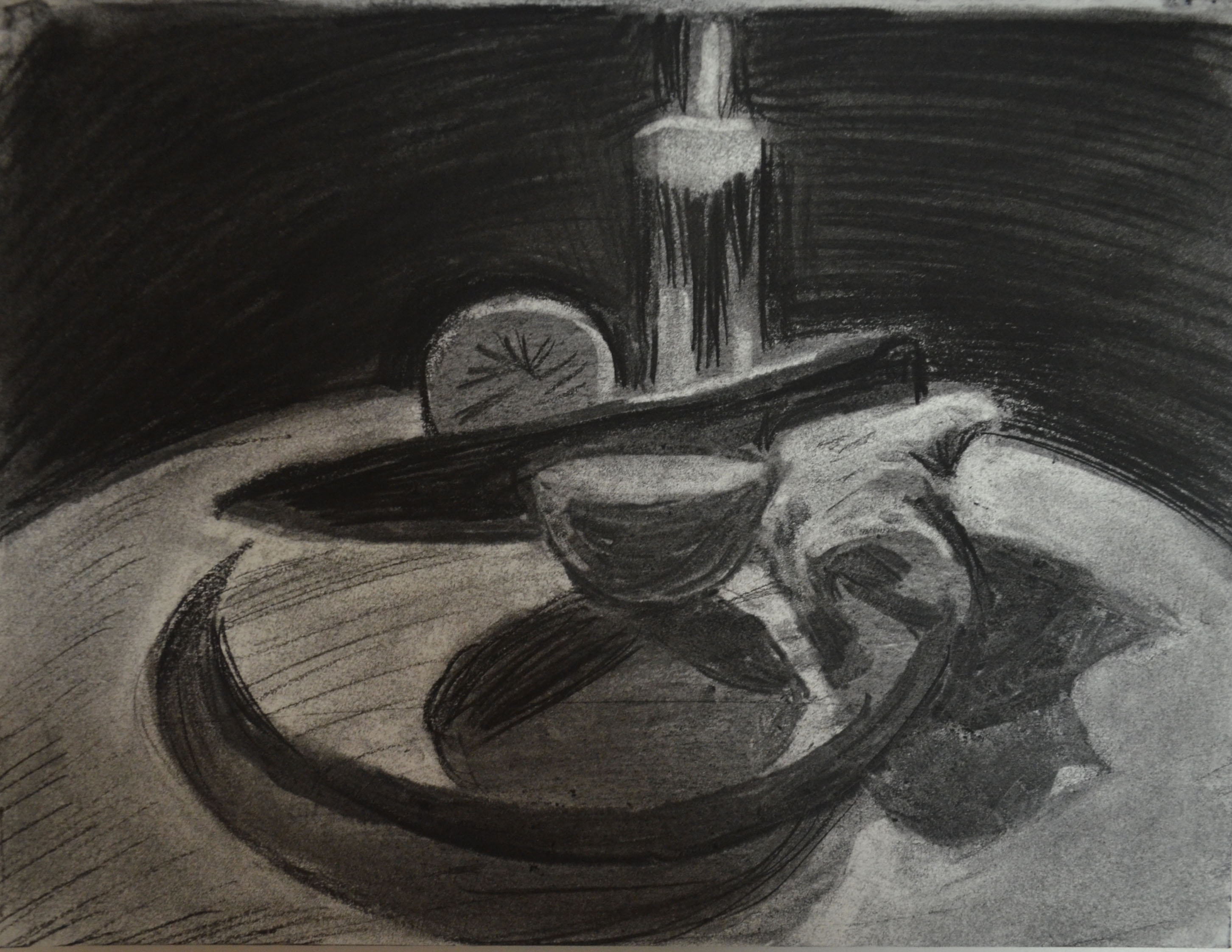
4th Study Charcoal lift off

4th Study Charcoal lift off

4th Study - notes

4th Study – notes


This time I drew from a different angle with my head closer to the level of the table, this added to a more dramatic effect and the knife rather than reflecting the orange and light like I had tried for in the first few sketches was completely dark with only a slight tonal difference between the handle and the blade; this meant that I could use more of the dark ground and could ‘model light’ defining the knife with a few simple details and highlights, this appealed to me. The shadow cast by the orange in front of the knife was also very appealing it meant that I could create a good sense of depth in the painting. I just wasn’t sure how well I would be able to paint the candle, flame and the light the glow around it.

Colour study

Materials used:

  • Canson watercolour paper painted with a dark wash
  • Oil pastels
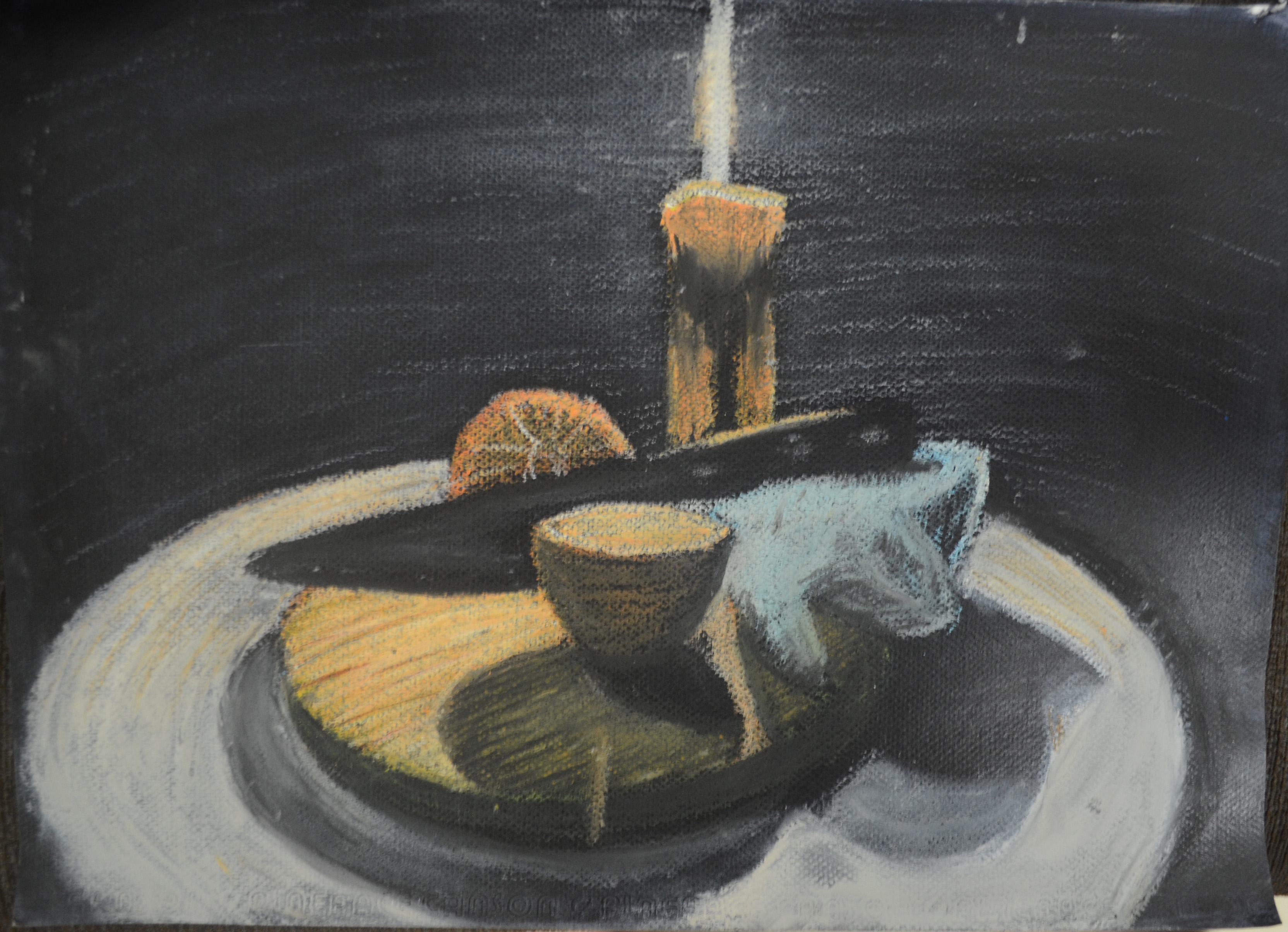
5 Colour Study in Oil Pastel

5 Colour Study in Oil Pastel

At this stage it was a toss up between the mediums I felt comfortable with for the finished assignment piece, either acrylic or oil pastel and so decided to a colour study in oil pastel on an A3 sheet of watercolour paper prepared with an imprimatura of Payne’s grey. The colour study helped me to determine which colours I would use for the final drawing, these were:

  • titanium white
  • payne’s grey
  • light blue
  • cadmium orange
  • pearl orange
  • chromium green
  • yellow ochre
  • lemon yellow
  • burnt umber

Finished Piece

materials used:

  • Canson A2 Acrylic paper 15 x 18 inch
  • Acrylic paint (colours as above)
  • Paint brushes – medium wide, filbert (2 sizes), round pointed (2 sizes), angular flat
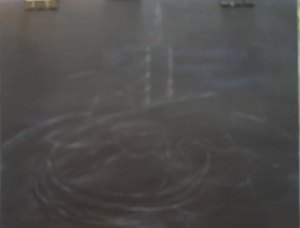
Drawing shapes on dark background with white conte

Drawing shapes on dark background with white conte

After preparing the acrylic paper with a dark ground (Payne’s grey I drew in the shapes with a white conte stick using my paint brush to help as a measuring tool. The shapes weren’t precise but that wasn’t too important at this stage just as long as I had something to work from. As it turned out the shapes were well out and did need a lot of editing while I was painting.

From there I painted the highlights on the top of the knife so that I knew it was at the correct angle and painted in the candle and both halves of the orange in cadmium  orange (highlights in yellow), I could have done this differently. The best way would have been to model light by building the colour gradually  on top of the dark ground rather than blocking in the shapes then painting the shadows over the colour like I did.
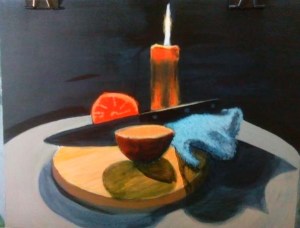
Half way point

Half way point

From there I painted the chopping block with the same cadmium orange but used a lot more white and the darker parts in yellow ochre. The towel was painted in different mixes of light blue, Payne’s grey and white using a stippling effect with a small flat brush to create texture. Shadows on the board and orange were painted in a mix of Payne’s grey and chromium green in thin glazes. while the shadows on the table were painted in thin glazes of white and payne’s grey over the top of the dark ground.

It got interesting round about the half way point with objects painted but still very rough and very bright I had to think about the techniques and colours that I would use to tone down the painting as well as give the painting a dramatic feel as seen in Caravaggio’s paintings. It was here that I stopped looking at the still life composition and any photos I had taken just glimpsing from time to time, as painting as I saw it had negative effects, when I came to take a photo the colours were to bright or didn’t look right so I started to paint how I felt it should look. Burnt umber, Payne’s grey, pearl orange, yellow ochre and white became the key players.

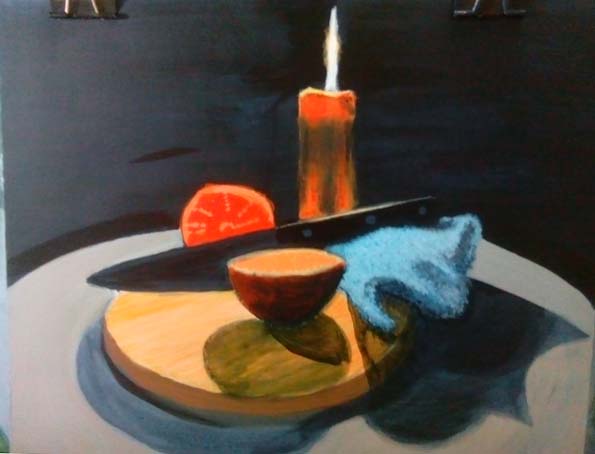
Finished Piece for assignment 1

Finished Piece for assignment 1 – Before Burnt Umber background wash

Very thin washes of Payne’s grey helped me to tone down the orange of the candle and upright orange slice while yellow and white followed by a very thin glaze of the grey were used to make the orange pointing upwards look more like an orange. I used a scrumbling technique with very thin seperate layers of white, pearl orange and burnt umber to make the blue of the towel more subtle.

The board was probably the most challenging it was just too bright and I knew that it was the board that would make the painting if the board looked bad the rest of the picture would too. The brief said not to get wrapped up in any one object and too look at the painting as a whole but the board was a major part of the painting and so it needed to be right. I added thin layers of burnt umber over the orange mix and then used thicker layers to paint in the grain. I painted over the shadow with a layer close to the original orange/white mix, then a layer of green followed by washes of burnt umber and Payne’s grey. This was a vast improvement.

While sat here writing this entry and thinking that the painting is finished I have started looking at the photos I have been posting to this log again and realising something is not quite right. I have stayed as close to the original tone of the background as possible. The dark painted paper that I used for a background reflected light from the candle and that’s what I have tried to show here and I think that’s where I’ve gone wrong. Rather than depicting any background at all I should be depicting an absence of one to allow the viewer to make up their own mind to where the painting is set, whether it’s in a small room, large room or even a cave.

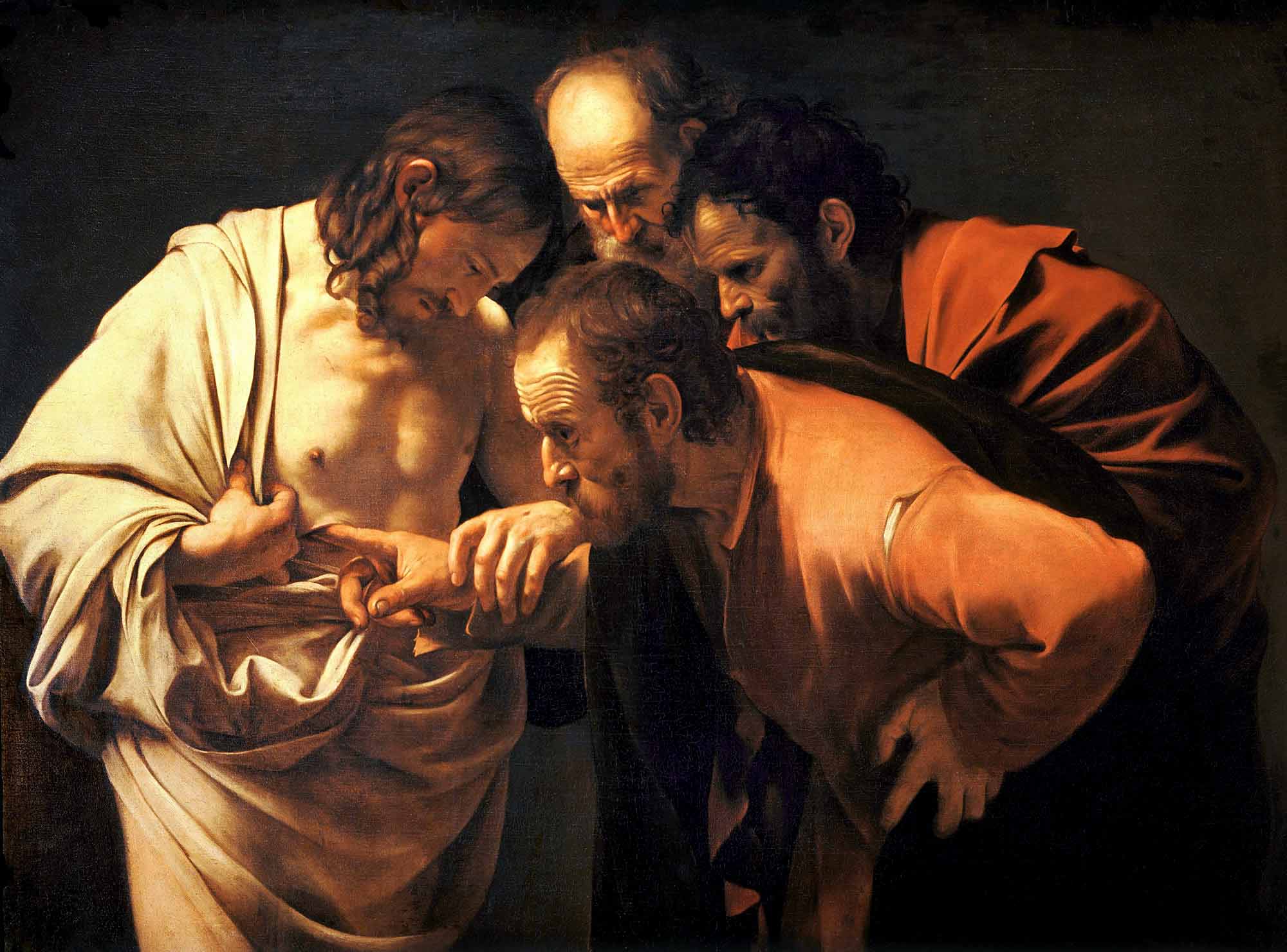
Caravaggio - Doubting Thomas

Caravaggio – Doubting Thomas

Caravaggio seems to use a brown tint in his background which allows the viewer to do this and so I have painted over the Payne’s grey background with a glaze of burnt umber and payne’s grey leaving the original colour around the candle to hopefully make it look like it is emitting light. Feedback from my tutor will hopefully let me know if I have been successful or not.


Things I am pleased with:

Method and technique

  • I managed to use most of the techniques I have learnt from starting the course plus a bunch of techniques from the drawing 1 course.
  • I didn’t rely on my eyes as I have done with most other exercises and assignments instead I went with how I felt it should look. Maybe this is the start of me developing a personal voice.
  • I particularly liked the way an oil pastel study gave me a good insight into which colours I would be using for acrylics. I didn’t question this and I’m glad because it worked.
  • Using washes and glazes in the painting was very interesting, years ago i would have repainted the subject if it was too bright, understanding how to use glazes has given me a push in the right direction.

The final piece:

  • I am very happy with the overall painting especially at this stage, it does have which I hoped it would a dramatic feel to it, even if it’s just a knife cutting an orange.
  •  I feel that the painting does show influences of the artists I researched for the Chiaroscuro particularly Caravaggio.
  • There are parts of the painting that I do feel exemplify the chiaroscuro technique really well particularly the knife handle resting on the blue towel. This is probably the best part of the picture.
  • The shadows particularly from the orange help to create a nice depth to the painting.
  • The texture of the hand towel could not be improved on to me this is perfect.
  • The brown tinted background – This really finishes the painting nicely. I may have been able to improve on the glow around the flame but I didn’t want it to strong but for now the tint of burnt umber helps to create a halo around the grey.

Things I am not happy with:

Method and Technique

  • For the life in me I couldn’t get the wax under the flame of the candle like it did.

The final piece

  • I couldn’t get the wax under the flame to glow like it did this would have probably  really improved the look of the painting.
  • The colours are a bit dull but any brighter didn’t look right at all so they had to be toned down.
  • The knife blade is out of shape but I couldn’t keep messing around with it for the objects around it.
  • Not sure if the blade looks twisted or not from the handle.
  • Too me the candle looks flat. I’m not sure what technique I should use to improve on this.
  • Not sure if the shadows of the board should be darker. I had a problem with the mix of greys and adding colour tints to them.



Working on Different Coloured Grounds 2 – Tonal Study on a Dark Ground

Finished Tonal Study

Finished Tonal Study

As briefed I prepared a dark ground with a dark wash of payne’s grey, this I did on A3 size watercolour paper. I had gone larger with the first painting but this time I stuck to the guidelines in the last exercise, Tonal study on a white ground, having now plucked up a bit of courage and got more confident with the brushes.

Chosen Composition

Chosen Composition

As in the last exercise I used acrylic paint for both the ‘imprimatura’ and the actual painting, I still haven’t plucked up enough confidence to use oils, I think this is because I am very worried about the drying time in my small condominium.

Having just researched ‘chiaroscuro‘ in the last research point, the works of Joseph Wight of Derby and the candlelit studies of Rembrandt really appealed to me and so I chose to do this study by candle light (from a large Buddhist candle that I bought for drawing 1) rather than it being lit from the side with the bendy lamp that I have used in the past.

Because I wanted to employ chiaroscuro effects in this painting the best way to do this was to create a composition that reflected the light best, so I played around with the three subjects that I used for the last exercise until I found a composition that worked well, reflecting light in a dramatic way.

Materials Used for this painting

  • Canson Watercolour Paper (A3)
  • Acryic Paint: Titanium White, Payne’s Grey, Chromium Oxide Green
  • Brushes: Medium Wide (synthetic), Fan, Pointed Round (synthetic), Flat (synthetic) Detail Flat (hog’s bristle) 
  • An old bank card
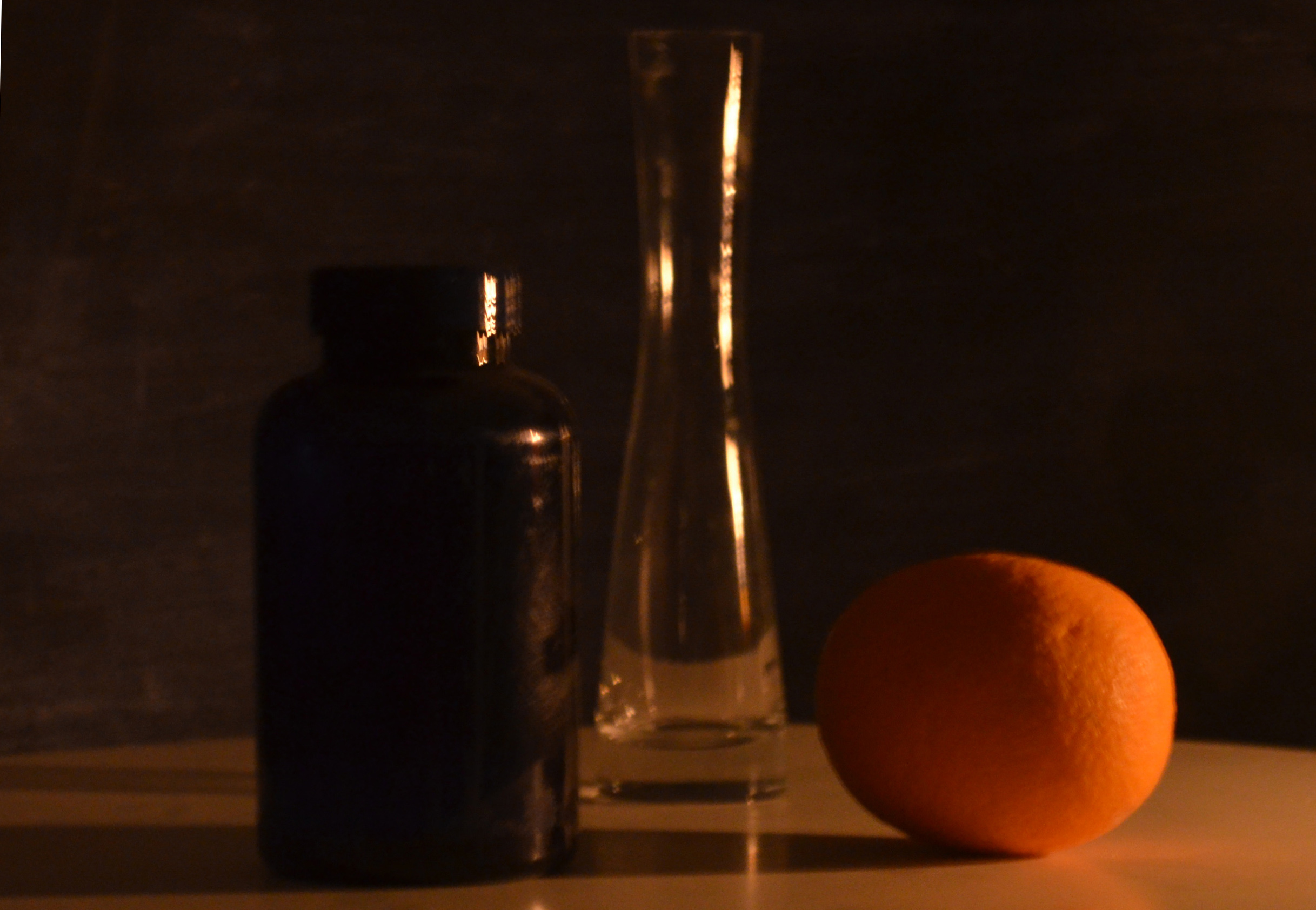
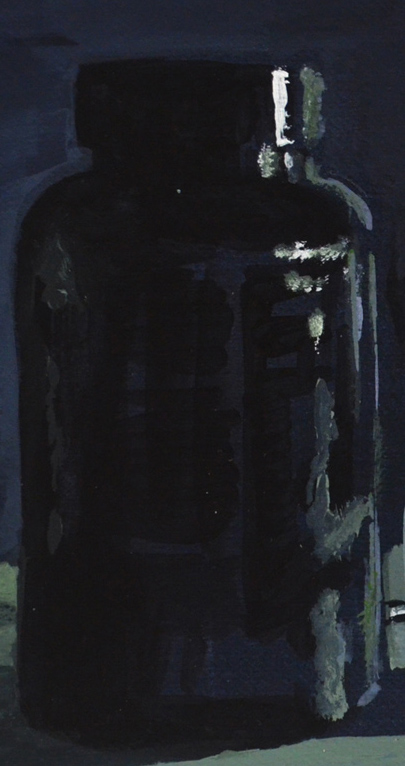
Empty Calcium Container

Empty Calcium Container

I sat facing the objects with the bendy lamp behind me switching it on as I needed as it was quite difficult to paint the objects in the dark.

For the first object, the empty calcium container I used payne’s grey (undiluted) for the darker shadows leaving the colour of the ground showing through in places for the reflections. I then painted the lighter reflections in a diluted mix of payne’s grey, white and green with highlights in titanium white which I later dulled down in a very dilute mix of green and grey. I then painted a thin line of reflection on the edge of the container by applying paint with an old bank card.

Reflection inside jar

Reflection inside jar

From there I painted the broad band of light reflected inside the vase which was empty for this painting rather than filled with coffee as it was for the last exercise. The reason for painting this part of the jar was so that I knew how far the orange needed to be as i would be painting that next and coming back to the jar as this would be the most difficult part of the painting.

Painting the orange helped me to decide on the tones I would be using for the rest of the painting as up until now I wasn’t sure if I should be putting more of the green in the mixes but as I

Orange

Orange

started painting the orange I saw that the balance of green grey and white was really nice and so I continued as I was. There is a white line on the bottom of the orange that I can see now as I am typing this that I will have to blend in before it’s finished.

After completing the orange I went back to completing the jar which took a create deal of effort  as I messed up with the reflections and highlights a couple of times and had to paint in and around it and trying to find the right mix of Payne’s grey and white was a difficult task.

Completed jar

Completed jar

I do realize that the aim of these exercises is to focus on tone rather than precision but I do like the objects to be the right shape and if the shape is out I do tend to correct them and with the jar it took some effort.

I think for my first attempt at using (if that’s the correct term) chiaroscuro effects I did quite well. The painting took me less time to complete than the Tonal study on a white ground as i was modeling light rather than painting whole objects, apart from the orange which I actually thought I could leave some of the ground coming through for the darker shadows.

On modeling light: Again for a first attempt I think I did quite well, there is still a lot of the ground showing through so I did use the ground to the best of my ability at this point, painting the reflections and shadows helped me to create the shape of the objects as to just painting them and adding the reflections later.

Comparison: Looking at the two studies I have to say that I prefer this one, it was not only easier and quicker but I think it does look much better and composition as a much more dramatic appearance.

Tonal Study on a White Ground

Tonal Study on a White Ground

Finished Tonal Study

Finished Tonal Study


Technical Difficulties: 

  • Painting in low light: This was extremely awkward and I had to keep turning the lamp behind me on and off.
  • Matching up paint with the coloured ground: There were times when I had to correct mistakes by painting on the ground, by doing this I had to match up the tones, I still haven’t perfected this but I realised I had to go with a very dilute mix and then thicken it up to match up the colours.
  • Painting very thin lines of light/highlights: There were times when I used the edge of a bank card, there were times when I went to thick and then thinned them down by painting against them with a darker colour.
  • Getting the colour mixes right: I used a second sheet of the same dark wash to try out the mixes if I was unsure.

Working on Different Coloured Grounds 1 – Tonal Study on a White Ground

The brief for this exercise:

Find a few simple objects that are ready to hand are  plain and un-patterned. A jug, vase and/or some fruit would be ideal. Place them so that they are lit from the side, either by natural light from a window or by lamplight.

Using a tonal drawing medium such as a soft pencil, pastel or charcoal, do some simple studies of your chosen objects in your sketchbook. Make several studies from different angles and then decide which viewpoint and angle you will use for your tonal painting.

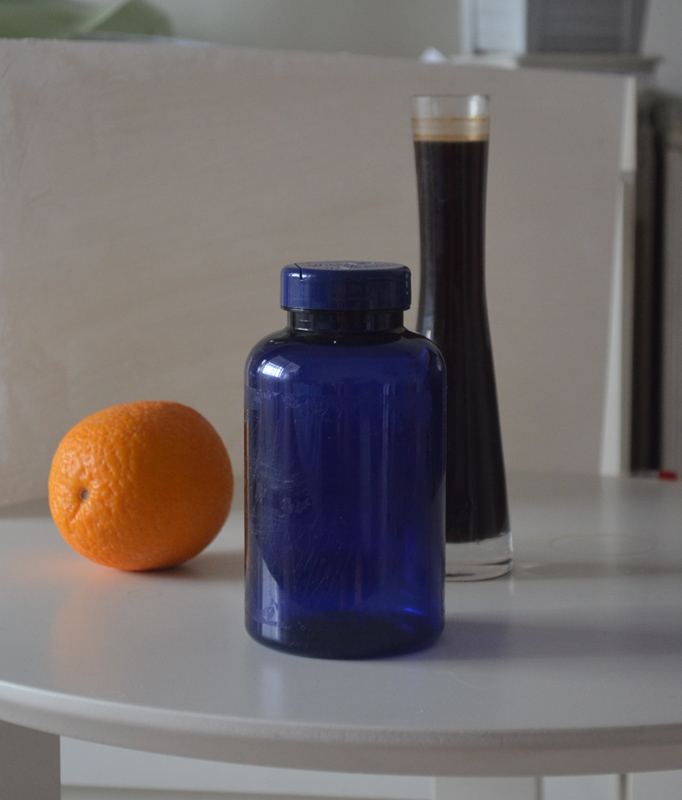
I didn’t have many jugs jars or a good choice of fruit at hand, my girlfriend had just brought some oranges down from up north so I decided to try and make a composition using them along with an aluminium bowl a glass vase filled with liquefied coffee and a jar of calcium tablets which I emptied and peeled off the label. I made some sketches in my sketchbook in charcoal.

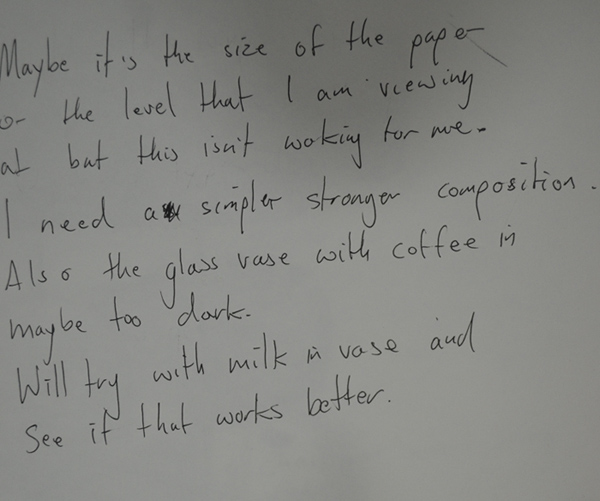
For the first two sketches I placed the objects on the top of the fitted unit at just under eye level lit by a bendy lamp. I decided that the top of the fitted unit was too high and I also wasn’t satisfied with the oranges in the bowl, I thought that less objects would make a simpler but stronger composition.


1st Sketch

1st Sketch

1st Sketch Notes

1st Sketch Notes

2nd Sketch

2nd Sketch

2nd Sketch Notes

2nd Sketch Notes

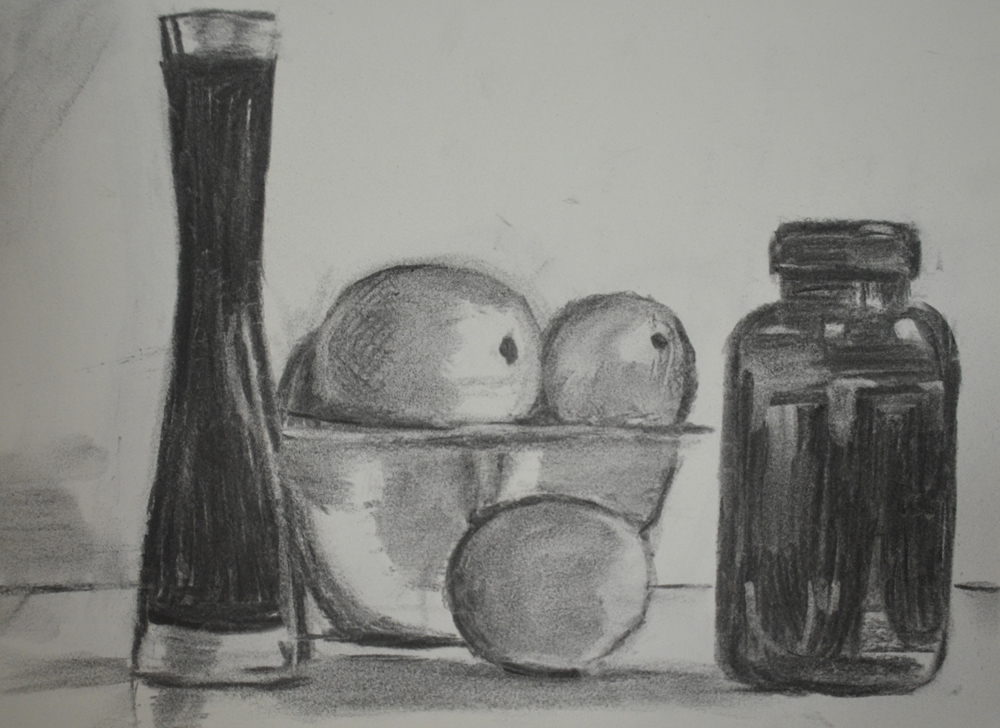
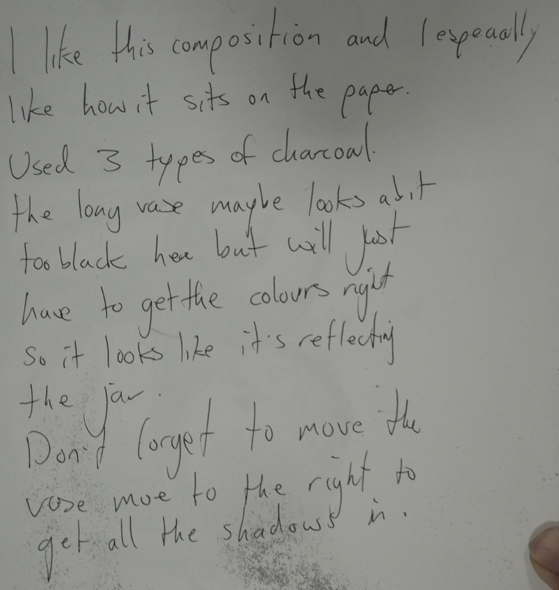
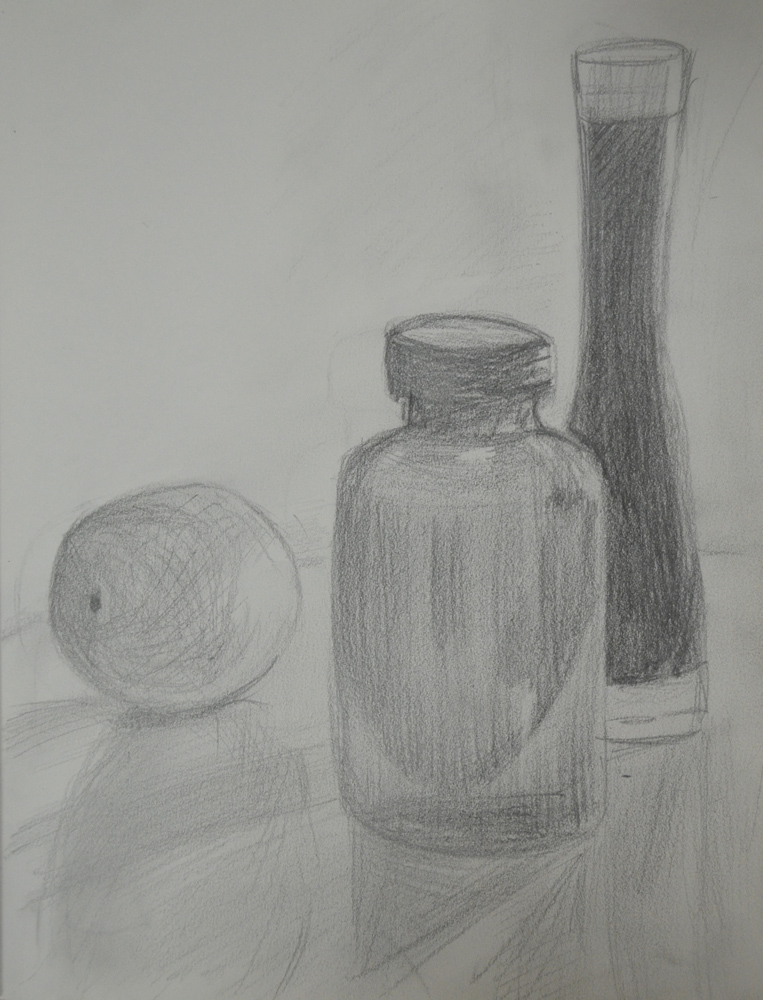
For the third sketch in charcoal I removed the bowl of oranges from the composition leaving 1 large orange plus the jar and vase and placed the objects on a round table at a lower level then I taped a sheet of paper to the back of the table to give it a plane background (always get distracted drawing backgrounds). The bendy light lit the composition from the right hand side. I did one more drawing with a 5B pencil to analyse the tones using a different monochrome media, between the two mediums  they helped me to ‘weigh up tonal variation without the distraction of different colours and hues‘.

3rd Sketch

3rd Sketch

3rd Sketch Notes

3rd Sketch Notes

4th Sketch -  Natural Light

4th Sketch

I have been working later than usual so all the sketches were done in electric light but the next day was an early finish for me and for the first time I got to see the composition with natural light shining through the window from the left and it looked a lot better and the highlights on the jar and vase were very attractive and so I decided to paint the tonal study in daylight which would take me the next 5 days, due to late finishes at short nights.

Chosen Composition

Chosen Composition in Natural Light

Materials Used for Painting

  • Canson paper for Acrylic and Oil
  • Acryic Paint: Titanium White, Payne’s Grey, Chromium Oxide Green
  • Brushes: Flat Brush, Pointed Round, Medium Wide (synthetic), Fan, Medium Wide, Detail Round, Pointed Round (hog’s bristle) 

The brief recommended that we paint small on A3 or A4 paper or card, the best acrylic paper I had was 15 x 18 inch and because this was going to be my first painting I wanted to use a quality prepared paper rather than Gesso on watercolour paper which was the only other paper I had.

Tonal Study on a White Ground

Tonal Study on a White Ground

I made a first thin off white acrylic wash with a very dilute wash of  yellow ochre thinking that there was an element of warmth in the composition in front of me, this was pretty silly of me I should have probably started with a grey wash, this was my first mistake. My second mistake was using a charcoal that was difficult to brush off and left quite heavy marks and so after I completed painting the objects I had to paint the background.

I started on the calcium pill jar first blocking in the form with the un-mixed chromium oxide green then painting in the lighter shades with a glaze of white mixed with green followed by the dark shadows and then the highlights in a very dilute mix of grey and then white for the lightest reflections.

With the vase I made the mistake of using Payne’s Grey straight which was too dark and so I went over with a mix of green and grey with the darker reflections with a green glaze before painting in the highlights in white.

To give the orange a bit of texture I stippled a base layer of paint and then once the paint was dry I depicted the various tones by blending the grey green and white with an almost scrumbling-like technique.

For parts of the painting I used water to moisture the paint and in the glazes  but I also bought a bottle of Liquitex flow aid that I used for the first time in this painting. For me this painting was not just a tonal study but the first painting that I had used a number of techniques, brushes and materials that I have never used in a painting before.

Notes:

I am not completely satisfied with the finished painting but I am happy that I learnt a lot here about how the acrylic paint behaves, making the following observations.

  • Acrylic paint looks darker on the palette than it does it does on the paper.
  • A diluted glaze of acrylic paint over the top of another layer of paint gets darker as it dries.
  • It’s best to start off lighter and then work darker when trying to match hues with a previous layer of paint. (There were times when I had to stop what I was doing and then came back to painting but had to clean the palette because the paint had dried).
  • Diluted paint is more likely to run when applied over the top of a dry layer of paint.
  • Washes are great for shadows.


Research Point 1 – Mark Rothko and the Seagram Murals

Look at the paintings of Mark Rothko, in particularly the huge Seagram Building Paintings, now in the Tate Modern, which form a solemn kind of tone poem all in shades of crimson.

Rothko was an American Abstract Impressionist painter, born in Russia and emigrated with his family to the U.S.A. in 1913. As a young buy Rothko was interested in literature, music and social studies and won a scholarship to Yale University where he studied liberal arts but left without graduating in his third year.

In 1925 Rothko moved to New York where he was he made irregular attendances at the Art Students League, one of the classes there was a painting class buy Max Weber, which remained his only formal art training. Mostly self taught, he educated himself by attending exhibitions and visits to artists’ studios such as that of Milton Avery, whose work influenced Rothko along with that of Matisse with their simple compositions and flat areas of colour.

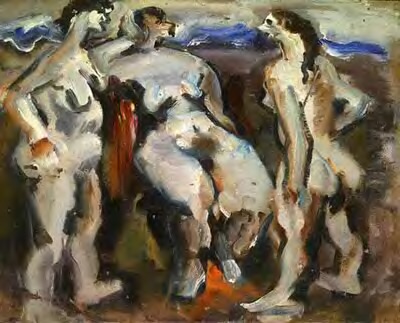
Bathers or Beach Scene Untitled 1933-4 by Mark Rothko

Bathers or Beach Scene Untitled 1933-4 by Mark Rothko

Rothko’s earliest pictures comprised of Expressionist landscapes, genre scenes, still-lifes, and bathers and were somewhat muddy in tone while his watercolours of the same period, demonstrate an expert approach to thin washes of pigment. His paintings throughout the 1930s invoked a feeling of mystery and dread with tragic figures set in claustrophobic apartments, lonely city streets and subway platforms.

Mark Rothko - Entrance to Subway - Subway Scene - 1938

Mark Rothko – Entrance to Subway – Subway Scene – 1938

In the lates 30s Rothko and Gottlieb as well as other Jewish artists with similar interests formed ‘the Ten’ together they mounted exhibitions in New York and Paris Until 1940.

During the mid-1940s Rothko evolved a personal watercolour technique.  he applied watercolour, gouache, and tempera to heavyweight paper, then before the paint had time to dry, he used black ink to define forms. The ink would bleed when introduced to areas that were still wet and resulted in the black burst often found in his works from this period. These watercolour techniques seemed to have influenced the technique which he  developed for his oil paintings.

Mark Rothko - Untitled  oil on canvas 1945

Mark Rothko – Untitled oil on canvas 1945

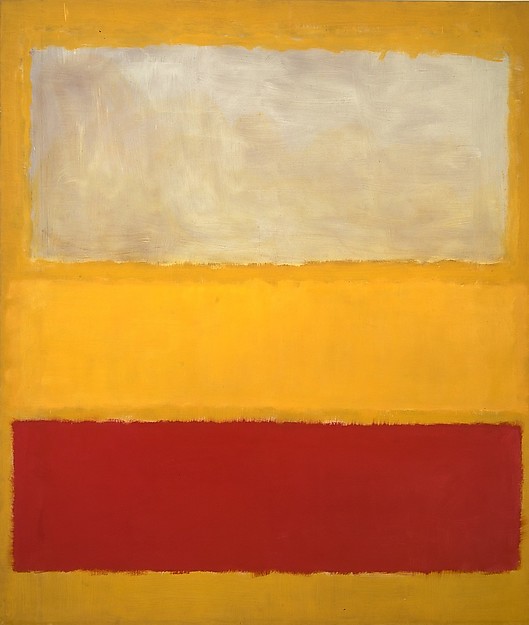
Rothko felt that his new work was consistent with the subject matter of his earlier paintings, he stressed he had not removed the human figure but had replaced it’s form with symbols and later shapes. In his opinion paintings like No.13(White, Red and Yellow) below had developed out of his hopes to express human emotions.

Mark Rothko Number 13 -White Red on Yellow

Mark Rothko Number 13 -White Red on Yellow

‘The progression of a painter’s work…will be toward clarity…..I’m interested only in expressing basic human emotions—tragedy, ecstasy, doom…and if you…are moved only by their color relationships, then you miss the point.’ Mark Rothko.

The Seagram Murals

Mark Rothko untitled Mural for End Wall

Mark Rothko untitled Mural for End Wall

Rothko was received one of the biggest commissions of his life in 1958, to paint a series of murals for the fashionable Four Seasons restaurant located in the Seagram Building on Park Avenue New York.

Mark Rothko untitled 1958


This set a new challenge for Rothko as it was the first time he had been asked to produce a coordinated series of paintings as well as producce an artwork space concept. To do this the artist constructed a scaffold in his studio, the same dimensions of the restaurant. Over the next three months he completed 40 paintings. A total of three series in maroon, dark red and black rather than the intense bright colours in his earlier paintings. He also altered his the usual horizontal format to vertical so that they would complement the restaurant’s vertical features: columns, walls, doors and windows.

Mark Rothko Untitled (section 3) 1959_0

Rothko was influenced by Michelangelo’s Laurentian Library in Florence, with its blind windows and deliberately oppressive atmosphere, he commented that Michelangelo ‘achieved just the kind of feeling I’m after – he makes the viewers feel that they are trapped in a room where all the doors and windows are bricked up, so that all they can do is butt their heads forever against the wall.’ While on the SS Independence Rothko disclosed to Harper’s Magazine publisher John Fischer, that his true intention for the Seagram murals was to paint “something that will ruin the appetite of every son-of-a-bitch who ever eats in that room….”

Mark Rothko Untitled (section 2) 1959_0

Eventually he realised that the worldly setting of a restaurant was no ideal location for such a work, Rothko withdrew from the Seagram Mural commission. He kept the commissioned paintings in storage until 1968 before presenting the series to the Tate Gallery, expressing his deep affection for England and for British artists such as J.M.W. Turner.

Mark Rothko Red on Maroon mural, section 5

Mark Rothko Red on Maroon mural, section 5

The Seagram Murals arrived in London for display at the Tate Gallery on the very day of his suicide, February 25, 1970. His assistant Oliver Steindecker, found him lying dead on the floor in front of the sink. Rothko was covered in blood with slices down his arms inflicted by a razor that was found lying at his side. The autopsy revealed that he had also overdosed on anti-depressants. ‘Mark Rothko was always incredibly depressed’ – Matthew Collings, This is Modern Art.

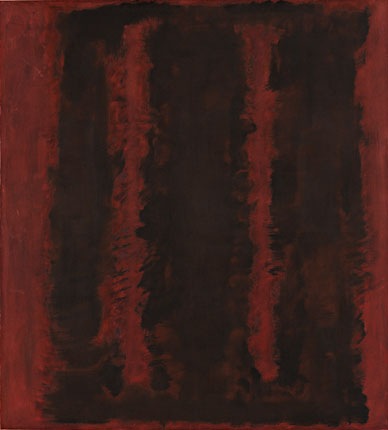
Mark Rothko Black on Maroon 1958

Mark Rothko Black on Maroon 1958

I used to have a reoccurring nightmare when I was a kid which was more of an intense feeling of anxiety than anything else. There were no figures in the dream just vertical blocks of dark greys and blacks pushing together and as they did the pressure that I felt would force me awake. This could have been from temporary damage due to lack of oxygen to the brain from pneumonia or asthma and I haven’t really thought about it for years but looking at the images above brings it all back and that’s just on the computer.

I’m not keen on the paintings, although I do understand the concept and respect the artist and I would like to get right up close and personal with Rothko’s paintings to feel just what the artist intended you to feel “tragedy, ecstasy, doom”

Although there is some emotion there for me looking at the murals above on a computer do not them justice at all, I have seen how two colours bleed into each other when wet  and can only really guess how the darker colours of the black shape on ‘Black and Maroon’ for example have bled into the lighter maroon. To see that on a grand scale would be something else.

If according to the Greek historian Plutarch ‘Painting is silent poetry, and poetry is painting that speaks.’ Then yes the poetry that these paintings offer us is very solemn indeed.

http://www.the-art-minute.com/

http://www.tate.org.uk/whats-on/tate-modern/display/mark-rothko

http://en.wikipedia.org/wiki/Mark_Rothko

http://www.oxfordartonline.com/

Transparent and Opaque 2 – Overlaying Washes

Once my papers from the last exercise, Tonally Graded Washes, had dried I made up the same colour mixes again but this time painting the second colour over the dried wash I had set aside. There were noticeable differences in the way the paint and colour behaved.

The colours did not merge in the same way, in the first exercise the colours made new colours and spontaneous patterns as they merged in the middle but in this exercise the wet layer faded into the dried layer. Merging in this way gives you more control as  the result is more predictable.


1 - Wet Blue Ultramarine over a  dry violet wash

1 – Wet Blue Ultramarine over a dry violet wash

2 - Wet Blue Ultramarine over a  dry violet wash

2 – Wet Blue Ultramarine over a dry violet wash

3 - Wet Violet over dry Ultramarine

3 – Wet Violet over dry Ultramarine

4 - Wet Violet over dry Ultramarine

4 – Wet Violet over dry Ultramarine

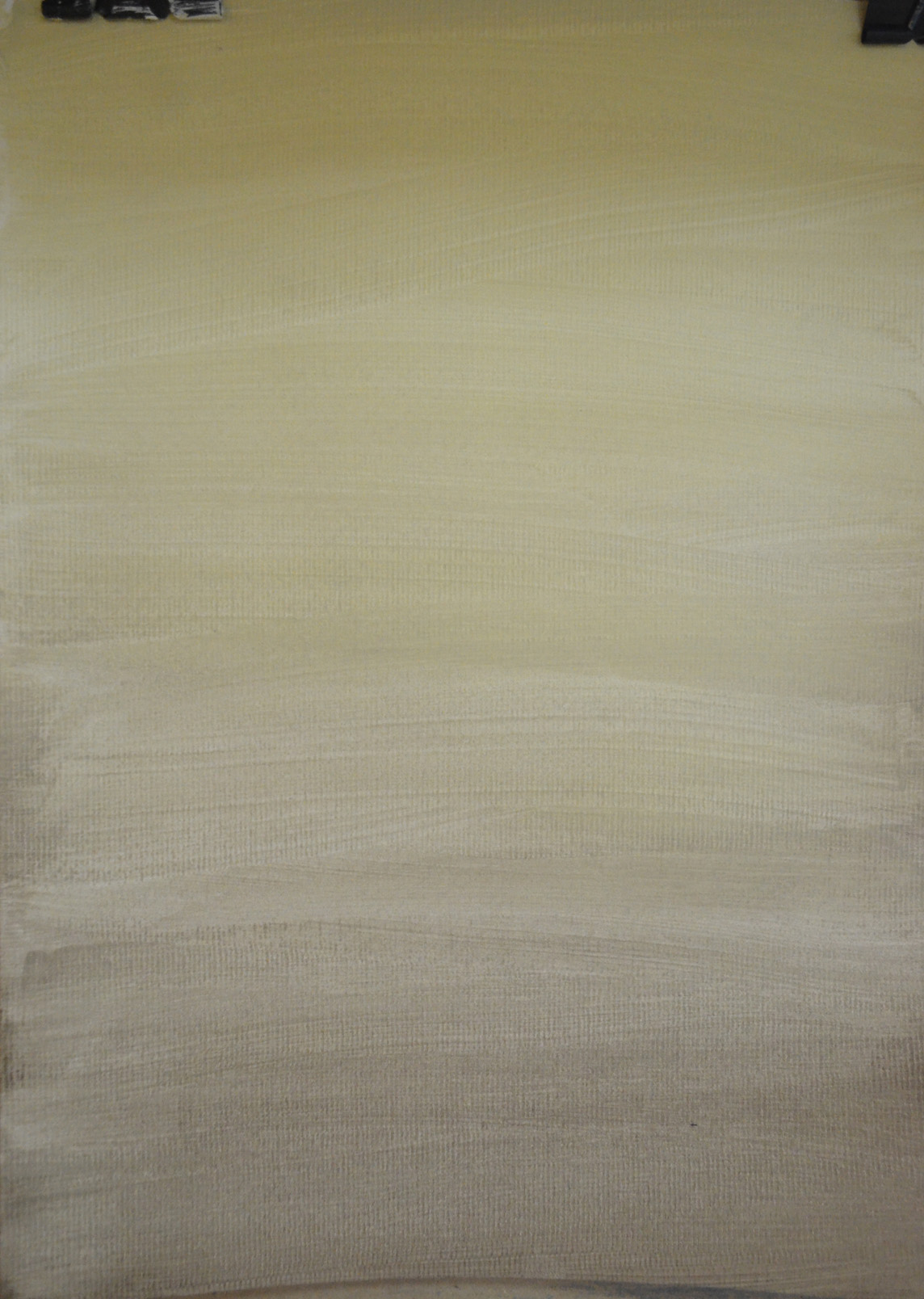
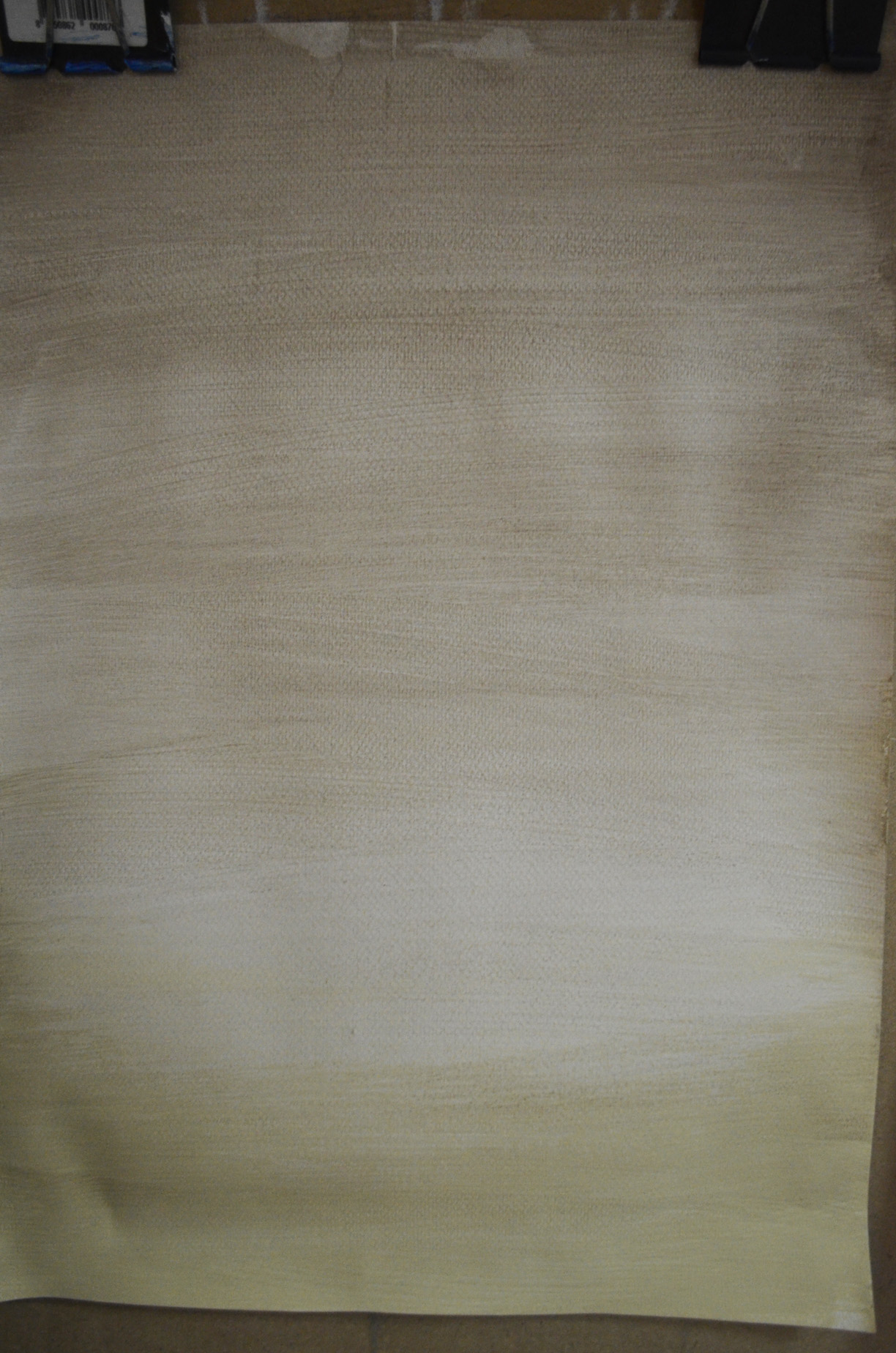
From there I went on to look at other pigments all acrylic and I found out that some pigments were thicker than others. Below is a wet and wet overlaying wash of sand over raw umber, with the same amount of water I found that the sand was more opaque than the raw umber so rather than run into the more transparent colour it had to be worked in. However, a wet and wet wash of raw umber over sand had the opposite result with the raw umber running into the sand.

5 - Sand over Raw Umber

5 – Sand over Raw Umber

6 - Raw Umber over Sand

6 – Raw Umber over Sand

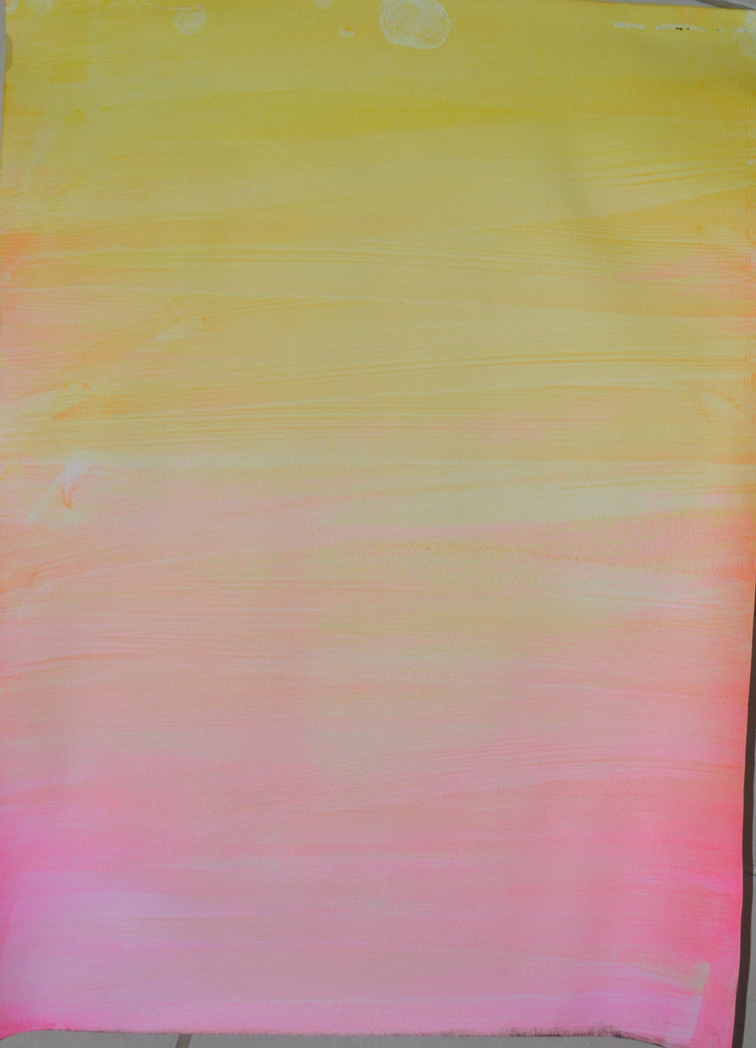
From there I wanted to experiment with two contrasting colours and so chose a yellow wash over fluorescent pink, again wet and wet, what I found was that the colours blended well together forming layers of orange as the layers of wet paint mixed into each other.

7 - Yellow over Flourescent Pink

7 – Yellow over Flourescent Pink

From there I chose to do some glazes with several colours over two different coloured backgrounds, one a bright yellow the other, raw umber. I found that bright pigments remained strong over the bright yellow while they toned down over the mellower raw umber.

8 - Glazes ovrer Yelllow

8 – Glazes ovrer Yelllow

9 - Glazes over raw umber

9 – Glazes over raw umber

Transparent and Opaque 1 – Tonally Graded Wash

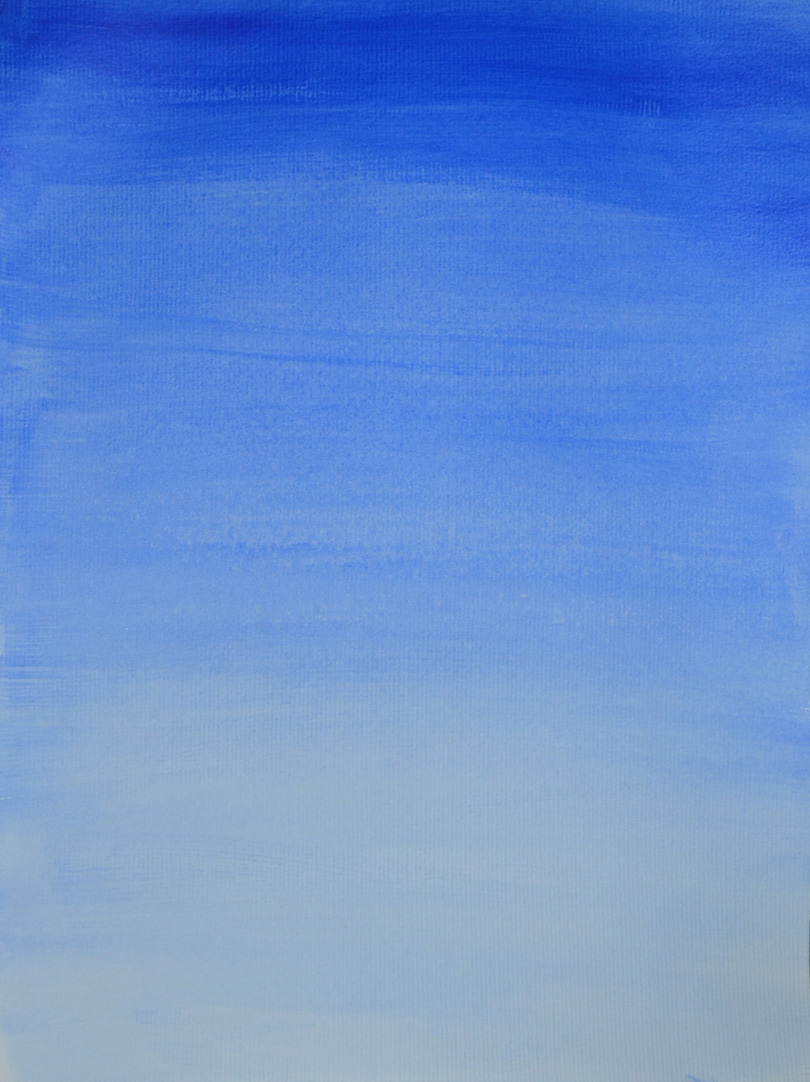
Set up length-ways and look through your colours for either a strong red (such as cadmium red) or Ultramarine. Then put a small amount of pigment on your palete and work inwater or turps until you have a strong fluid mix of the colour. Load a medium wide brush and work from the top to the bottom of the sheet with increasingly dilute mixes of the colour until, at the bottom of the sheet you have a very pale wash, almost faded out to white.

It was eveming and I had neither a string red or so I tried mixing two blues together to start and the only paper I had was a thin 150 gsm watercolour paper. I learnt my lesson, the two acrylic blues werent mixing together as well as i thought they would and the dilute wash was very streaky and between that and the thin paper the results were horrifying.

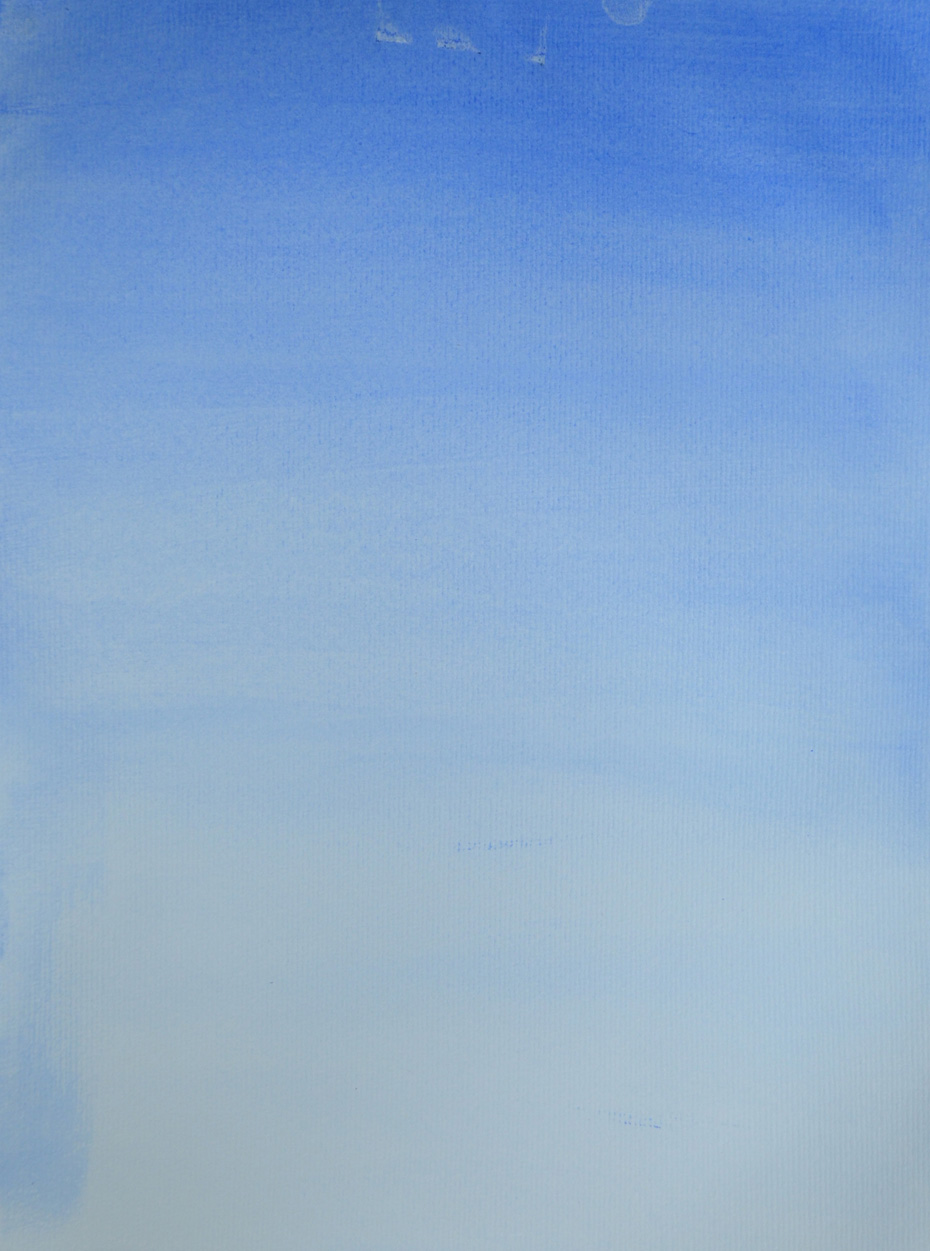
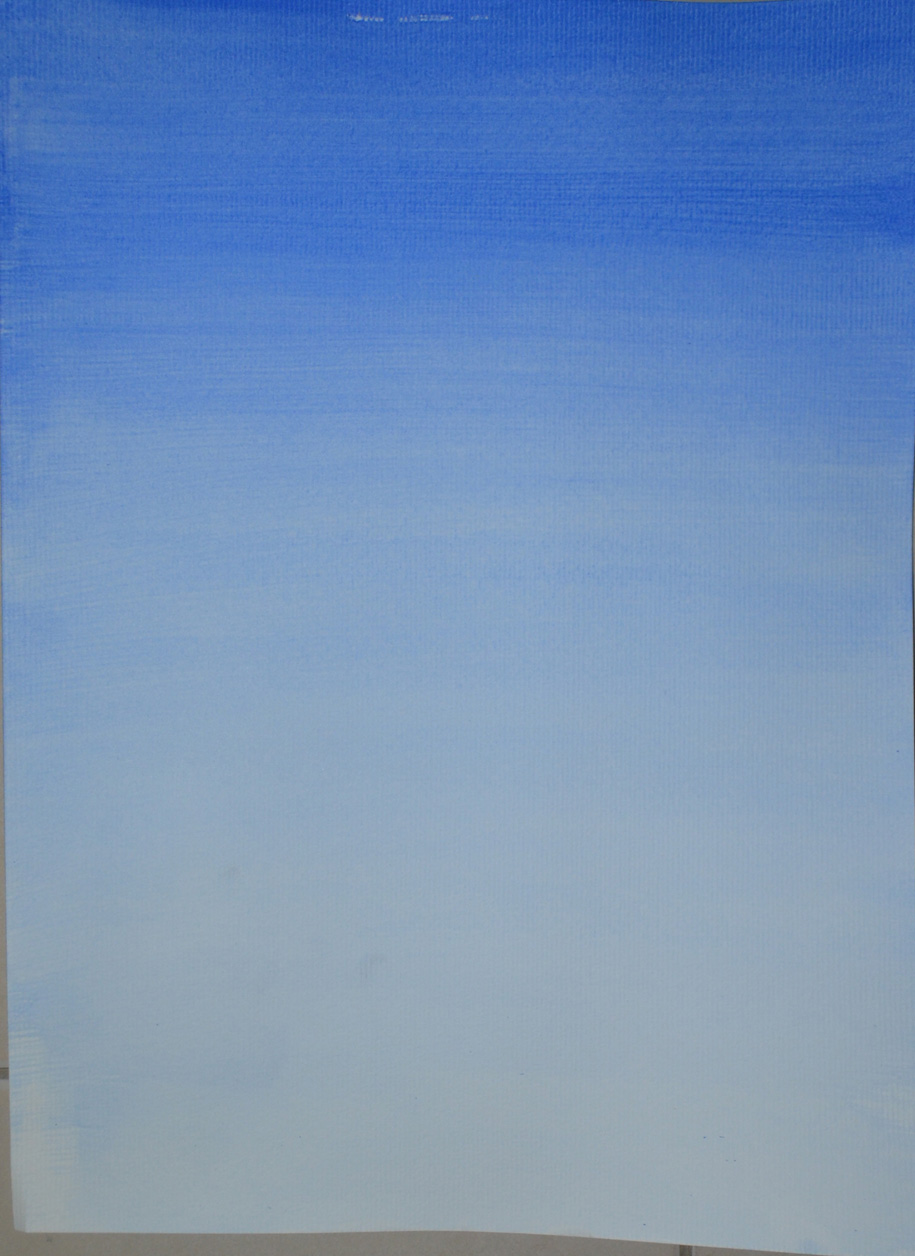
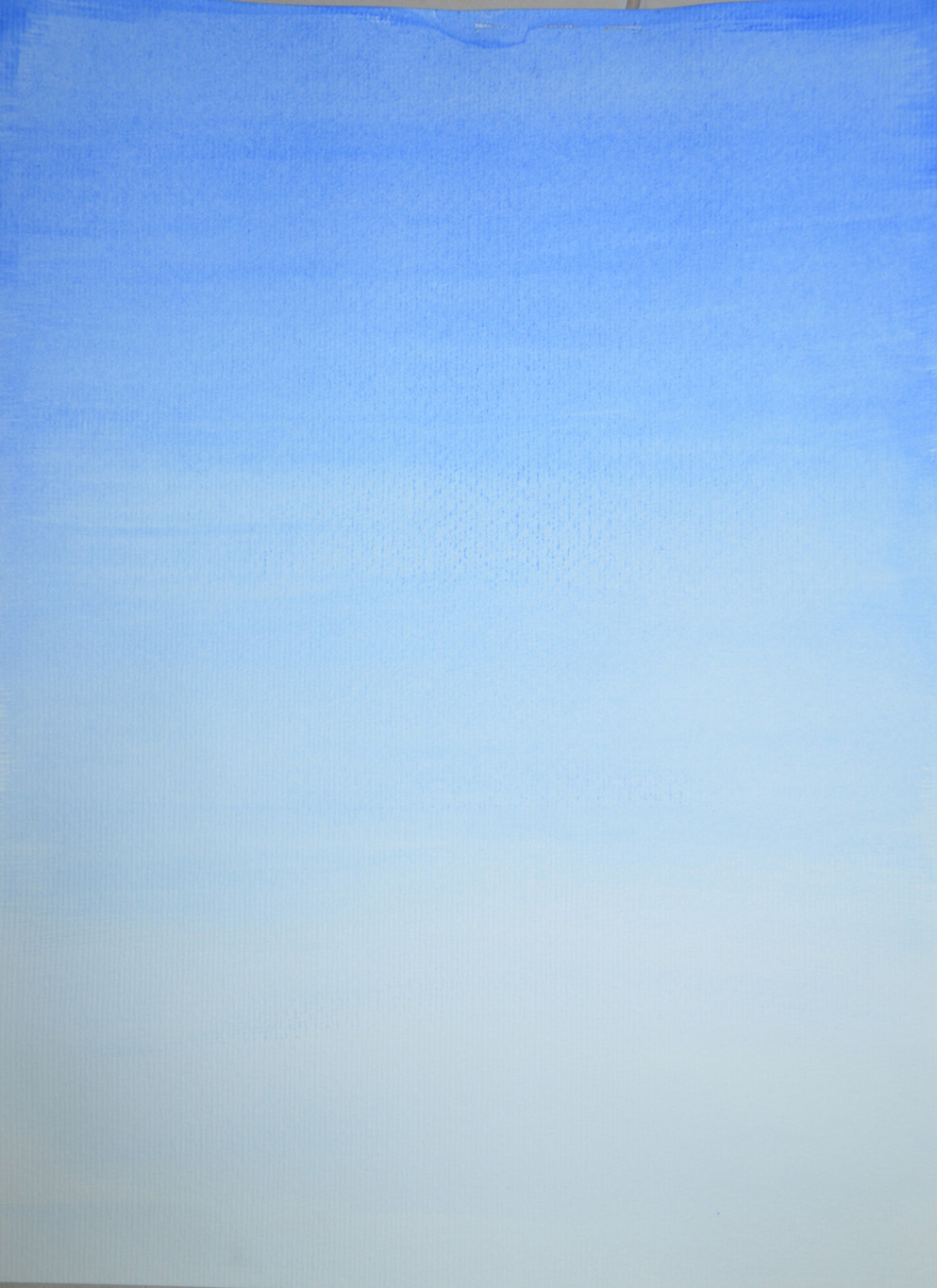
I decided to start again the next day after I purchased some Ultramarine paint and some nice Canson 300 gsm watercolour paper as well as a good quality medium brush. With the new quality tools i started to produce quality washes.

i found it wasn’t as straight forward as working my way tk the bottom with increasingly dilute mixes, occasionally I had to load up the brusb with a thicker mix and work my way back up to get the graded wash.

intitally started out by bulldog clipping the sheets to the drawing board but as i got better at the tonally graded washes i let the bulldog clip alone.


1st Successful Wash Ultramarine

1st Successful Wash Ultramarine

2nd Successful Wash

2nd Successful Wash

3rd Successful Wash

3rd Successful Wash

4th Wash Tonally Graded Wash More Improvement

4th Wash Tonally Graded Wash More Improvement

5th Wash Couldn't ask for better

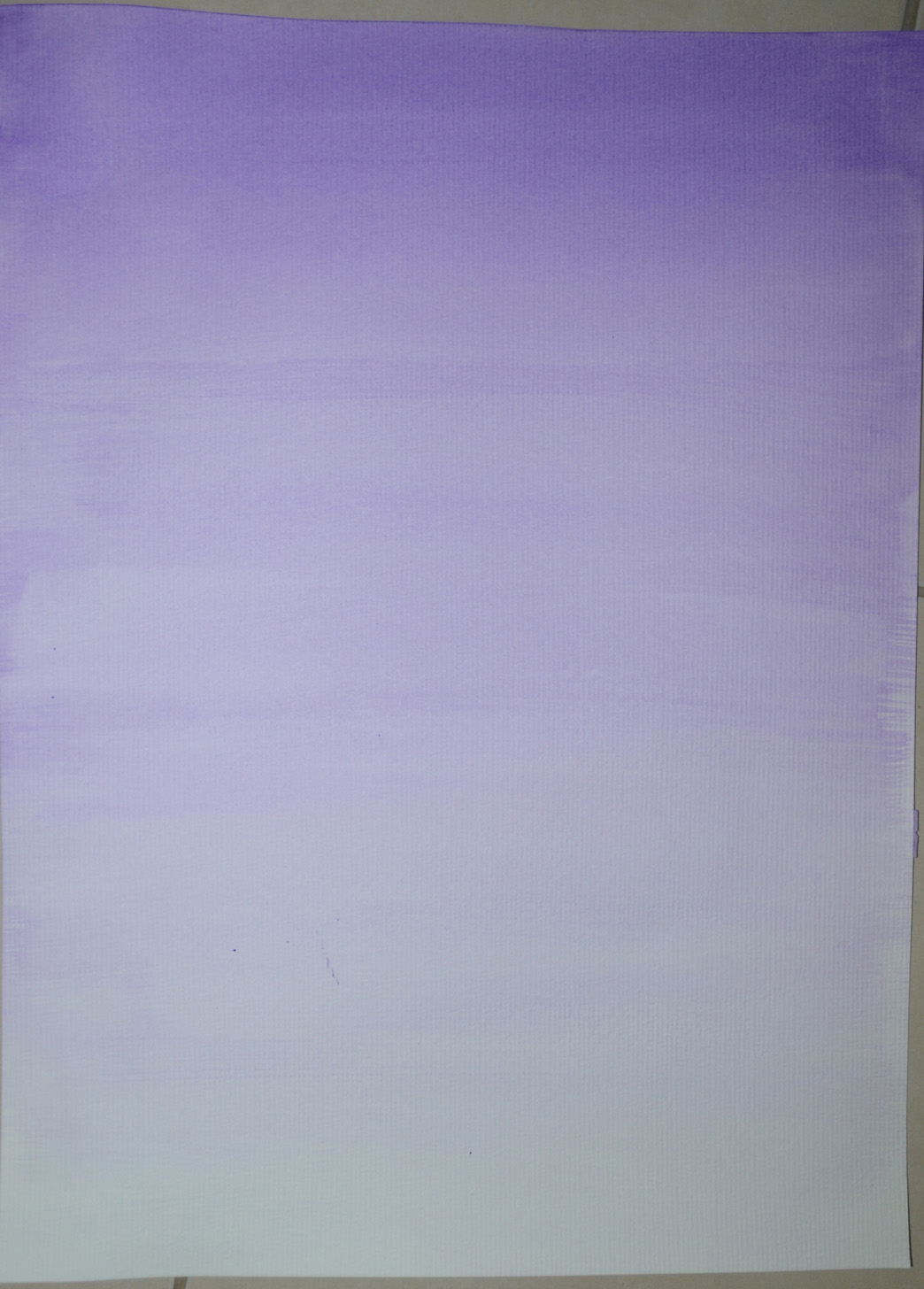
As the brief instructed I practised this several times until I had a satisfactory progression from deep tones to the very palest tones. All the time controlling the load on the brush and the flow of paint on the paper to avoid the paint running, then I put the ones with the most steadily graded wash aside to dry to be used in the next exercise,  overlaying washes. I then did more washes in a dilute mix of violet as it is close to the original colour on the spectrum (as instructed) and set those aside for the next exercise as well.

6th Wash in Violet

6th Wash in Violet

7th Wash in Violet

7th Wash in Violet

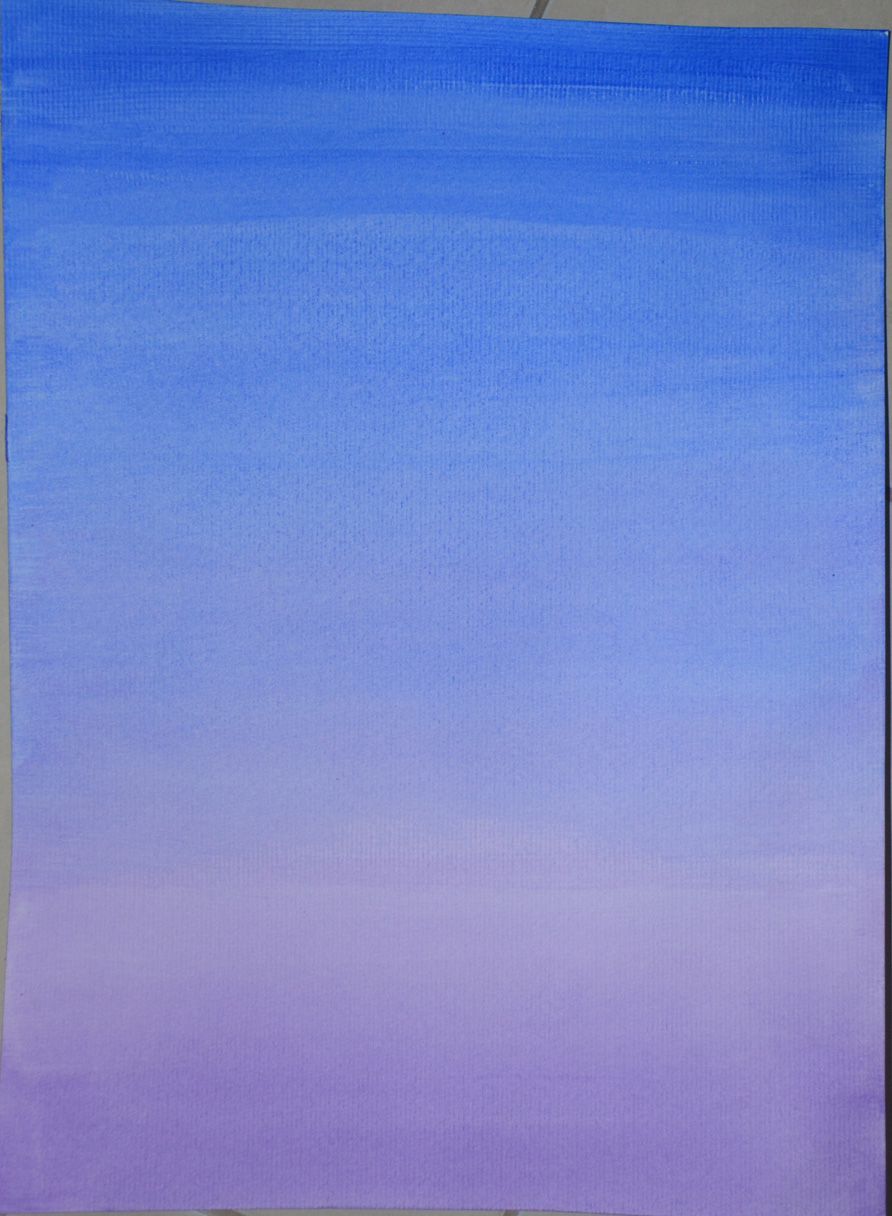
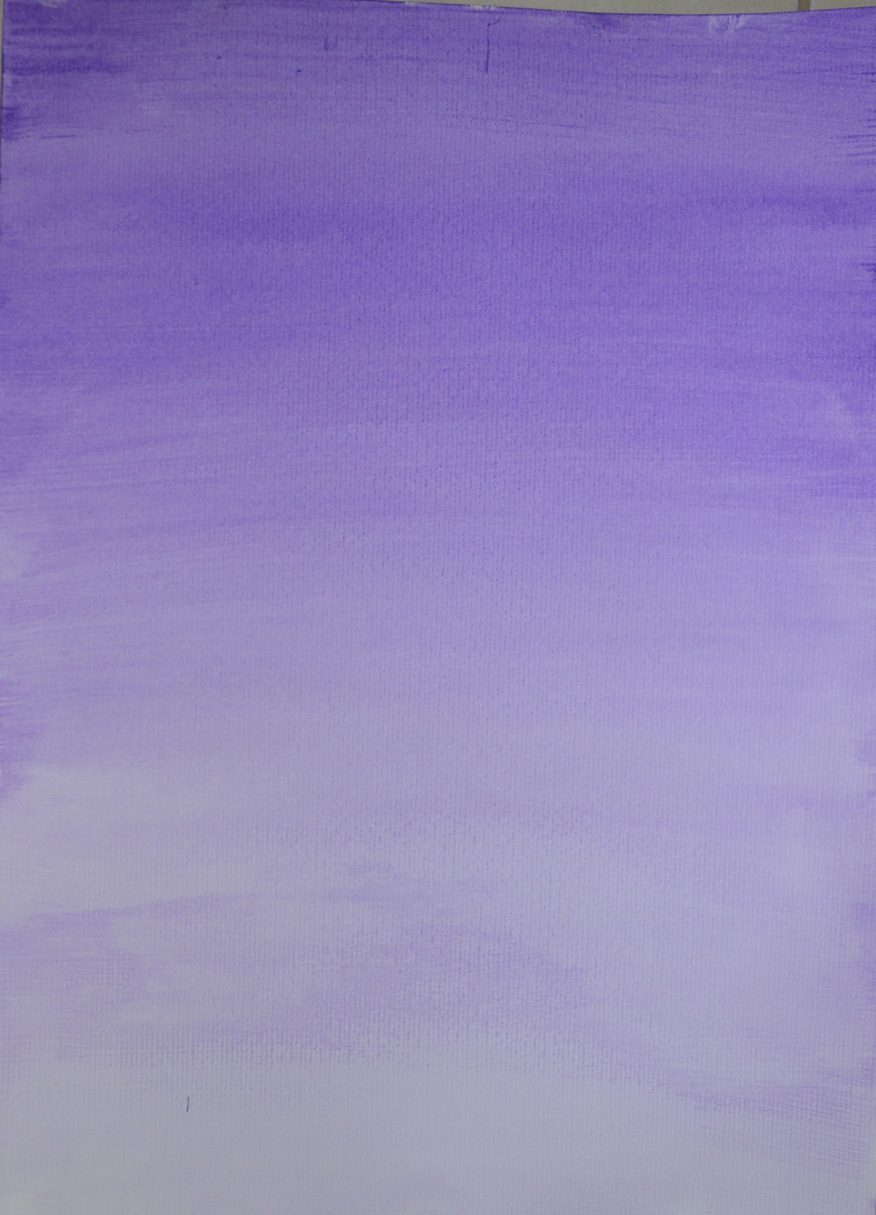
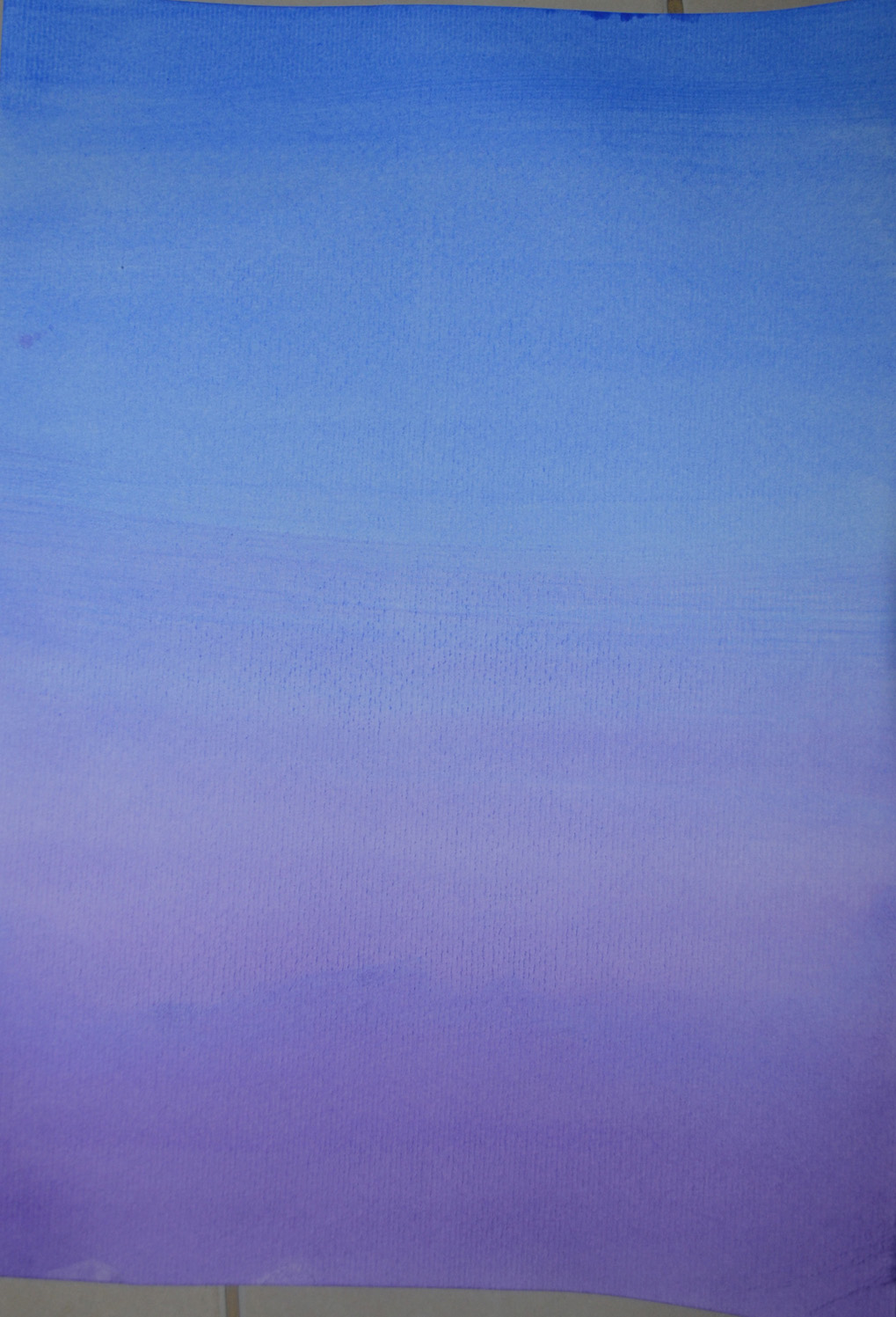
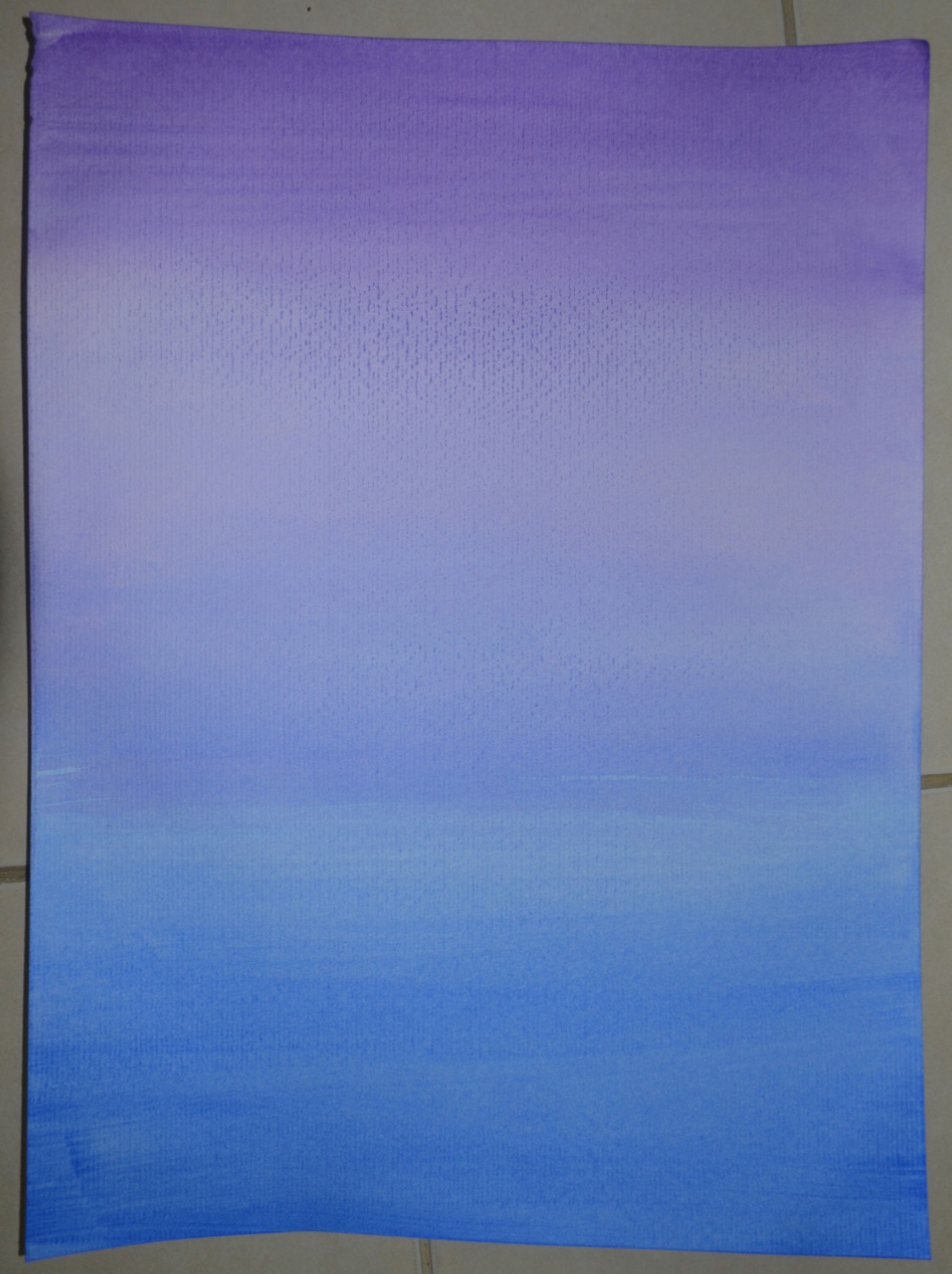
Then i worked wet-in-wet and painted a graded wash of the second colour (violet) on to one of the sheets with the second colour (ultramarine) and vice versa allowing the colours to merge in the centre, what i found was that the violet and ultramarine formed layers of purple as they blended into each other which reminded me of an horizon seen from over the wing of an aeroplane.

8th Wash Wet and Wet

8th Wash Wet and Wet

9th Wash Wet and Wet

9th Wash Wet and Wet