Category Archives: Coursework

Colour Relationships 3 – Optical Effects Exploited by Different Artists

Optical effects have been exploited by many artists to create and depict effects of light. The impressionists, Post-Impressionists and Neo-Impressionists – in particular the Pointillists, Seurat and Signac – made full use of the new understanding of the nature of human perception. Find out what you can about these artists’ aims and study their pictures to see how they achieved effects such as optical mixing. Look at the work of Bridget Riley or the Op artists. Make notes in your learning log.

The Impressionists

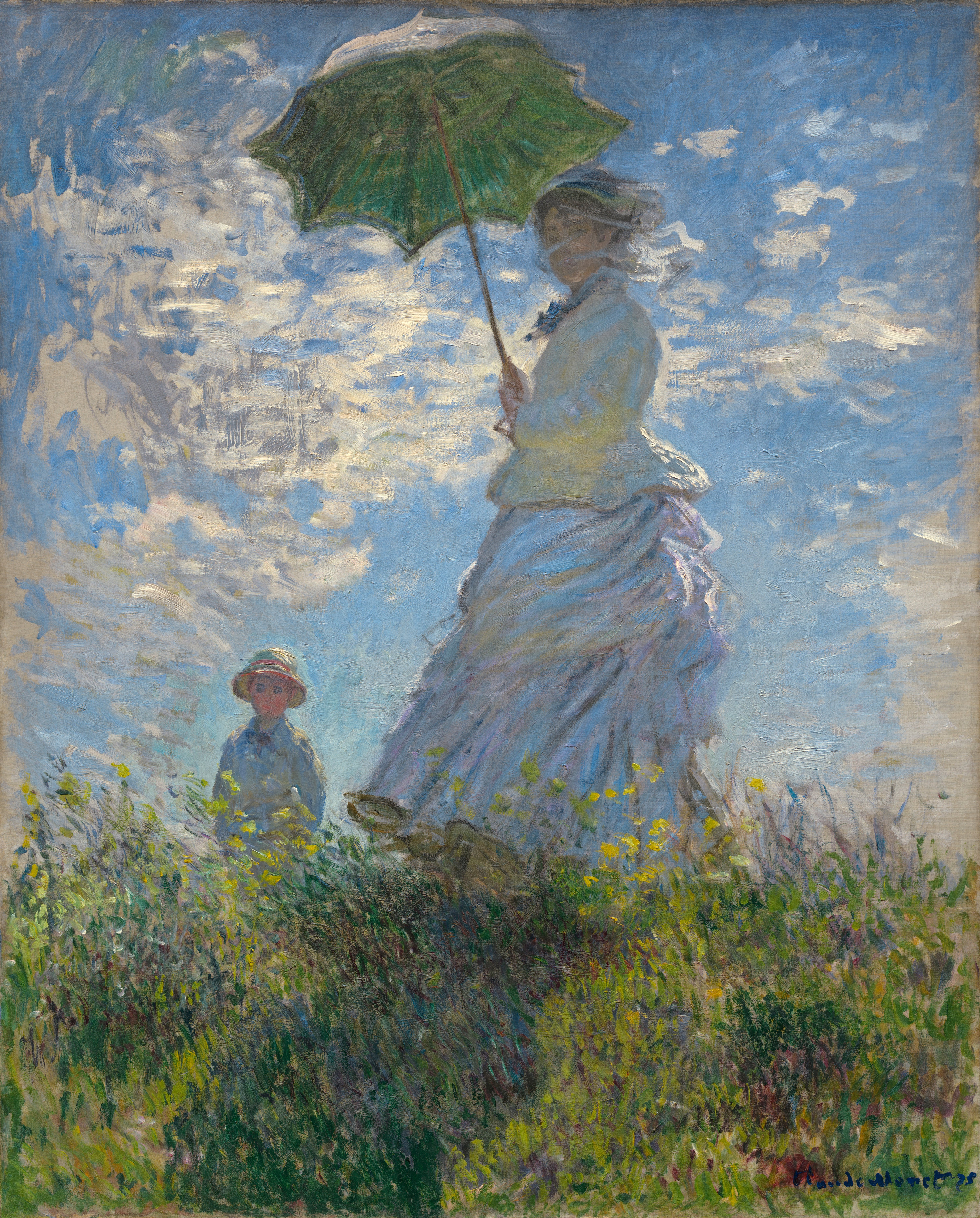
I began by looking at the impressionists, with Claude Monet one of the best examples of artists who used optical effects to depict light. Looking through his paintings, most of which I knew from my time selling reproduction art but the one that made me stop to enlarge it was.A Woman with a Parasol 1975. The painting is of a Woman with a Parasol like in the painting I looked at in the earlier research point Chevreul’s Colour Theories,  Poppies at Argenteuil, 1873.

Claude Monet Woman with a Parasol 1875

Claude Monet Woman with a Parasol 1875

When I first looked at the painting I thought ‘wow he has painted the woman in some detail’ but when I enlarged it I could see that it wasn’t the case. Monet basically modeled the light by painting the sky first then with darker paint he depicted the folds of the woman’s dress, the blue of the sky still showing through portrays the light of the sky reflecting off the material of the dress above the folds. On the right hand side of the woman he uses white and other light colours to show light reflecting off her dress from behind helped by the shadow on the grass slightly to the left in front of her which he paints using darker hues and a greater use of blue than the rest of the grass. I particularly like the way he depicts the glow of the flowers by adding yellow under her arm.

Pointillism

The Pointillism technique developed by Georges Seurat and Paul Signac uses small distinctly coloured dots that are applied in patterns to form an image. This technique relies on the ability of the viewer’s eye and mind to blend the colour spots into a larger range of tones on canvas as to more traditional methods of painting that blend pigments on the palette.

After looking closely at a few paintings Seurat’s and Signac’s I began to examine two paintings that had familiar features, water, reflections and trees. The artists’ aims were clear in both paintings and in their own style using the same technique they both achieved them.

Signac’s painting below seems to use larger clumsier dots to form the painting, this I noticed and most of his other works. Unlike his other paintings The Tugboat Canal in Samois below wasn’t saturated with blue. Although Signac’s placement of dots is quite crude compared to Seurat’s he  carries of certain details in the painting very effectively. In the painting you can see how he has managed to depict the steam by using larger dots maybe pressing on harder to open up the brush, he uses darker hues at the bottom of the trail of steam this makes it look denser while the orange dots at the top of the steam makes it look like it is reflecting the evening sky, I say evening sky because of the orange glow and because the sun looks to be shining through the trees which means it would be low down. To paint the footpath he has used larger dots of a layer of small dots to illustrate how solid it is compared to the larger dots of the water.

Paul Signac - The Tugboat Canal in Samois

Paul Signac – The Tugboat Canal in Samois

He depicts the reflection of the barge on the water by using similar colours to the boat but using white dots to distort the reflection, which is a very different approach to how Georges Seurat painted the water in The Seine and la Grande Jatte  below. Here Seurat has painted the water by painting in lighter patches among a river of blue to depict either the break from the sail boat or the pull of the current in the water, either way it works well and he hasn’t had to paint a reflection of the boat in the water. In Signac’s paintings as I said earlier he saturates a lot of them with blue to depict shadow or an absence of light, In the painting below you can see that Seurat has done the same under the leaves of the tree in the foreground.

Georges Seurat - The Seine and la Grande Jatte - Springtime 1888

Georges Seurat – The Seine and la Grande Jatte – Springtime 1888

Bridget Riley

Op art is the kind of art that makes my eyes bleed so I really had to look for works of Bridget Riley’s that weren’t too…effective.

Bridget Riley Op Art

Bridget Riley Op Art

In Bridget Riley’s paintings she depicts irregular three dimensional surfaces as well as movement which she achieves by using warped lines or checks which are thinner or narrower in certain areas to create a sense of depth such as the painting above.

In the painting above she adds a white reflection to the black lines on the right of the image this forces the viewer to see the curves differently from the left. I can only describe it as circles of waves or half tubes which you would walk over to get to the middle, however because of the added reflection it creates an optical illusion of the peak of the wave being up at one side and down at the other.  I can only guess that her work is influenced by one of my favourite artists optical artists M. C. Escher.

Colour Relationships 2 – Successive Contrast

Successive Contrast

Successive Contrast

This is something that we encounter a lot but we don’t think about how it happens. The first part of the brief tells us to find or paint a large area of bright colour, stare at it for 30 seconds and then close your eyes and wait for an after image to appear. Because I chose red the after image that appeared was the complimentary colour green.

Successive Contrast - Flourescent Pink

Successive Contrast – Flourescent Pink

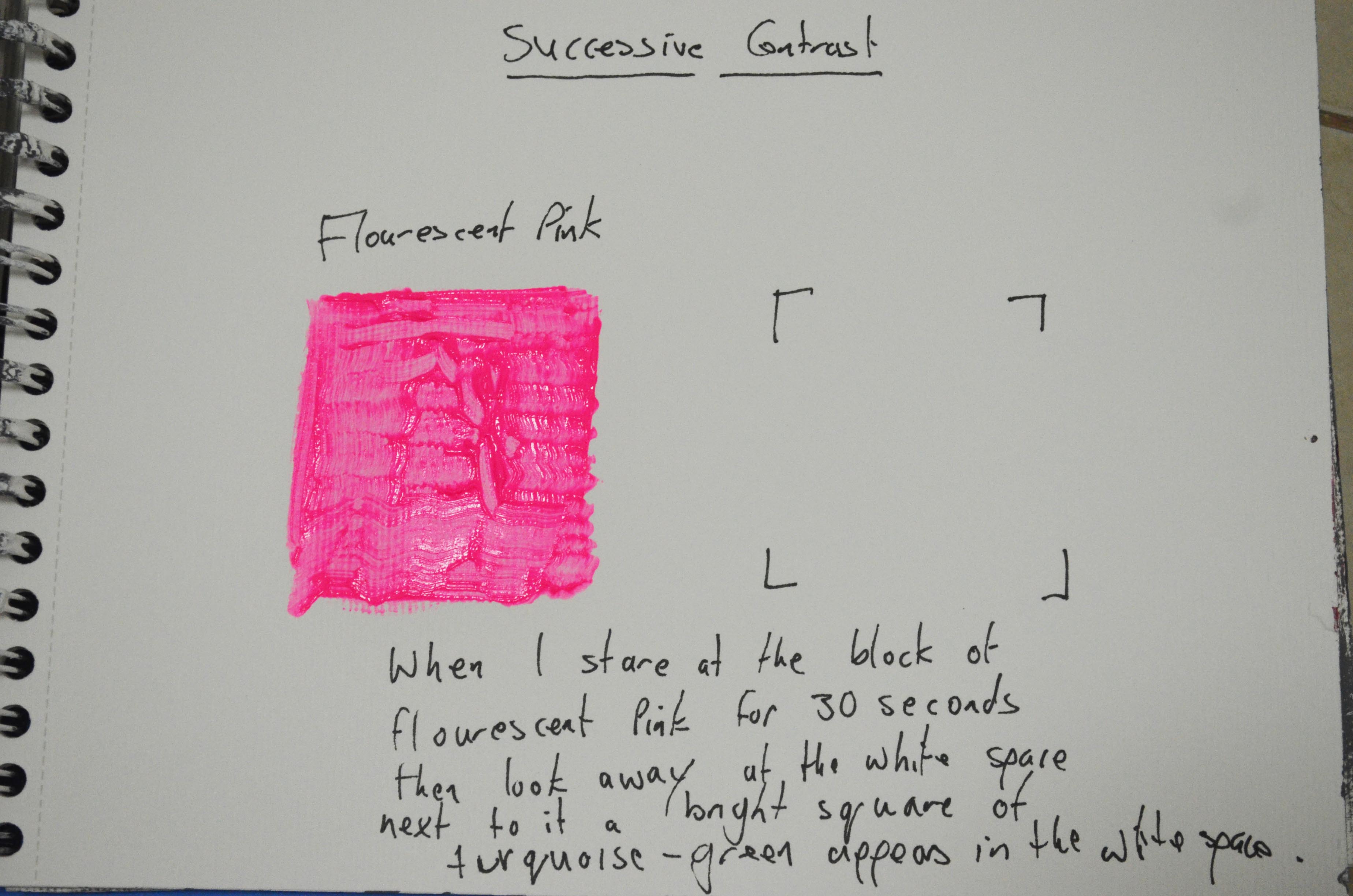
From there I painted an isolated square of my most vivid and intense pigment, which happened to be fluorescent pink, I did the same with this then after 30 seconds I shifted my gaze to a white space on the same paper, the after image that appeared was an intense turquoise, Its complimentary colour.

These effects are caused by the stimulation and exhaustion of the receptors in the retina. By Exhausting the receptors for red, for example, only the remaining combinations of colours that mix to produce blue green are seen when you turn from looking at red to looking at white.

White light, as Newton showed, is made up of all the colours of the spectrum. The human eye has full colour discrimination through the rod and cone cells. The rod cells in the Retina distinguish light and dark, while the three types of cone cells respond to red, green and violet which make up colours.


Colour Relationships 1 – Exploring Contrasts

1 Exploring Contrasts

1 Exploring Contrasts

Choose any colour you like (colour A), then mix a series of several colours that are close to colour A on the spectrum. From there paint a series of small squares of colour A, surrounding it each time with one of the colours you’ve mixed.

Following the brief’s instructions I chose red as colour A and then made various mixes similar to colour A then used colour A to paint a series of small squares then surrounded the small squares with the other colours that I mixed. I noticed how the surrounding colours altered how the centre square of red looked, in some squares looking more orange-red and others looking darker and even brownish.

From there I made a series of several small squares in yellow and several mixes of different tones of violet which I surrounded the centre squares. Each of the mixes had different amounts of white in so that I could try and equal the tonal value of the yellow centre square. Which I think I managed to match with the mix in the bottom left of the above image.

Matching the tonal value by adding white seems to tone down the yellow centre square but with the darker mixes of violet surrounding the yellow it seems to look the brightest.

2 Exploring Contrasts with medium Grey Centre

2 Exploring Contrasts with medium Grey Centre

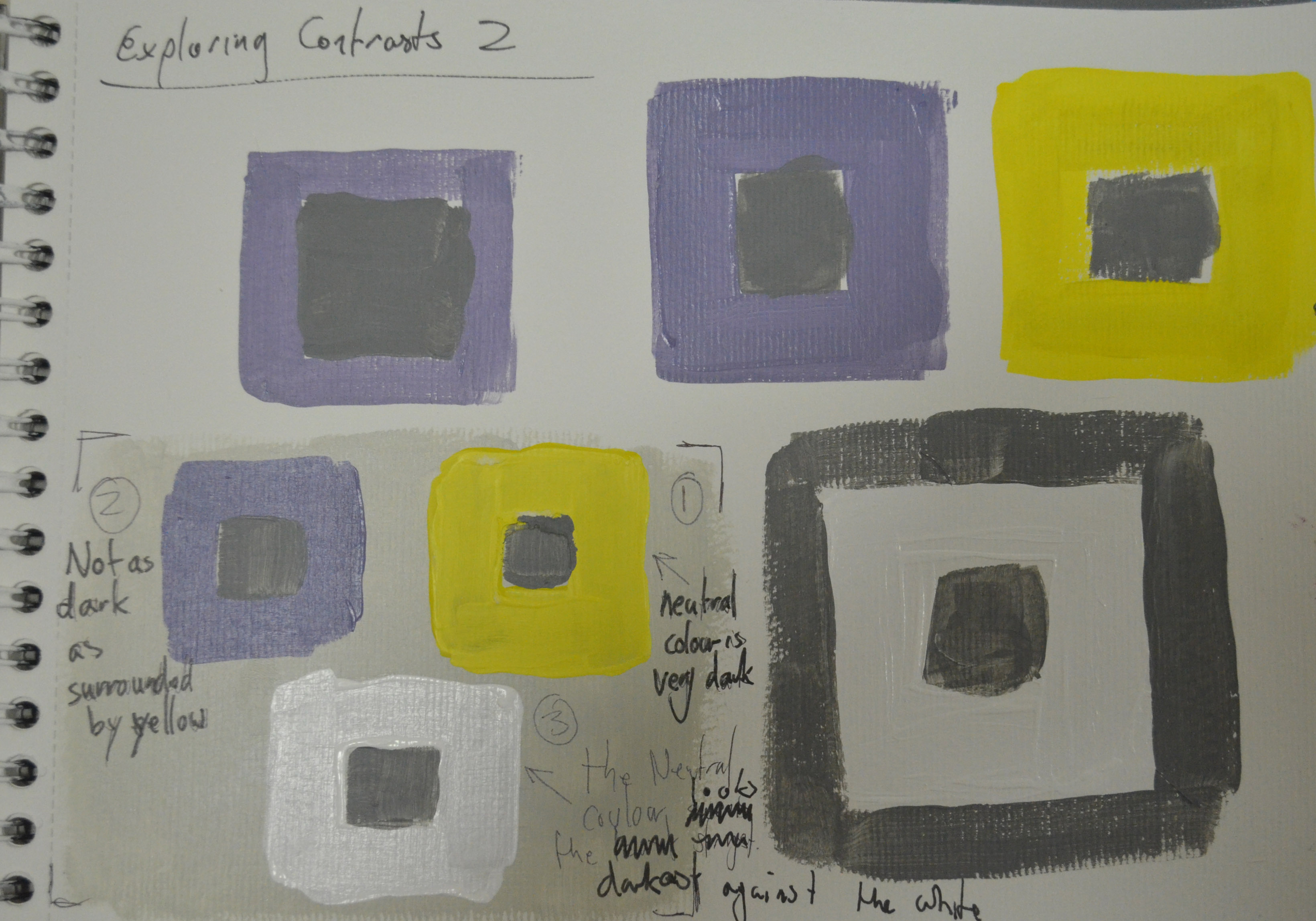
Next I painted a square of violet leaving a space in the centre, next to it I did the same with yellow and underneath both of them I painted a white square, again leaving a space in the centre. From there I mixed a neutral grey and painted a small square of this colour in the centre of each.

Doing this I noticed that the neutral grey looked different with each of the surrounding colours. With the violet surround the grey looked the lightest then darker in the centre of the yellow surrounding square with the medium grey looking the darkest in the centre of the white square.

I was pushed for time with this project so I didn’t have much time to experiment further but I made a quick painting using some complimentary colours and a medium grey noticing how the tone of the grey altered against the different colours.

3 A Simple painting with Complimentary Colours

3 A Simple painting with Complimentary Colours


Still Life 4 – Still Life with Natural Objects

5 Finished Painting with Natural Forms

Finished Painting with Natural Forms

The brief for this exercise: Assemble a group of natural objects such as fruit or vegetables, more subtle coloured vegetables or highly structured objects that are almost monochrome such as shells, skulls, rock crystals or seed heads. If you chose to work with tertiary colours and subtle lines and tonal variations you could include an element that is highly coloured such as a red fabric background or a brightly coloured piece of fruit such as an apple, orange or  lemon. It’s best to chose simple forms rather than complex ones for this exercise, just two or three objects will give you enough subject matter.

Subjects for this exercise

I already had some objects for this exercise, leaves which I picked up at the beginning of the year from the park just outside the school where I work. While visiting England last month I picked up some more objects that I thought would go with them, baby pine cones attached to twigs from a walk around Newmillerdam near my hometown Wakefield, plus a large pine cone that my mother gave me which she brought from Italy.

Subjects:

  • 2 leaves
  • 1 large pine cone
  • 4 baby pine cones attached to a twig
  • A piece of Thai Buddhist monk robe material

Inspiration for painting leaves

Looking for new artists while studying the Drawing 1 – Drawing Skills course I came across Eliot Hodgkin who painted leaves, vegetables and other natural objects with Tempera, one of my favourite paintings by Eliot Hodgkin is this one Large Dead Leaf 2:

Large Dead Leaf 2 - Eliot Hodgkin

Large Dead Leaf 2 – Eliot Hodgkin

In this painting he manages to breathe life into the dead leaf and it’s twisted form becomes a ballet of light and shadow allowing you to see every detail, stalk, veins and surface texture. It’s a painting that inspired my leaf drawing with stipples and dots in the drawing course and will probably keep influencing my work with natural forms.

Process

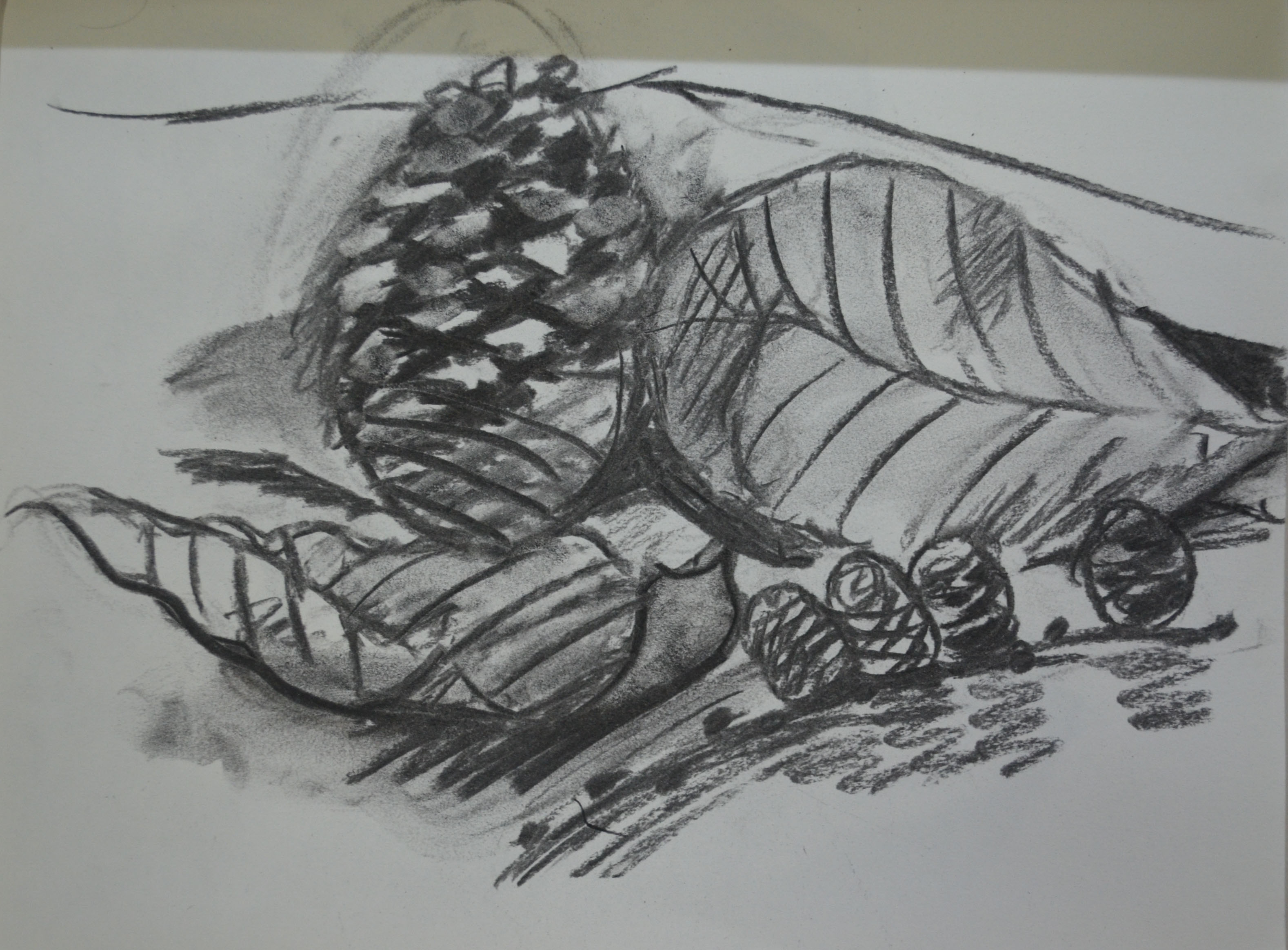
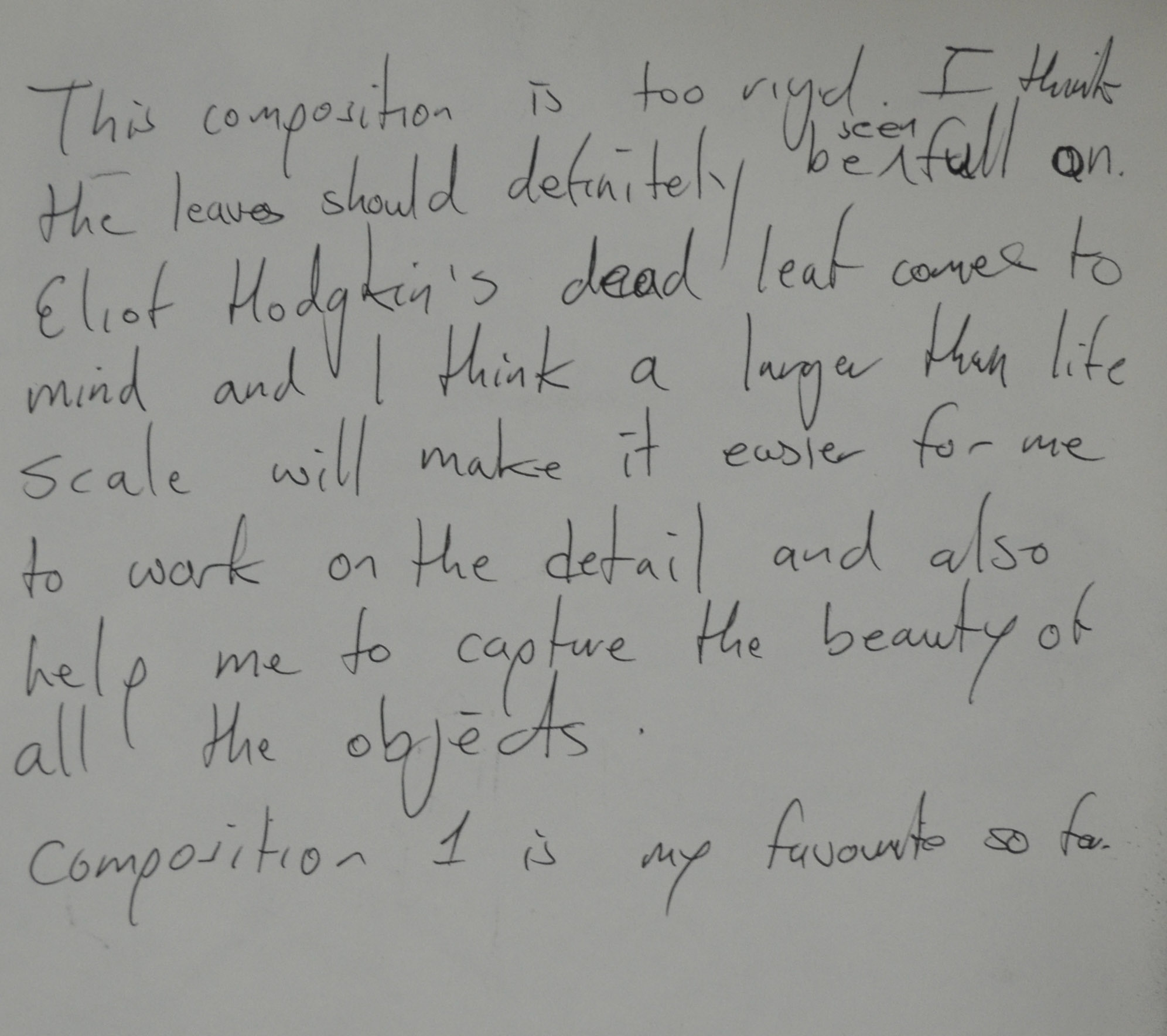
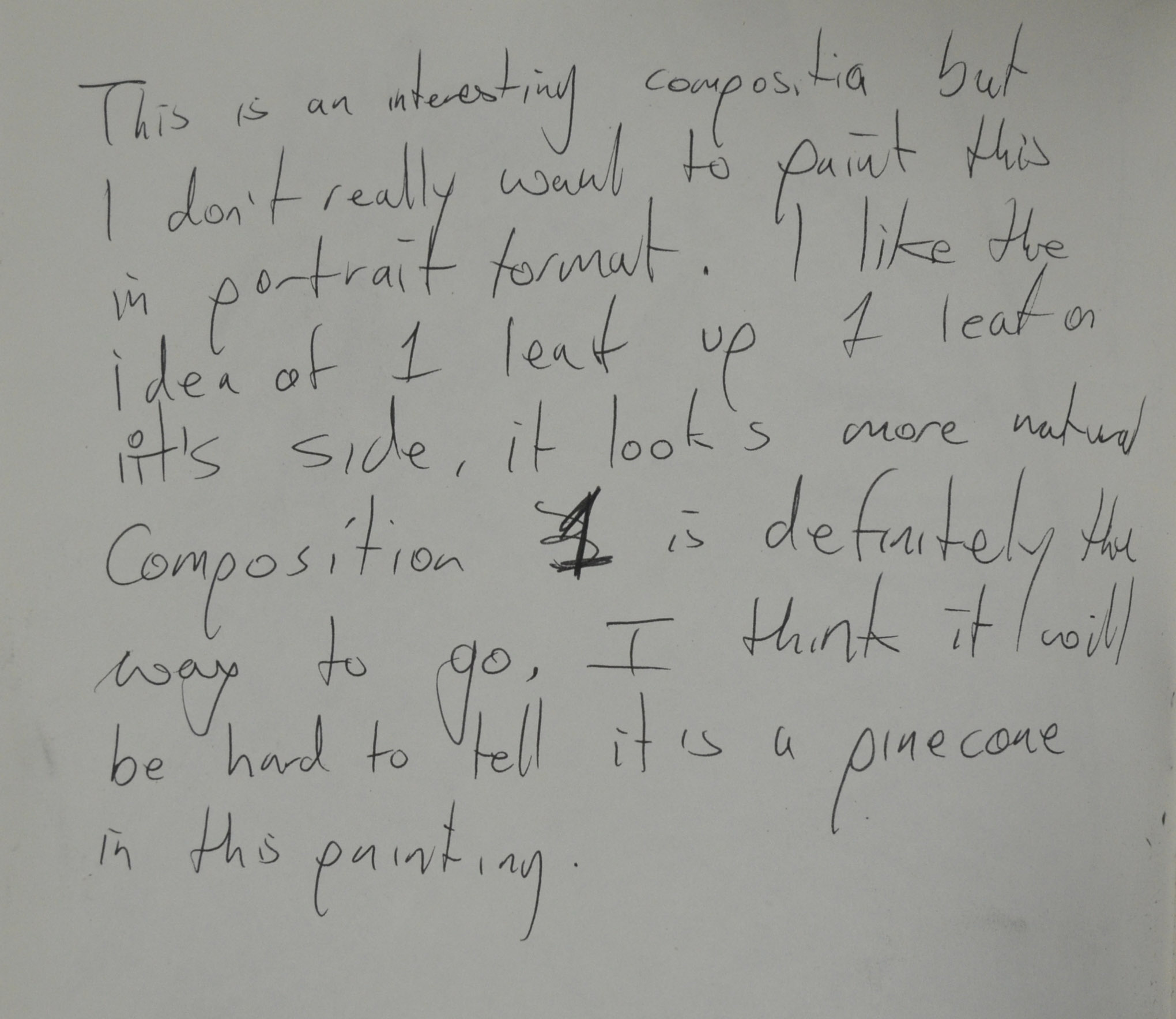
I started by making sketches of the subjects in my sketchbook and notes on the best composition and the best technique to use for the exercise. Decided that it would be better to tackle the leafs full on to see all their detail and colours and to do this a stippling technique would probably be the best technique to use for the chosen subjects.

1st Sketch in Charcoal

1st Sketch in Charcoal

1st Sketch in Charcoal - Notes

1st Sketch in Charcoal – Notes

2nd Sketch in Charcoal

2nd Sketch in Charcoal

2nd Sketch in Charcoal - Notes

2nd Sketch in Charcoal – Notes

3rd Sketch in Charcoal

3rd Sketch in Charcoal

3rd Sketch in Charcoal - Notes

3rd Sketch in Charcoal – Notes

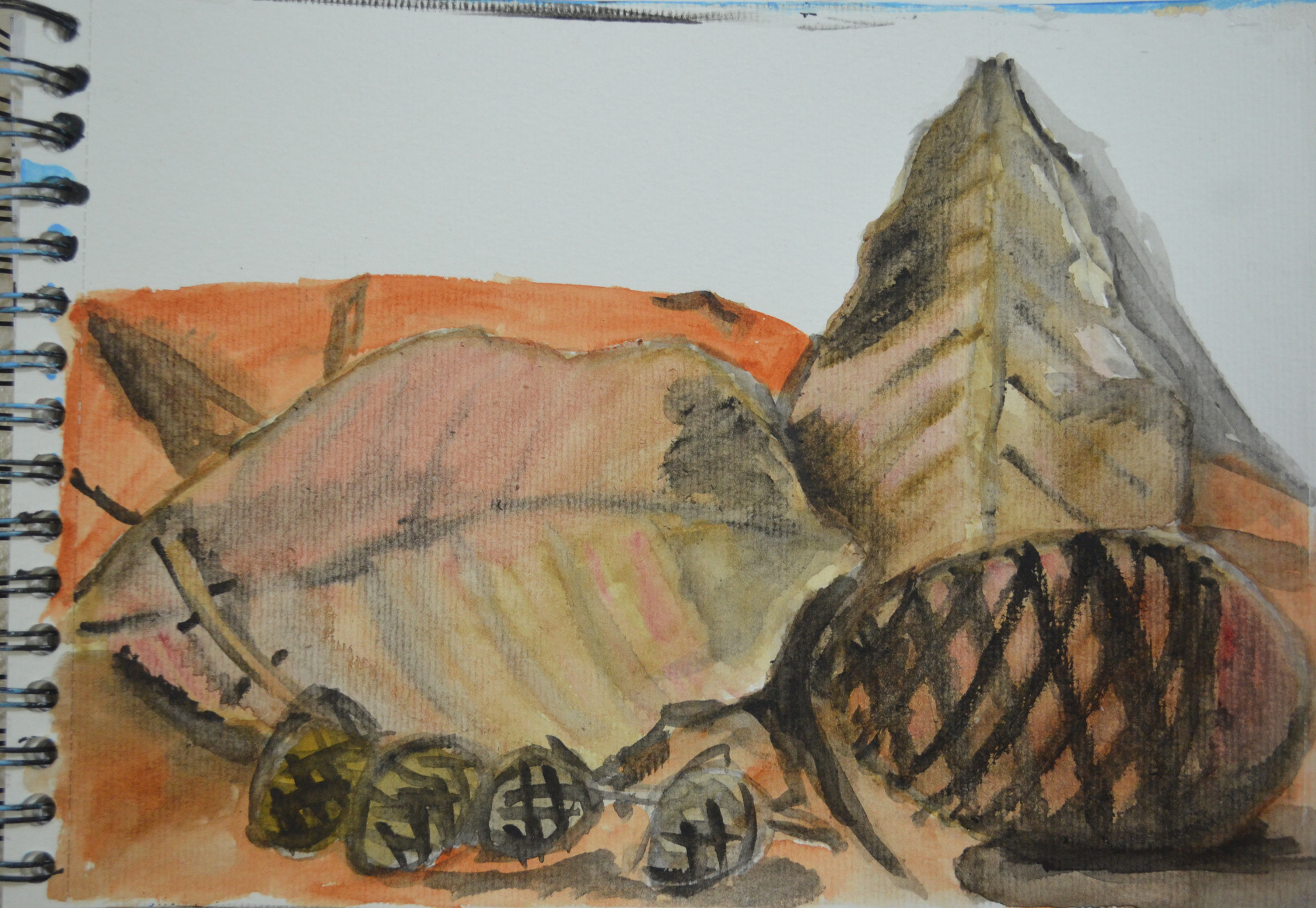
After making three charcoal sketches to find the best composition I made a watercolour sketch to see which colours I would be using for the final piece. With the lamp shining on the composition I could see just how complex the objects that I chose were. I was half tempted to make a sketchy painting rather than detailed as I did well to depict the objects in both the charcoal sketches and the watercolour sketch below but the detail and the so many different colours that I could see in all the objects with the light shining on them the way it was it would have been a shame not to try and capture as much detail and colour that I could in the finished piece. Stippling was perfect for this painting, not just for the leaves and cones but for the white background as I could see several different colours through the light reflecting off the wall.

4th Sketch in Watercolour

4th Sketch in Watercolour

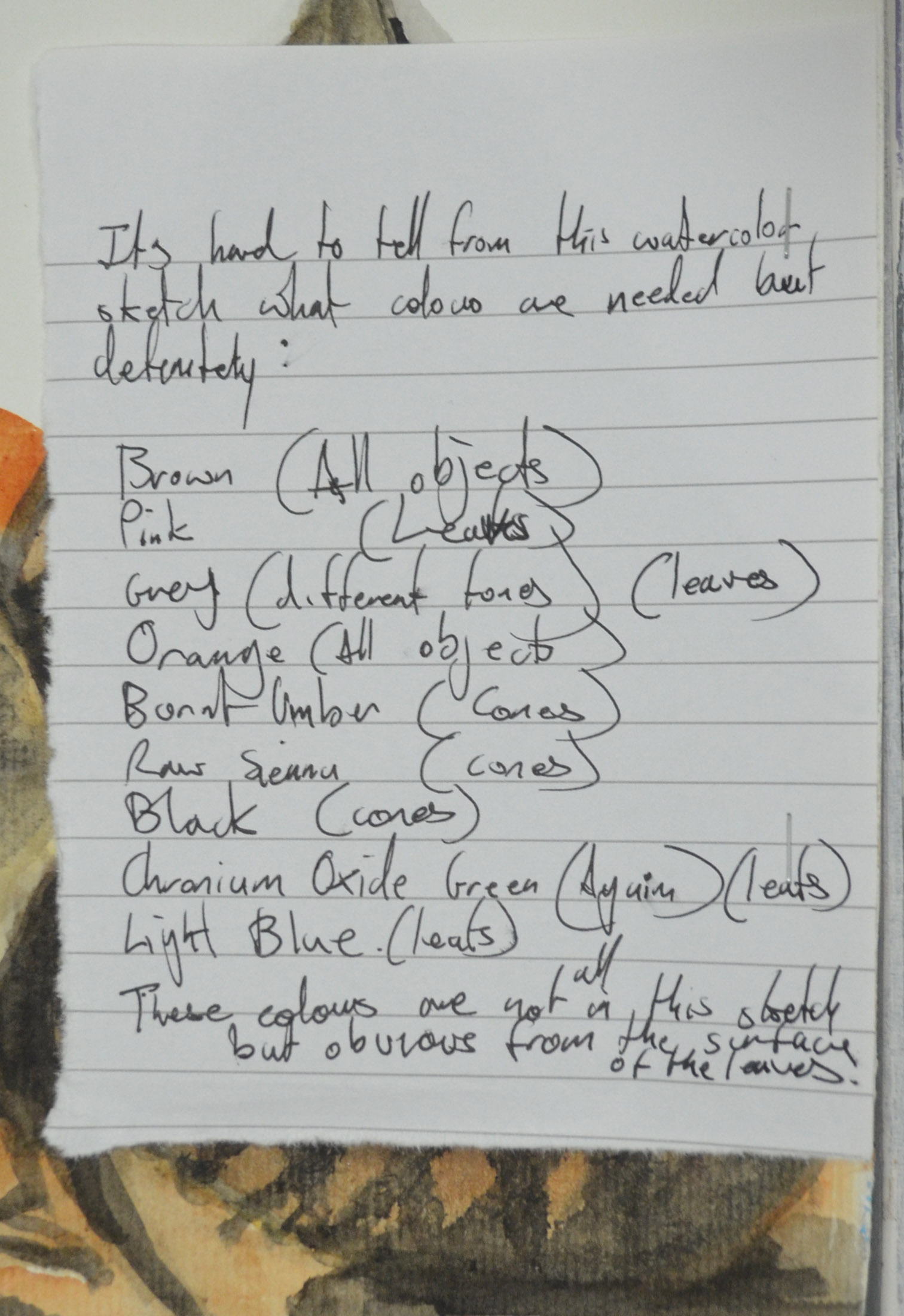
I made a note of the colours that I was confident I would be using, even though it was difficult to depict half of the colours in the watercolour sketch. These were:

Brown

Pink

  • Grey
  • Orange
  • Burnt Umber
  • Raw Sienna
  • Black
  • Light Blue
  • Chronium Oxide Green
4th Sketch in Watercolour - Notes

4th Sketch in Watercolour – Notes

The painting took four evenings to complete, 1 evening for each leaf, 1 for the background orange cloth and 1 for the pine cones which were the most difficult to paint. i started with grey on the leafs over an orange wash and then started to build up the colour from dark to light and and then back to dark for the shadows and darker tones such as for those in the veins of the leaves.

The process was pretty much the same for the large cone which shared similar hues and tones to the upright leaf but when it came to painting in the shadows for the centre of the cone the whole thing pretty much had to be painted again rethinking the process on how I was to get things just right. The cone was a pretty complex shape and the needles fit together life a jig saw and so finally I treat them as such painting in the darker tones ti give each of the needles a similar shape which I highlighted in white.

From there I painted white background, again with a stippling technique so I could depict the different colours I noticed with the light reflecting off the white surface then the  orange cloth which I didn’t want to spend too much time on as this was not the main focus. Finally I painted the twig of the smaller cones with various shades of green and white stippled over a dark reddish- brown undercoat and then for the small cones various tones of light grey and orange for applied the needles applied with a medium size filbert over dark reddish-brown undercoats.

5 Finished Painting with Natural Forms

5 Finished Painting with Natural Forms

Noticeable Progression

I am pretty pleased with the finished piece, I am not sure if the quality of this painting is better than my first still life, still life with flowers but I do seem to have loosened up, which is what I am hoping to do, as well as gained a lot more brush control.

Problems with painting natural objects

The biggest problems I encountered painting these subjects were, firstly, depicting the texture and secondly trying not to tighten up so they did indeed look like natural objects and not made objects. The stippling technique I used helped me to depict texture in the subjects but I am far from where I need to be with loosening up when I paint.

What I learnt from this exercise

Probably to have more props at hand and not to bight off more than I can chew working on complex forms and textures at this stage, however leaves were something I have wanted to paint for a while and so I am glad I got this chance to do so.

Still Life 3 – Still Life with Flowers

For this exercise I was to set up a still life with flowers that could remain in place for a day or two, keep the arrangement simple. Notice the outlines between things – Negative shapes – and try to create interesting and varied spaces and interesting intervals between the objects in my arrangement.

Subjects and Composition

Due to the shopping mall where I work being shut down for refurbishing I was a bit stumped on where I could find some flowers for this exercise but while having a stroll around my apartment complex looking for interesting flora to make a flower arrangement I came across a white flower with a yellow centre growing on a tree in the grounds of the next apartment which I know know to be a type of Plumeria called Frangipani so I went out when it was dark with a pair of scissors and clipped a few off.

When I got them back to the room I realised they weren’t enough by themselves so I went out and found another flower, Heliconia that when closed reminded me of a crab claw to add to the arrangement, These in a vase together with my christening silver and placemats that we brought back from England with us were all I needed to make an interesting composition.

Subjects used in the composition:

  • Silver serviette ring
  • Silver egg cup
  • Silver Spoon
  • 2 Simple floral placemats
  • Vase with Flowers
  • 1 Egg

By using the subjects I chose was to set up a fresh and simple narrative of flowers with breakfast.

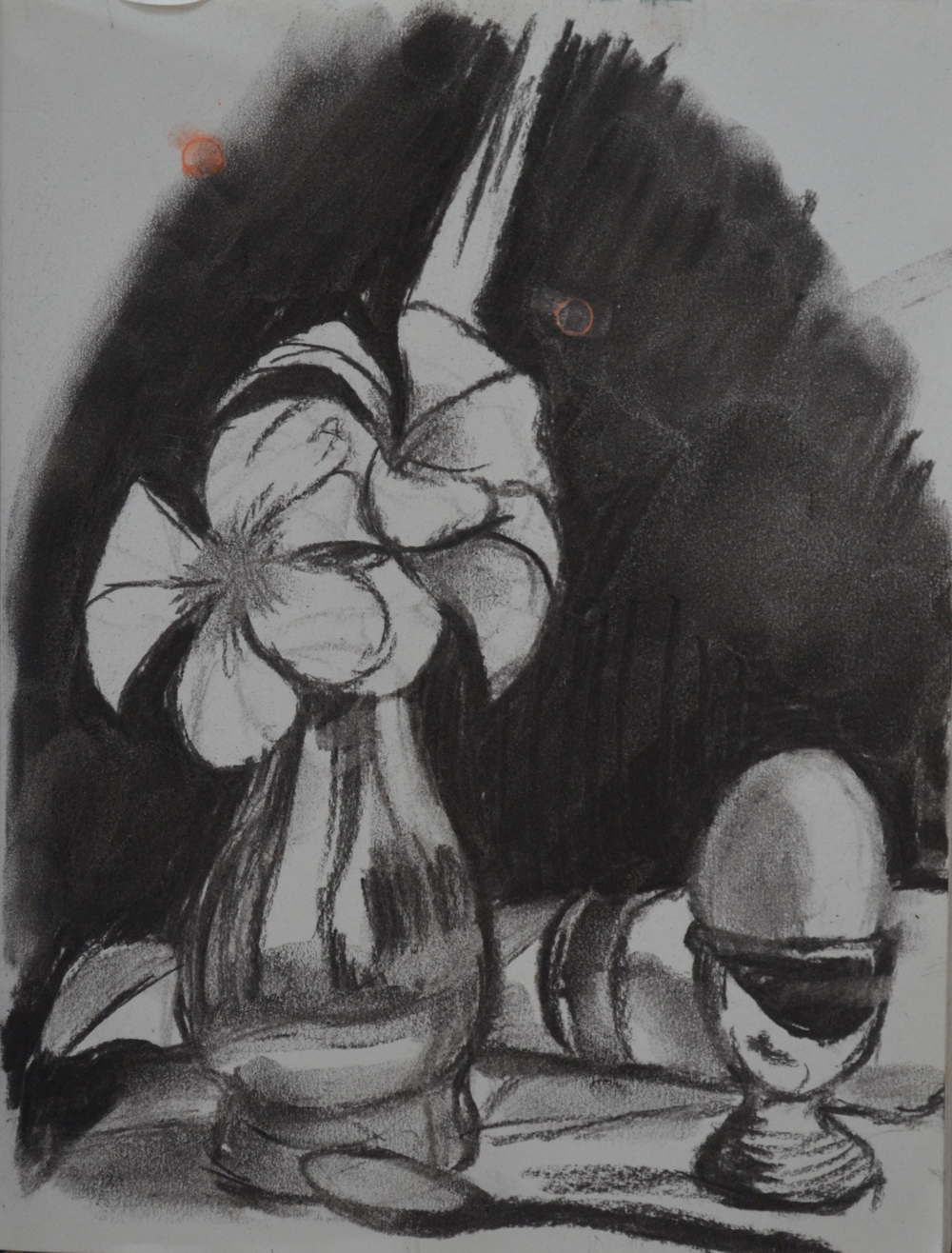
Working in my small 1 bedroom flat I am limited to where I set up a composition and what I set it up on as I don’t have many shelves or units. I chose to set the objects down on a black chair which gave me a black background. I played with the subjects trying them in different positions and looking at them from different angles but there seemed to be only 1 composition and one angle from which this still life would work from and for me the first charcoal sketch confirmed this for me.

I wanted the silverware to look bold not delicate, and at the angle that I chose with the light illuminating the composition from the right hand side the eggcup looked goblet-like and the serviette ring almost regal. I deliberately placed the eggcup at an egg-cup’s distance away from the vase with the serviette ring between them both to create the most interesting negative shapes.


1 - Charcoal Sketch - Notes

1 – Charcoal Sketch – Notes

1 - Charcoal Sketch

1 – Charcoal Sketch

I had painted my assignment piece in landscape so for this one I really wanted to paint in portrait, adding the Heliconia behind the Frangipani meant that I could paint the eggcup and the vase on a large scale in portrait format while making the best use of the paper in this format.

Because I was using a black background but wanted to paint a fresh-looking still life I placed the light source very close to the composition facing down from the right, this gave me less shadows with light bouncing off everything.

Choice of Colours

There are certain colours that I associate with breakfast, light blue, salmon pink, yellow and light green and this composition seemed to have all of them but I wasn’t sure how the black background would affect the outcome. Thinking about the yellow-orange in the flowers and what I would describe as pink-orange tones of the egg I felt that a primary coat of light blue under the black would bring those colours out, making them a lot brighter. I tried this out in a quick acrylic sketch of the composition and I felt that the result was a positive one.

3 - Drawing in Paint

2 – Drawing in Paint


2 - Acryic Sketch

3  – Acrylic Sketch

From the quick acrylic sketch I managed to put together a list of colours which I used in the quick sketch and I stayed true to this in the finished piece. These were:

  • Primary Blue/White (Light Blue)
  • Titanium white (although I either mixed this with blue or c finished drawing to tone it down)
  • Titanium white buff
  • Orange pearl
  • Payne’s Grey
  • Ivory Black
  • Primary Red/White (pink)
  • Lemon Yellow
  • Orange Cadmium
  • Yellow Ocher
  • Burnt Umber

Scale

I thought about painting this on a small scale as that would have probably helped to develop my painting skills more but after working on the acrylic sketch I decided that it would be better to paint a larger than life piece so that I could capture all the detail.

2 - Acryic Sketch - Notes on Colours

4  – Acryic Sketch – Notes on Colours

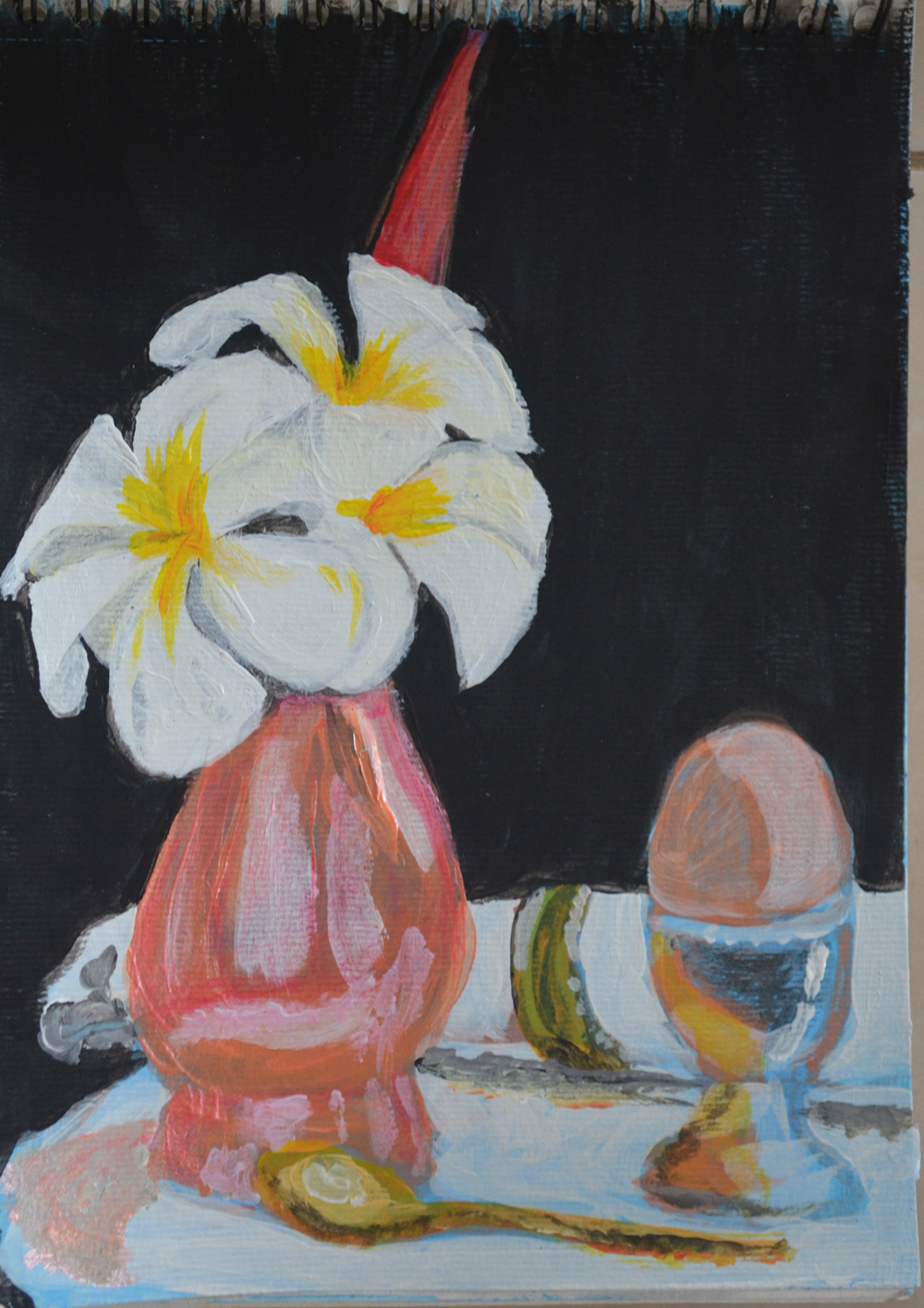
Like the acrylic sketch I began the final piece by drawing in acrylic paint rather than pencil as I used to do before the Drawing in Paint exercise. It did take a bit of reworking but not much. This final piece took me about four days to complete starting with the flowers as I knew they wouldn’t last me long as they started dying as soon as I removed them from the tree, this was a wise decision as the rest of the painting with the reflected light took the longest time to paint.

I worked mostly with large brushes, painting thick layers this helped me too loosen up as I have so far been too worried about getting my paintings to look exactly like the subjects that I am painting, to me this looks more like an impressionist still life and that was the look that I was going for.


4 - Finished Still Life

4 – Finished Still Life in Acrylic

Still Life 2 – Drawing in Paint

Look around your house for an arrangement of objects that just happens to be there. Don’t spend too long looking. It could be things that you keep on a shelf, table or window ledge or a corner of your kitchen. Don’t choose objects that are too complex in appearance, but choose things that you find interesting to look at. Make any minor adjustments that you need to create a simple still life arrangement from what happens to be there.

There’s not much going on in my apartment but a few simple things left around and kitchen utensils, I move that often that I keep things to a bare minimum. However I did have a handful of things laying around.

The first objects that I laid my eyes on were my wooden manikin that I have never used and a Siamese football (taakraw) they were on a small white wooden table that I used in my assignment and other exercises so I placed them on a thin layer of wrapping material that was elevated with a plastic bottle to give the composition an interesting background. This arrangement had everything I was looking for really but I thought I would look at other things I had laying around.

First Sketch Manakin and Taakraw Ball

1 First Sketch Manakin and Taakraw Ball

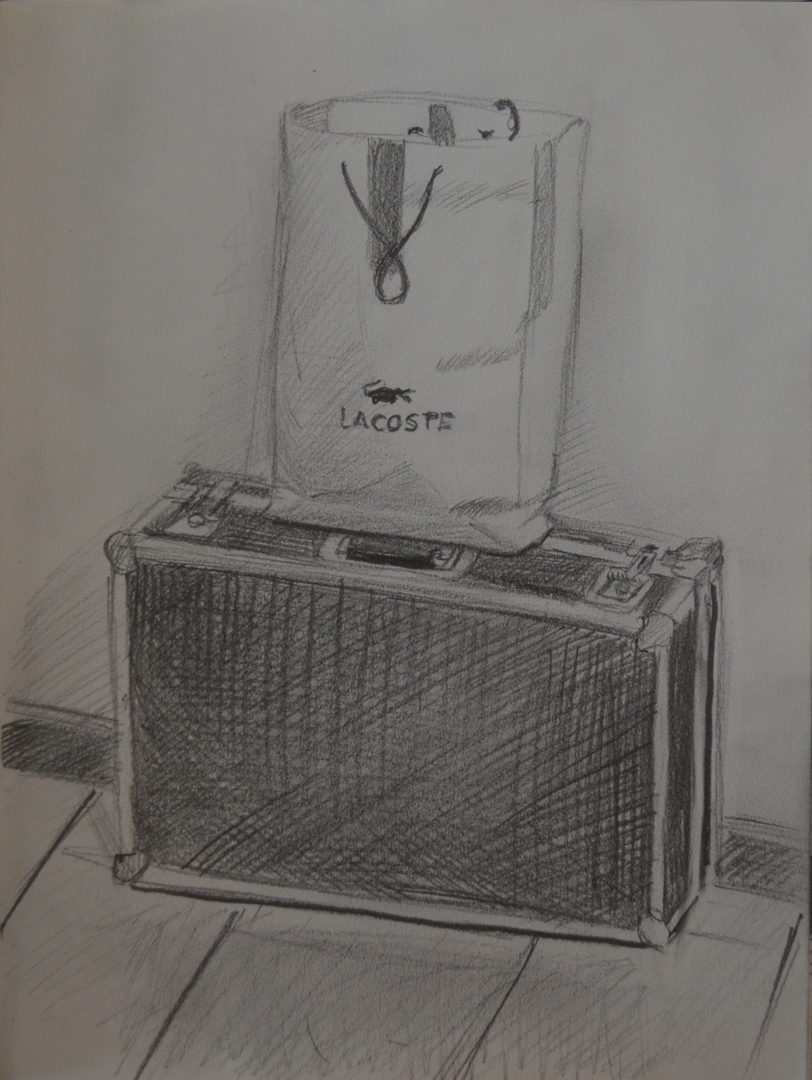
The second sketch was of a Lacoste shopping bag on top of a case containing a drone that I have never used. This was also an interesting composition and will be a subject for a painting at some stage but for this exercise it was quite technical with the detail on the case.

2 Second Sketch - Drone Case and Lacoste Bag

2 Second Sketch – Drone Case and Lacoste Bag

My third sketch was of my camera on top of the case containing the remote control for the drone, This was very technical and so I decided against it and left the sketch unfinished.

3 Third Sketch - Camera and Drone Remote Case

3 Third Sketch – Camera and Drone Remote Case

For the third drawing i set up a composition of my acrylic paint basket and some material used for monks robes that I bought for my drawing course. I didn’t know how it would turn out but I couldn’t have asked for a better result. This would have been ideal for this exercise with the lines of the fabric folded behind the box and how the lines seperated the different tones of the colours on the box inside the tube…BUT…I liked it so much that i wanted to save it for my still life with man made objects.

4 Fourth Sketch Acrylics in Wicker Basket

4 Fourth Sketch Acrylics in Wicker Basket

Going back to the manikin and taakraw, I made the second sketch of my chosen arrangement in watercolour. I bought a watercolour set about a month ago and have been doing some urban sketching. I usually draw with a Rotring first and then do the rest in watercolour, this was my first 100% watercolour sketch. I started with the outline of the manikin and ball and then applied the colour followed by glazing for the shadow. For the ball I drew the outline in a fairly watered down mix then finished it off with a mixture of dry brush and glazing. I thought this would have given me enough practise for finishing off the ball in the acrylic painting but it proved to be much more difficult in acrylic.

5 Watercolour Sketch of Manakin

5 Watercolour Sketch of Manakin

The composition looks easy to draw but it wasn’t, it actually took three attempts to draw the two objects in pencil due to the dimensions of the two objects together. So when it come to drawing in acrylic I tore out the watercolour sketch from the XL pad and put it in front of me with the pencil drawing so I could work from real life with the two drawings as reference.

Unlike previous exercises I wanted to work small on an A4 sheet, I had never painted on a small scale before and I felt that this would help me develop my ‘drawing with paint’ skills. Painting on a small scale did increase the level of difficulty

I started by preparing the paper with an off-white first coat of acrylic and then once dry I painted the outline of the two objects with a watered down mix of yellow ochre and burnt umber. From there I made a couple of edits before applying colour.

6 Drawing in Acrylic Paint

6 Drawing in Acrylic Paint

Yellow ochre played a big part in the colouring of the mankin with different mixes of white for the lighter tones, then I used a mixture of dry brush and glazing techniques for the shadows and darker tones. My palette wasn’t too large but I did use a few different colours such as burnt umber, burnt sienna, yelllow ochre and titanium white (my tutor did warn against using titanium white but as of yet I have been unable to find zinc white here) as well as cadmium orange and chromium green.

Although I applied the colour very randomly switching from technique to technique as I moved through the manikin, I did work in a very structured manner, like the Dutch Masters I painted the manikin piece by piece first the head then the arms, body and so on.

Once I had finished the manikin the drawing of the outline of the ball looked way out and so I painted in the basic colours of the background, pink ( a mix of primary red and white) and then a very light grey (black and white), this gave me a rough idea how much it needed editing, which wasn’t much.

7 Manakin and Taakraw in Acrylic

7 Manikin and n in Acrylic

When working on detail of the ball it changed from a drawing with paint exercise to mixed media. Firstly I painted the light and dark tones of the ball and then I needed some kind of technique for drawing the woven sections. I came across ‘Hitofude Ryuu’ dragon with 1 stroke painting and thought maybe I could borrow something from this to paint the ball so I dipped a small flat brush in two different coloured paints, hoping that I could paint the detail of the weave as well as the shadow in 1 stroke. Unfortunately it didn’t work and I had to paint over it and start again but it was worth a try.

Eventually I settled for a dry brush technique with a darkened mix of yellow ochre which worked really well but it still needed detail which I thought I could achieve with black applied with a small brush. The brush snapped when towel drying it and so I tried applying the paint with the blade of a cutter with no joy and so I made the decision not to paint the black detail but to draw it with a black Uni-ball pen. the result of this can be seen above.

Research Point 4: Still Life from the Dutch Golden Age to Contemporary Art

Part 1 of this Research Point

Look at the work of some of the 17th century Dutch still life and flower painters. Make notes on paintings that you especially admire and find out more about the techniques that were employed at this time. Research at least one painting that has iconographic significance.  Which of the objects depicted carry particular meaning and what was that meaning?

I started by searching for names of 17th century Dutch painters making a list of the names of artists whose work caught my eye, these included Jan Davidsz. de Heem, Jacob Gillig, Pieter Claesz and Evert Collier as well as Jan Weenix and Harmen Steenwyk. From there I went onto research the techniques used at that time so I could come back and examine the works of some of these painters in detail.

Techniques of the Dutch Masters

Unlike modern painters execute their paintings as a whole, working in a standing position so that they can step back to visualize the painting in its entirety, 17th century artists worked in a master studio to a fixed step by step method. They divided the workload into separate phases so that they could take care of the all important components individually. The compositions of the still life paintings of the 17th century were much more intricate than today and therefore the Dutch masters paid far more attention to detail and perspective and so a more technical process was needed, completing each painting in a piece by piece fashion once the drawing and lighting had been worked out at the underpainting stage.

The artists of 17th century Holland also had far less pigments on their palettes than today’s artists as their choice of pigments were far less, usually having to be hand ground at the beginning of each working day, in addition to this not all pigments were compatible with each other and so had to be used individually. Complex painting techniques such as glazing, underpainting and using varying paint consistencies and application methods helped them to compensate for the lack of pigments.

For the 17th century painter there were several stages to producing a painting, these were: inventing (drawing or sketching), dead-coloring (underpainting), working-up (finishing/application of colour) and retouching.

One notable technique that I found was for painting patterned lace, Rembrandt evolved a technique where he painted lightly in black over white to show the pattern but the other way, one which particularly appealed to me was to paint in white over black then scratch off the white with the end of the paintbrush to depict the pattern.

Paintings of the Dutch Masters

Examining the still life paintings of this era is different from anything I’ve looked at before as I have to remember that most of these were commissioned and so I have to look at iconography in the painting, floral compositions, backgrounds etc.

Jan Davidszoon de Heem
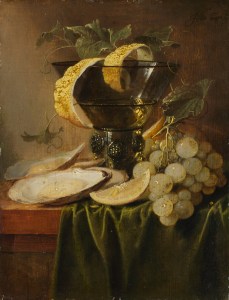
Jan Davisz de Heem Still Life with a glass and Oysters

Jan Davisz de Heem Still Life with a glass and Oysters

I looked at several paintings by Jan Davidsz. de Heem but the first one that caught my attention was Still Life with a Glass and Oysters. However, it wasn’t the oysters that caught my eye, it was the bunch of grapes, and glass.

According to the paper Symbols of Change in Dutch Golden Age Still Life Paintings by Ellen Siegel, grapes in Dutch Golden Age Paintiings (DGAP), grapes were a religious symbolism or symbolism of purity and can also be symbol of trade with Spain. Glassware was symbol of wealth or moderation. The large luxurious glass in this painting is obviously a symbol of wealth and so I would say that the grapes rather than a religious symbol in this piece were the latter, a symbol of trade. Oysters in DGAP symbolism were a symbol of natural aphrodisiac and temptation. So i am thinking that person who commissioned the artist to paint this piece enjoyed a luxurious lifestyle and maybe parties with this piece on display for all to see.

Jan Davisz de Heem Still Life of Flowers

Jan Davisz de Heem Still Life of Flowers

Although we just see floral paintings as beautiful paintings, something to brighten up the room, certain flowers in DGAP’s carried a lot of symbolism. In the painting on the right ‘Still Life with Flowers, there are several flowers that have hidden meanings. Tulips are a symbol of wealth and beauty, originating from Turkey this maybe why in most of the paintings I have looked at by Jan Davidsz. de Heem the tulips point east, the white rose which can be seen in the bottom left is a symbol of virginity while the three petal pansy in the bottom right was a symbol of the holy trinity. White carnations have become a symbol of love but when that started is unclear.

Could this painting have been commissioned for a merchant’s wife or girlfriend? Could this have been commissioned by the merchant himself? Are the flowers in the painting really symbolising these things or is it just a painting that has been commissioned to display the wealth of the owner as cuttings from his luscious garden?.

Pieter Claesz
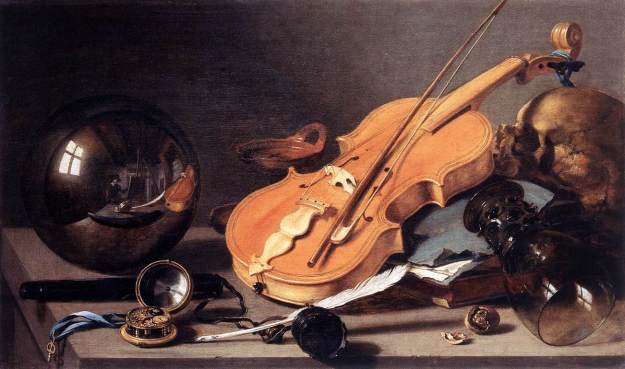
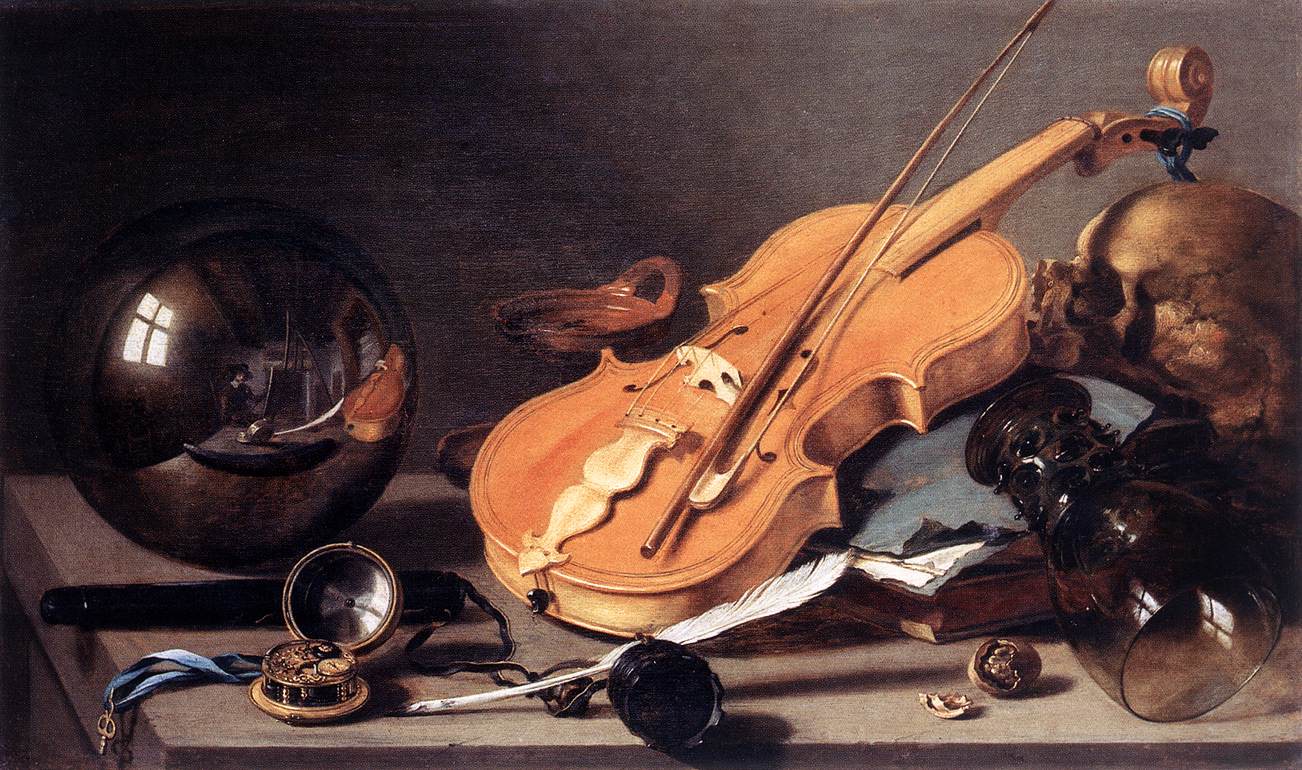
Vanitas with Violin and Glass Ball Pieter Claesz

Vanitas with Violin and Glass Ball Pieter Claesz

The first ‘vanitas’ painting by Pieter Claesz  that caught my eye was ‘Vanitas with Violin and Glass Ball’, but is this really a commissioned painting or a painting that was kept in his studio  for clients to see as they walked in, there seems to be far too much iconography for one painting Why is the reflection of the artist seen in the painting? Could this be to show the level of work that he could accomplish for his clients or to be shown off by the person who commissioned the piece, that ‘Pieter Claez really did paint this piece’!

In GADP symbolism  a voilin was often the symbol of learning, knowledge or warning against sinful life . The skull is a reminder that life is short and a warning to put more emphasis on spiritual rather than earthly cares while a spilled glass may imply moderation or fleeting life. If a commissioned, piece could it imply that the owner is a man of knowledge, an educated person (hence the who quill and ink) who is not simply wasting away his short time on earth but using it the best he can?

Part 2 of this research point

Explore the development of still life through the 18th, 19th and 20th centuries, For example, look at traditional still subjects were dealt with in some early cubist paintings by Brque and Picassso. Investigate how some contemporary artists are interpreting this genre.

Still Life in the 19th Century

I looked at four still life artists from the 18th century these were Jean Siméon Chardin‎, Jan van Huijsum‎, Jean-Baptiste Oudry‎ and Jan Weenix. There were certain differences that I noticed and I have noted them here:

Jan van Huysum Vase of Flowers

Jan van Huysum Vase of Flowers

With floral paintings, 18th century artists were now showing more of the vase than before, I’m not sure whether the vase itself now began to symbolise something other than a luxury, The attention to detail was still there but the paintings began to lose there hyperreal look, maybe the artists of the 18th century were now beginning to look at the painting as a whole, colours were brighter, this could have been down to more pigments being available and if this is so then artists of the eighteenth century could have put less focus on the techniques of the 17th century. Stalks, stems and petals were more expressive, and now showed a life of their own.

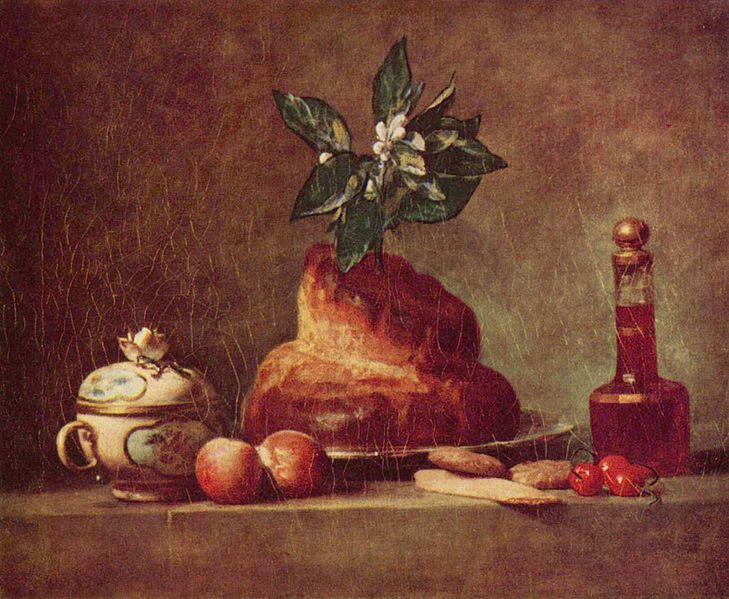
Jean Baptiste Siméon Chardin Still Life with Bread

Jean Baptiste Siméon Chardin Still Life with Bread

More still lifes of this century were painted outdoors, with statues, dogs and dead game now showing off the owners wealth and social status. Artists such as Jean-Baptiste Oudry were now combined superb renderings of the textures of fur and feather with simple backgrounds, While Jean-Baptiste Chardin painted small and simple compositions of food and objects in a most subtle style that both built on the Dutch Golden Age masters, and was to be very influential on 19th-century compositions. Vanitas and religious symbols had now been dropped from commissioned works.

Still Life in the 19th Century
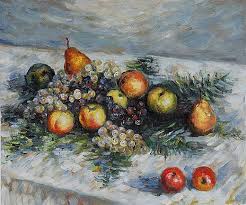
The Luncheon II Claude Monet

The Luncheon II Claude Monet

Artists in the 19th began to break the tradition of the dark background with Claude Monet being one of the first to do so, Moreover, technique and colour harmony began to play more important roles than subject matter. ‘The Luncheon II’ left is a perfect example of this.

Van Gogh made one of the main contributions to floral still life in the 19th century with is ‘Vase of Fifteen Sunflowers.’ But other notable paintings by van Gogh were his version of a ‘vanitas’ painting, ‘Still Life with Open Bible, Candle, and Book’ and ‘Still Life with a Drawing Board’.

Vincent van Gogh  - Still Life with a Drawing Board

Vincent van Gogh – Still Life with a Drawing Board

This was a self portrait in the form of a still life which was a composition of some of his personal items such as pipe, a letter from his brother as well as onions and an inspirational book presented on a table.

Still Life in the 20th Century
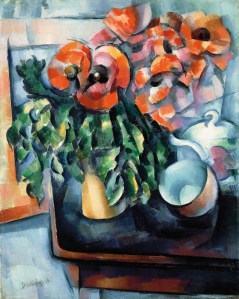
Paul Cezanne - Floral Still Life 1914

Paul Cezanne – Floral Still Life 1914

The first few decades of the 20th century produced a string of overlapping movements, gradually reaching total abstraction in the mid century. Paul Cézanne started to experiment with geometric spatial organization using still life to demonstrate elements of colour, line and form.

Cézanne’s experiments lead to the development of the cubist still live movement in the early 20th century. Cubists such as Pablo Picasso, Georges Braque, and Juan Gris deconstructed objects into pure geometrical forms and planes, their still life’s that often included musical instruments brought the genre to the forefront of artistic innovation for the first time.

Looking at Georges Braque’s ‘Still Life with a musical scroll’ below you can see that his still life composition includes many of the traditional still life subjects that have been present since the Dutch Golden Age of painting including musical instruments. grapes and other fruit.

Still Life with Music Scroll - Georges Braque

Still Life with Music Scroll – Georges Braque
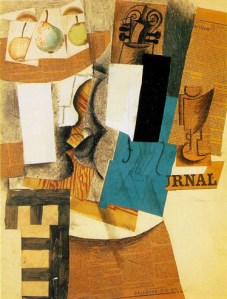
Picasso - Still Life with Violin and Fruit

Picasso – Still Life with Violin and Fruit

Picasso’s Still life with violin and fruit, comprise of still life objects that are barely recogniseable as they merge into the background. This is an example of the synthetic cubist works which achieved goals almost opposite to those of traditional still life.

Still LIfe in Contemporary Art
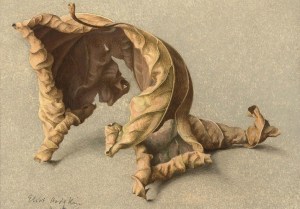
Eliot Hodgkin Large Leaf 2 Tempera on Card

Eliot Hodgkin Large Leaf 2 Tempera on Card

Contemporary artists gain influence from past movements but they are also constantly developing there own interpretation of still life.

http://www1.umassd.edu/euro/2011papers/siegel.pdf

http://en.wikipedia.org/wiki/Dutch_Golden_Age_painting

http://www.essentialvermeer.com/technique/technique_overview.html#.VPMKkfmUfjs

http://www.metmuseum.org/toah/hd/nstl/hd_nstl.htm

http://global.britannica.com/EBchecked/topic/623056/vanitas

http://en.wikipedia.org/wiki/Still_life

Understanding Colour 3 – Complementary Colours

Complementary colours are the opposite side of the colour spectrum. One way to learn about locating and mixing these colours is to make your own colour wheel.

Like the brief instructed I drew a circle on an A4 sheet of paper ( in my mixed media XL book) with a compass, drew a much smaller circle inside of that and then also with the compass as well as ruler divided up the wheel into 12 separate segments.

Then I tried to mix the colours from Chevreul’s wheel beginning with primary red, red-orange, orange yellow and so on. I worked on the colours I was unsure about several times on a sheet of grey prepared paper but the ones I was confident about I applied directly from the palette.

Colour wheel

Colour wheel

As I started writing this up, I realised I may have gone at it a bit too quick and that also laying them on a white background to pair them up may have been betters so I decided to have another go.

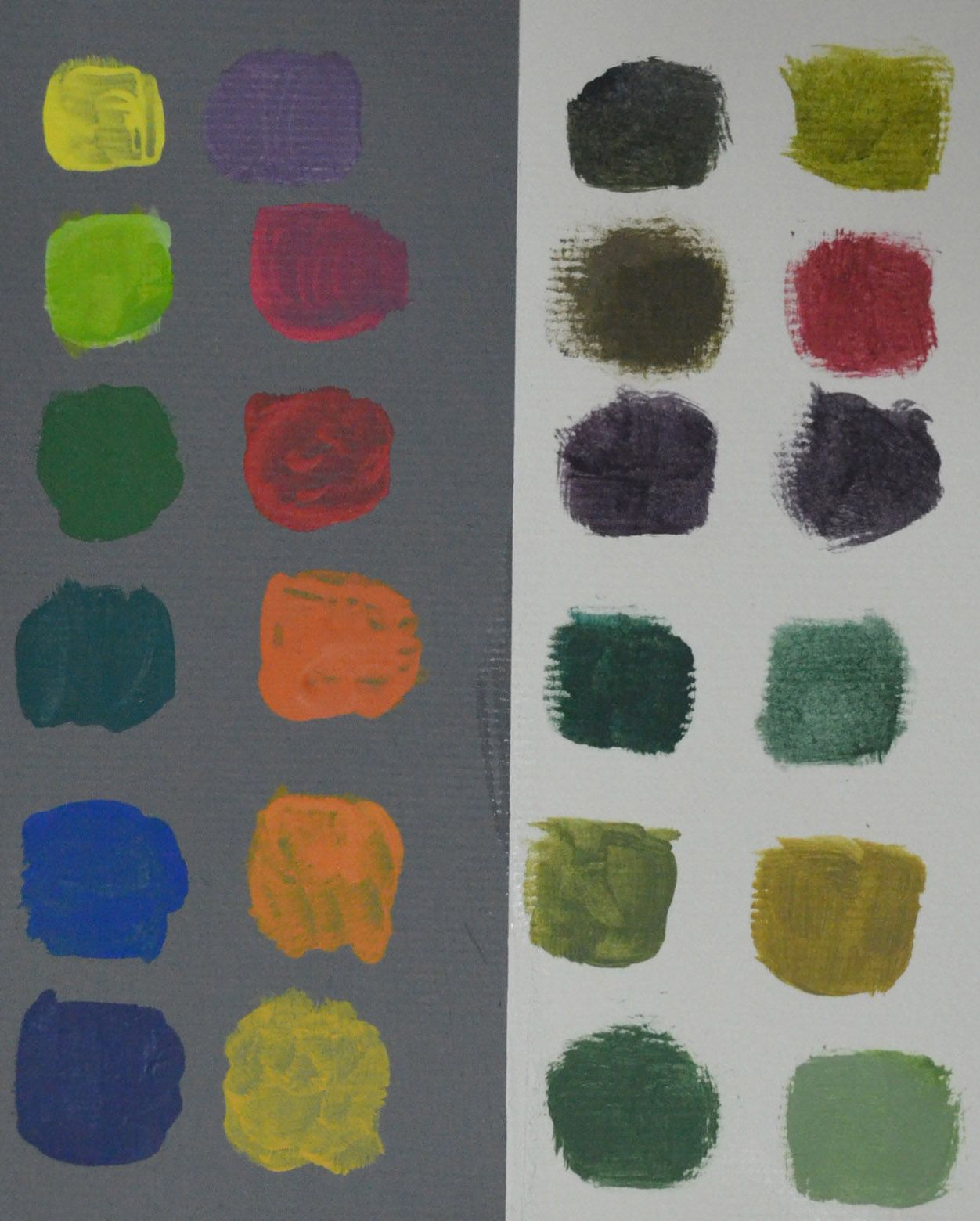
This time I tested out all the colours on a grey ground with colour mixes from each of the two colours on white. I could have probably done more colour testing with colour scales between  each but even with the flow-aid the paint was drying fast.

Testing colours

Testing colours

From there I applied the mixes to the colour wheel as I did in the first attempt.


Colour wheel 2nd attempt

Colour wheel 2nd attempt

The second attempt proved that I didn’t need to do anymore work on this exercise as the hues were the same even though the tones were slightly different. Now I had 2 colour wheels to use for reference in the coming exercises.

Understanding Colour 3 – Broken or Tertiary Colours

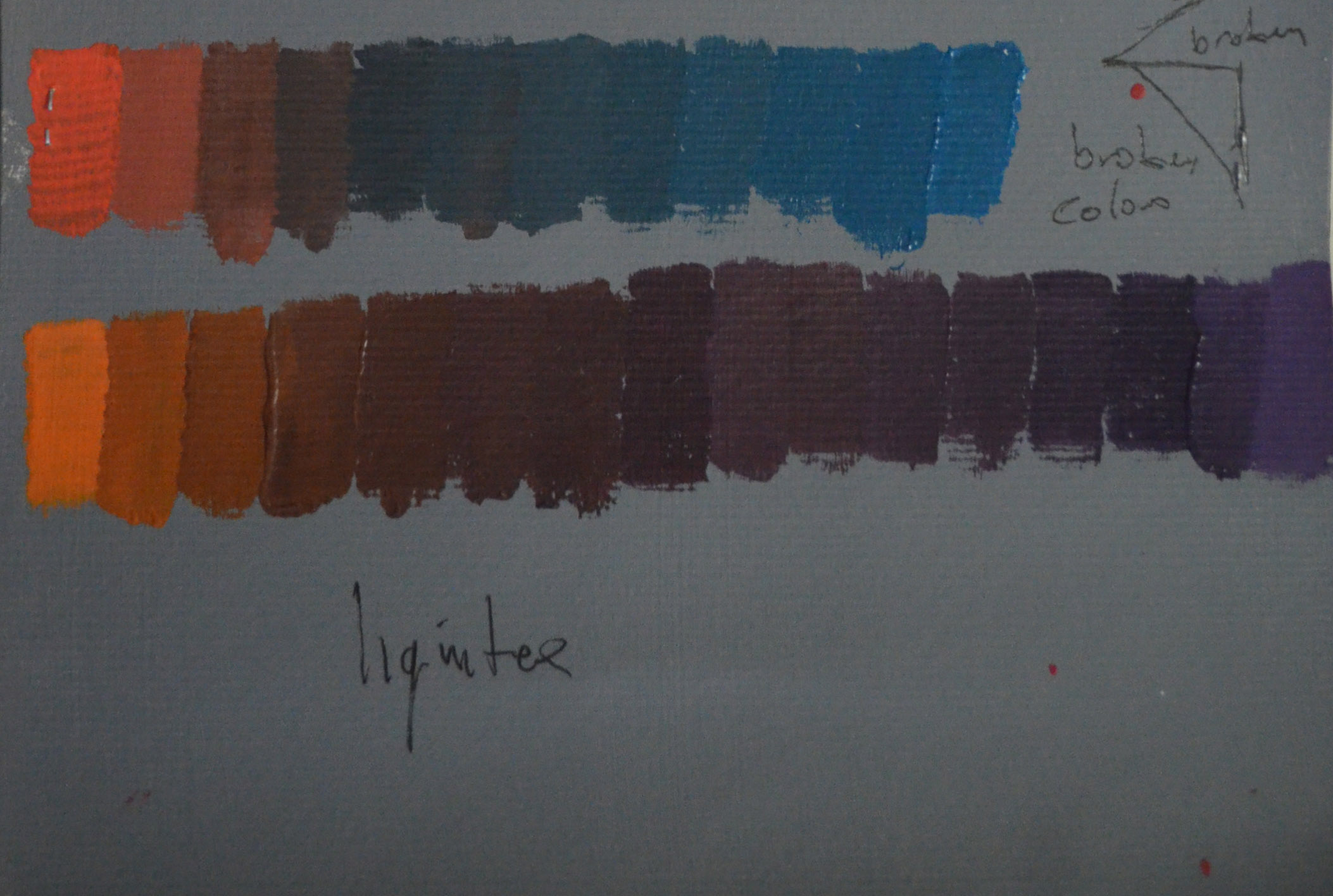
Make a scale between an orange red and a greeny blue. Try to maintain constant tonal values across the scale by adding a little white, as you did in the previous exercise. At the mid point at more white the result should be grey. This is known as a broken or tertiary colour and this type of colour makes up the appearance of much of our world.

In this part of the exercise I worked from brilliant red which had a very orange hue to turqoise as can be seen in the upper scale in the image. The middle mixes are more of a blue-green grey which isn’t very clear from the photo. Working with these orange red and turquoise produced some very interesting and quite pleasant broken colours which did surprise me and it has got me interested in experimenting with colours in future paintings.

Broken or Tertiary Colours

Broken or Tertiary Colours

Make a carefully graded scale between a pair of secondary colours choose either orange to violet, green to orange or violet to green. Mix in white to maintain equal tones throughout (the lightest tone is orange). Once again the middle mixes lose chroma to become broken/tertiary colours.

Here I worked with orange to a blue violet but lightened it up with white to take away some of the blue hue. These two colours produced more interesting colours than the first scale, here are some of the colour mixes that I made using these two colours as some are hard to describe, Orange, Ginger, Red-Brown, Chocolate, Grey – Brown, Brown-violet, and various tones of grey-violet.